T0
Getting started
A short diagnostic that places each student at the right entry point, so the course adapts to what they already know.



For tourism and hospitality faculties, this builds direct pathways into industry and closes the curriculum gap through applied learning, leadership skills development and AI education that equips faculty and students alike with the capabilities the sector is hiring for.
Students take on live briefs submitted by national, regional and city tourism organisations, present to industry audiences at FRONTIERS and have their work published through the DTTT network under their own name.
Briefs are scoped directly with the organisation, researched inside DTTT's methodology and reviewed before delivery, so the work meets the standard the organisation was expecting.
Scoping a brief, exercising judgement under real constraints, presenting recommendations to senior professionals. The capabilities that carry graduates into senior roles, built through the work itself.
The Digital Literacy for Effective AI course and AI Transparency Framework certification, delivered through the institution's own learning management system, with unlimited faculty and staff access alongside the student cohort.
This runs as an annual partnership on the academic calendar. Once the initial configuration is complete, it operates through student curriculum activity.
Students graduate holding the DTTT AI Transparency Framework certification, the sector-specific credential for AI in destination management.
A recognised and precise qualification in a field their future employers are actively navigating.
Students work as consultants on live challenges from real destination organisations: scoping briefs, conducting research and delivering recommendations to a professional standard.
The advisory skills that distinguish graduates entering senior career pathways.
Sprint outputs and Applied Research briefs are published through the DTTT network with named student attribution.
Graduates enter the industry with visible, circulated work rather than a folder of academic exercises.
Partner institutions hold a single annual partnership covering the academic year: the curriculum and certification strand delivered through your LMS, year-round intelligence and network access, plus participation in the annual FRONTIERS event.
The Digital Literacy for Effective AI course and the ATF certification strand, delivered through your existing LMS.
Industry intelligence, framework updates and network connections running through the whole academic year.
The one physical gathering point in the partnership year.
How the partnership runs across a year.
Eleven tracks covering the digital knowledge required to use AI well in a professional tourism context. Written for practitioners, not developers.
Runs inside Moodle, Blackboard, Canvas and Brightspace. The Tourism Edition is available now; a Higher Education Edition is in development.
The certification gives students the strategic grounding to evaluate, govern and communicate AI use in a professional destination management context: the application of AI tools, critical assessment of outputs, disclosure practice and the governance frameworks destination organisations are beginning to build.
Students who complete it leave with an understanding of AI that goes beyond tool familiarity. They can make strategic decisions about which tools to use, advise on governance and engage credibly with the questions their future employers are navigating now.
Visit the AI Transparency Framework



Developed specifically for tourism bodies, all tools focus directly on everyday destination operations and management.
The standard referenced by DTTT members and destination management organisations across the network.
Full teaching materials, exercises and assessment frameworks provided to partner institutions.
Sits within the Digital Literacy for Effective AI course, not a standalone extra.
Students hold the credential when they leave, independent of their institution.
DMOs can submit live operational briefs to high-performing academic teams for comprehensive analysis. Governed by rigorous DTTT oversight frameworks, these engagements produce high-impact strategic deliverables and practical resources that directly support tourism goals.
Organisations submit through a structured form covering the challenge, context, available data and what a useful output looks like. Underdefined submissions are returned for clarification. DTTT reviews for scope and feasibility, matches the brief to a cohort, then documents the outcome with both client and student team.
Submit a challengeFive controls sit between a submitted challenge and a delivered recommendation. They are what make the work a professional engagement rather than a classroom exercise.
Every brief passes through all five, in order.
Students work inside DTTT's own methodology, which structures how research is conducted and how outputs are framed.
Teams clarify the brief directly with the organisation before any work begins, exactly as a consultancy would.
Every output is reviewed before delivery, against the standard the client was expecting.
The strongest work is published as DTTT intelligence with the student team and institution named.
The process builds the capabilities graduates need in client-facing roles, not just research technique.
Only work that clears all five is delivered to a client and only the strongest of that is published.
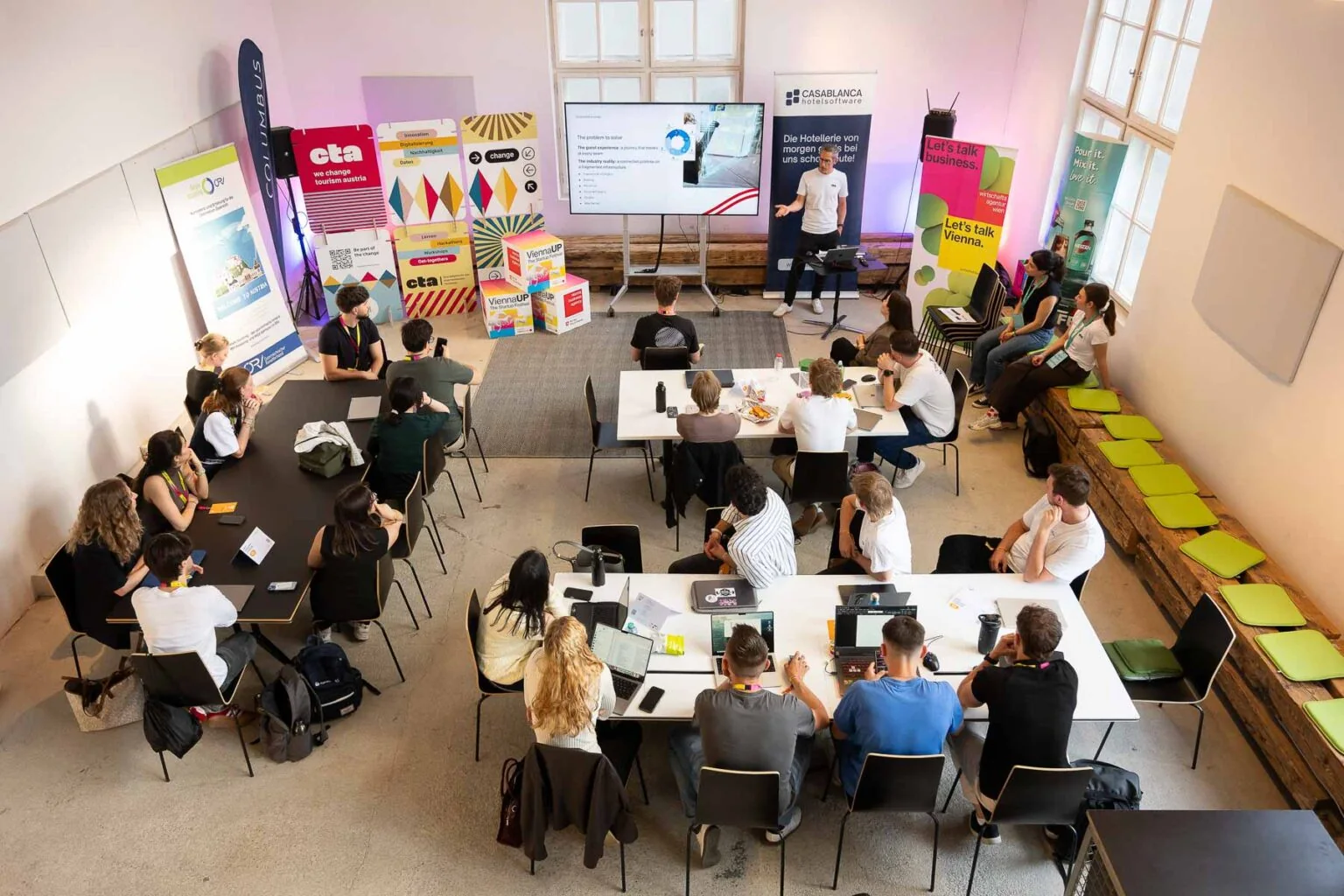
Students, academic staff and destination professionals in one room, around live challenges and the year's research.
Day one is public and student-facing. Day two is a closed working session for academic staff and industry practitioners. Both produce published outputs shared across the partner network.
Visit the FRONTIERS siteFour panels, then the cohort takes the stage in front of an industry audience.
Curriculum design and the AI Transparency Framework, with published outputs shared across all partner institutions.
FRONTIERS is structured as a student programme event. Participation as a module requirement, assessed live brief or curriculum field trip may sit differently within institutional travel and budget frameworks than standard conference attendance.
The programme connects institutions to the destination organisations working on the challenges their graduates will meet professionally.
Structured access to real questions organisations across Europe and beyond need help thinking through, not hypothetical briefs.
Students and staff engage with the people hiring graduates, assessing research and setting the direction of the sector.
Institutions bring their own networks in. Regional academic clusters and European applied sciences partnerships, RUN-EU among them, strengthen the model.
No network currently serves applied sciences tourism institutions on practice, skills and career outcomes. We are building it from 2026, so institutions joining now shape what it becomes.
IFITT serves research-oriented tourism academics well. This programme serves a different community: applied sciences institutions where the measure of success is graduate employability.
Each year DTTT sends partner institutions a summary structured around outcomes rather than access metrics.
From September 2026 the ATF micro-credential becomes the primary certification metric: a named qualification issued to individual students on completion of the assessed components.
Every partner institution holds the institutional layer. The cohort certification layer sits on top of it and scales with the number of students you put through the programme. The self-funded track sits alongside both, open to students whose institution is still considering the partnership.
Pricing is set in conversation against cohort size. We are working with a small founding cohort of institutions now, ahead of the September open intake.
Everything your faculty needs to teach the programme: the course, the framework materials and the intelligence that keeps them current.
What the students themselves receive: the credential, the live briefs and a place at FRONTIERS.
For students whose institution is still considering the partnership, the same certification and challenge access taken independently.
From a first conversation to your students working live briefs at FRONTIERS.
Your institution, your programme and which elements matter most. We scope from there.
One focused call on your LMS, cohort size and how the certification strand fits your assessment structure.
LMS integration configured, certification strand initiated, institution registered for FRONTIERS.
Your students in the Day 1 sprints, your staff in Day 2 curriculum work, then the first Applied Research intake opens.
Discover how your institution can join our founding network. Reach out today to schedule a consultation with our Knowledge Team.
Research, frameworks and field notes on destination transformation. No noise.

Industry research, open frameworks and field-tested practice on how destinations lead through AI, sustainability and brand. Since 2012.