Mapping Silence: Visit Skåne’s Map of Quietude and Stay Quiet
Urban noise has become one of the defining public health concerns of the decade. Visit Skåne's answer was the Map of Quietude.

Urban noise has become one of the defining public health concerns of the decade. Research consistently links chronic sound pollution to elevated stress, disrupted sleep and long-term cardiovascular risk. The problem extends well beyond densely populated city centres into how people choose to rest and travel.
Visit Skåne, the tourism body for Sweden’s southernmost region, spotted an opportunity. Instead of following the wellness crowd with generic talk of nature and calm, they took a sharper approach by asking: what if silence could be measured, documented and offered as a reason to visit? The answer was the Map of Quietude, an initiative that transforms quiet into a tangible destination asset, a campaign that won the Purposeful Brand Award at the X. Awards. The concept has since extended into Stay Quiet, an experiment for invited guests to test how long they could hold their silence.
Continue reading...
Urban noise has become one of the defining public health concerns of the decade. Research consistently links chronic sound pollution to elevated stress, disrupted sleep and long-term cardiovascular risk. The problem extends well beyond densely populated city centres into how people choose to rest and travel.
Visit Skåne, the tourism body for Sweden’s southernmost region, spotted an opportunity. Instead of following the wellness crowd with generic talk of nature and calm, they took a sharper approach by asking: what if silence could be measured, documented and offered as a reason to visit? The answer was the Map of Quietude, an initiative that transforms quiet into a tangible destination asset, a campaign that won the Purposeful Brand Award at the X. Awards. The concept has since extended into Stay Quiet, an experiment for invited guests to test how long they could hold their silence.
Silence as a Destination Proposition
Audience research on travel motivations was paired with scientific studies documenting the measurable health benefits of natural soundscapes. The evidence showed that noise pollution had become a public health issue in its own right. Within Skåne’s key markets, escaping this pollution had become a primary driver for travel.
From this, a proposition emerged that was both rational and emotionally resonant. Skåne offered places where the decibel level drops far below the urban norm. The challenge was making the scarcity of that proposition credible and tangible.
Measuring Quiet
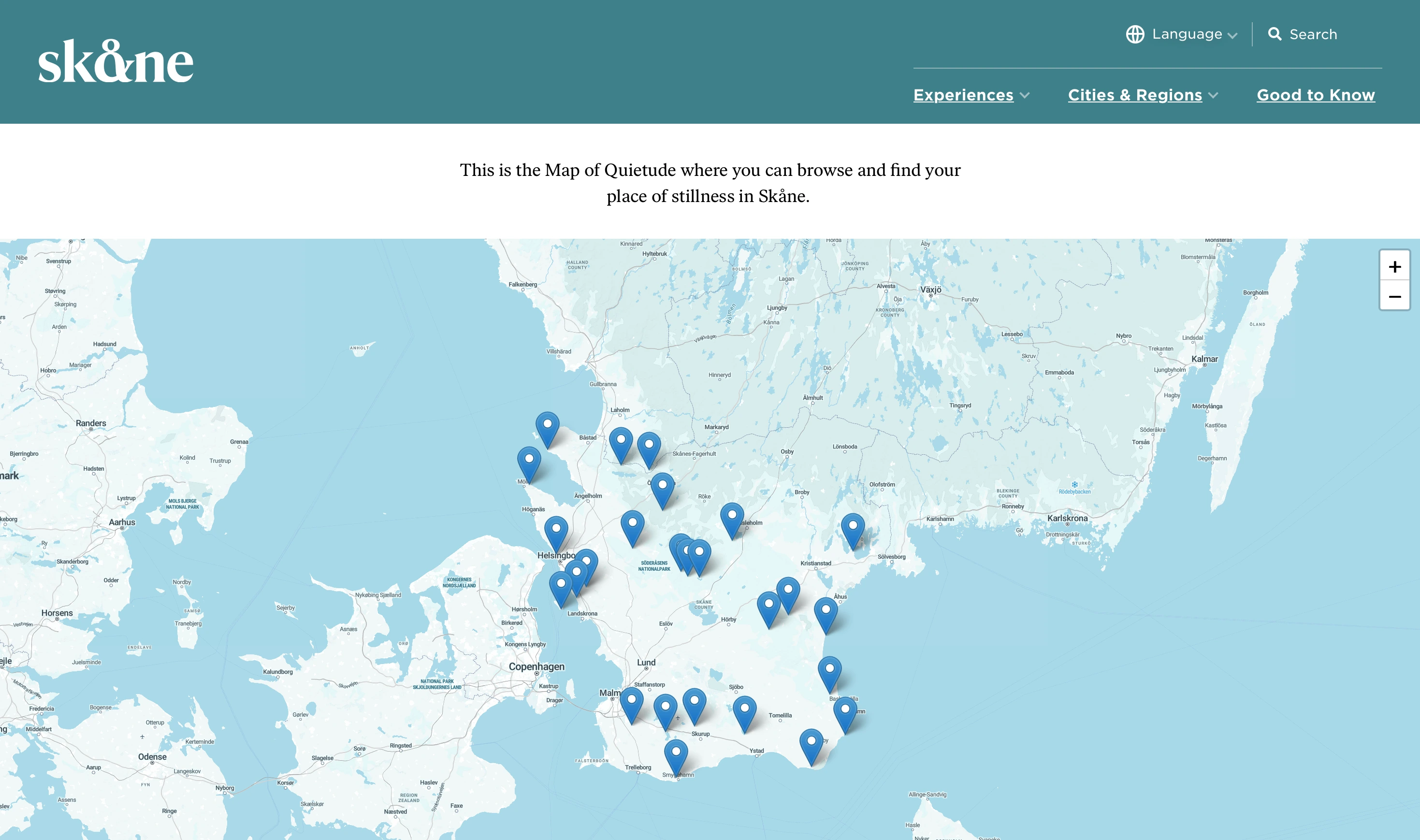
Visit Skåne treated silence as a measurable asset. Each location on the Map of Quietude was assessed in person, with decibel levels recorded on site to document the actual sound environment. One-hour soundscapes were captured at each spot, allowing potential visitors to experience these places before travelling. These recordings are accessible through an interactive map and on Spotify, where 26 hours of Skåne’s natural soundscapes are published.
Grounding the project on measurement set the work apart from conventional destination marketing. Silence became a tangible encounter available before booking. Documented evidence replaced reputation as the core of the proposition. The balance between scientific rigour and sensory storytelling provides the initiative with credibility as the two approaches reinforce each other.
Built with the Municipalities
The Map of Quietude was developed in partnership with Skåne's municipalities through Ett Skånskt Partnerskap, the regional collaboration framework. Identifying quiet locations across a diverse region, from wetlands and beaches to rural hideaways and forested hillsides, required local knowledge.
Municipal involvement also gave the initiative a dual purpose. Beyond positioning Skåne internationally, the map guides visitors towards lesser-known areas instead of concentrating footfall at the most popular attractions. In doing so, travel is distributed more evenly across the region. Communities that typically miss out on tourism’s economic returns gain visibility and this helps build a more sustainable visitor pattern over time.
From the Map to the Experience
The Map of Quietude was intended as a starting point of a broader strategic approach. Stay Quiet, took the idea and turned it into something guests could physically test. Visit Skåne partnered with local accommodation provider, Faunbäck Retreat, specialists in retreat design and mindfulness, to offer a free stay in a remote cabin in Skåne's forest under the single condition that guests have to stay quiet.
A decibel meter inside the cabin measured sound levels continuously, roughly calibrated to the hush of a library. Guests could continue their stay for as long as they remained under the threshold and the stay ended if the silence was broken. Word spread through an open call, drawing more than 200 applications from over 30 countries. Selected guests disconnected from screens and spent their days on forest walks, outdoor cooking and quiet reflection, with silence functioning as the shared language of the stay.
The connective logic runs through Visit Skåne's concept of 'guestpitality': the idea that great hospitality requires active participation from both hosts and visitors and that a destination's role extends to shaping how guests engage with the places they visit. The Map of Quietude built awareness and intent. Stay Quiet turned that intent into something guests had to live rather than simply imagine.
Coverage followed without a single paid placement, spreading across international outlets and broadcasters within weeks of launch. Visit Skåne reports millions in earned reach from the campaign, generated entirely through organic interest rather than media spend.
Built to Accumulate
One of the more significant features of the initiative is that the concept was designed to grow. New locations can be added to the map, the soundscape library expands and partner municipalities can contribute their own quiet places. The first edition of Stay Quiet has since concluded and Visit Skåne has indicated a second chapter is already taking shape, with Faunbäck Retreat as an ongoing partner. This means the concept accumulates value across formats and over time, rather than exhausting its relevance at a single moment.
The project’s growing international media attention reflects an appetite for destination communication grounded in evidence. By replacing promotional slogans with documented data and streamed soundscapes, Visit Skåne has built a compelling case for how to influence brand associations based on research-backed principles.
Key Takeaways
- Ground propositions in evidence: Wellness travel is a growing segment, but generic claims about nature and calm no longer offer differentiation. Measuring and documenting the specific qualities a destination offers creates a proposition that is both more credible and more distinctive. Campaigns anchored in research carry more authority and earn a higher quality of coverage, giving journalists and policymakers a more substantive reason to engage.
- Provide access to assets before arrival: Giving potential visitors access to sensory content changes the nature of the pre-trip relationship. Streamable soundscapes, documented environments and immersive previews reduce the gap between expectation and experience in ways that images and descriptions cannot.
- Design for accumulation: Destination initiatives built to grow, adding locations, partners and content over time, outlast campaigns built around a single moment. Treating a creative concept as an ongoing platform instead of a one-off campaign produces compounding returns.
- Use distribution goals as a design constraint: Spreading tourism across a wider geography is easier to achieve when the visitor proposition actively points people towards less-visited areas. This is more effective than relying on general encouragement to explore responsibly. Place-specific content that makes lesser-known locations tangible and appealing does more than broad calls to disperse.
- Make responsibility a visitor benefit: Framing responsible behaviour as something visitors gain, instead of something asked of them, produces more durable attitudinal change. When a destination’s interests and a visitor’s own wellbeing point in the same direction, the case for thoughtful travel makes itself.


