Visit California's Brand Evolution: The Ultimate Playground
Travellers are prioritising experiences that offer joy, escape and a sense of wellbeing. Visit California's brand evolution answered that shift.

For a destination as well-known as California, the marketing challenge is rarely awareness. Most travellers already hold a vivid picture of the place, which makes emotional relevance harder to sustain than recognition. A brand that continues to maintain legacy impressions for too long risks remaining as a familiar background noise instead of sparking fresh desire.
The years following the COVID pandemic sharpened that risk and, at the same time, opened a route through it. Travellers across markets began prioritising experiences that offered joy, escape and a sense of wellbeing, giving destinations a reason to speak to what motivates a trip. The Ultimate Playground, Visit California’s first brand evolution in more than a decade, answered that shift by positioning the state around play.
Continue reading...
For a destination as well-known as California, the marketing challenge is rarely awareness. Most travellers already hold a vivid picture of the place, which makes emotional relevance harder to sustain than recognition. A brand that continues to maintain legacy impressions for too long risks remaining as a familiar background noise instead of sparking fresh desire.
The years following the COVID pandemic sharpened that risk and, at the same time, opened a route through it. Travellers across markets began prioritising experiences that offered joy, escape and a sense of wellbeing, giving destinations a reason to speak to what motivates a trip. The Ultimate Playground, Visit California’s first brand evolution in more than a decade, answered that shift by positioning the state around play.
A Brand Evolution Grounded in the Science of Play
The platform rested on a documented research base. Insights from the National Institute for Play, refreshed in a 2024 study on the role of recreation, framed play as a measurable contributor to physical, mental and social wellbeing. Consumer research reinforced the commercial case, with more than 85% of people across six global markets saying that incorporating play into their lives mattered to them and 43% describing a holiday as the only time they truly let go.
That evidence gave the repositioning a defensible foundation. Visit California connected an established human need to something the state could credibly own, giving the platform staying power beyond a single trend cycle. California’s range of geography, activities and communities meant that almost any definition of play, from surfing and hiking to wine tasting and city culture, mapped onto a real experience. The strategic move was to make that breadth legible under one idea, so that a highly diverse destination read as a single proposition.
Turning a Platform into a Campaign
Let’s Play brought the platform to audiences. The launch campaign, a three-month integrated push worth $32.8 million, ran across the United States, Canada, Mexico, the United Kingdom, Australia and China from March 2024. Its hero film followed a beach ball, invented in California, drifting through the state’s regions in an impromptu game of keep-it-up, set to Electric Light Orchestra’s “Mr. Blue Sky”.
Drawing a clear line between the brand platform and launch campaign outlines how the story was put together. The Ultimate Playground was designed as a long-term brand position, while Let’s Play served as an agile first expression that could move quickly and be adapted by market. That let the brand shift land at pace without collapsing into a single burst of activity.
Early performance backed the approach. Ad recall for Let’s Play reached its highest recorded levels, at 72% in the United States and higher still in Mexico and China, at 79% and 82% respectively. Positive sentiment for the video advertising ran at 78% across key markets, ahead of historical averages, alongside measurable lifts in awareness and likelihood to visit.
Personalisation as an Engagement and Data Strategy
The interactive Let’s Play quiz gave the campaign its most direct connection to the individual traveller. Built around eight play styles drawn from the National Institute for Play, the quiz matched each user to the regions and activities that suited their disposition, turning a broad brand idea into a personal recommendation.
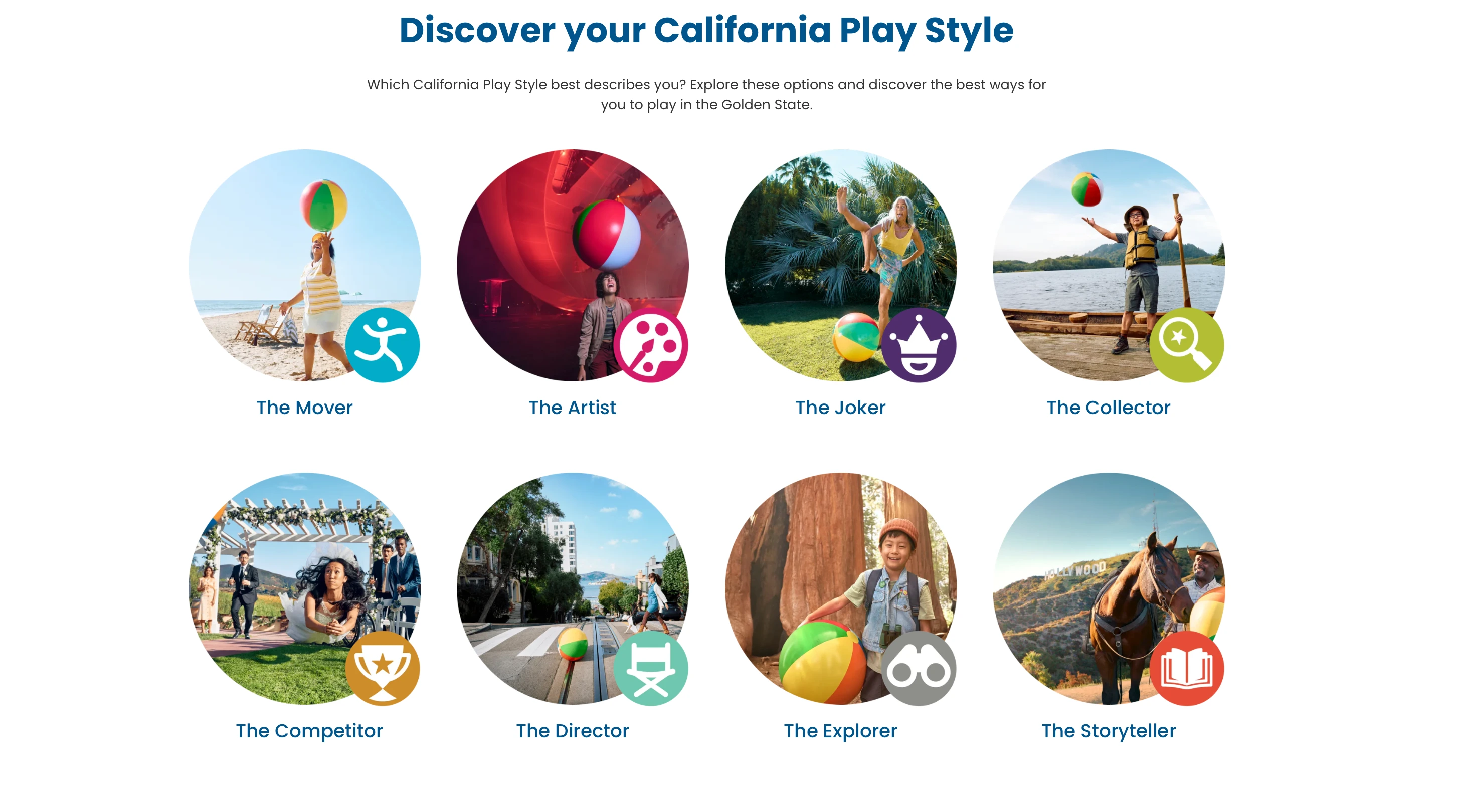
Alongside deepening engagement, each quiz interaction produced first-party data that fed audience segmentation and future personalisation, building a marketing asset that Visit California owns outright. That focus on consented, owned data aligns the campaign with a privacy-first direction many destinations are still working towards, converting a single creative feature into longer-term capability.
Collaboration across California’s Tourism Industry
Delivery drew on the wider California tourism industry. Visit California worked with DMOs, regional partners and local creators, letting the campaign present specific places through the people who know them, from surfing in Santa Cruz to wine tasting in Napa Valley. That approach kept the content credible and gave partners a stake in a shared brand.
The collaboration also extended reach without proportional cost. Regional destinations and industry partners contributed content and distribution, so a single platform could carry many local stories at once. Coordinating that many contributors under one idea is itself an achievement, and it is what allowed a state-level brand to feel locally grounded.
Maintaining the Brand Platform
The clearest test of a brand platform is whether it still generates activity once the launch has passed. In June 2026, more than two years after Let’s Play, Visit California and Virgin Atlantic Holidays staged California Games, a two-day takeover of Outernet London that invited visitors to “Play Big” through interactive sports, live entertainment and Californian food. The activation reworked the 1987 California Games arcade title into large-scale interactive screens, tying the platform to a specific cultural memory for a UK audience.
The timing was highly intentional. The takeover opened alongside the first FIFA World Cup 2026 fixture in Los Angeles and pointed towards a run of global events on Californian soil, including Super Bowl LXI at SoFi Stadium in 2027 and the LA 2028 Olympic and Paralympic Games. Play, sport and entertainment gave the brand a natural bridge into that events calendar, showing how a platform built on one insight can keep finding fresh expressions as the destination’s story develops.
Key Takeaways
- Anchor a brand shift in an owned truth: The strongest repositioning connects an established human need to something a destination can credibly claim. Grounding a brand in evidence gives it a defensible foundation and a reason to exist beyond a single campaign cycle, which protects the investment when trends move on.
- Separate the long-term platform from its first campaign: Treating the brand position and the launch campaign as distinct layers lets a destination move at pace without spending its whole idea in one burst. The platform sets the direction while individual campaigns provide agile, market-specific expressions that can evolve over time.
- Design engagement features that also build owned data: Interactive tools earn their place when they deepen engagement and generate first-party data at the same time. Consented, owned data turns a creative moment into a lasting marketing asset and supports personalisation without depending on third parties.
- Distribute delivery across the wider industry: A state or national brand gains credibility and reach when regional partners and local voices carry it. Coordinating many contributors under one clear idea extends distribution without proportional cost and keeps content grounded in real places.
- Building platforms that flex to future moments: A brand position earns its investment when it keeps generating activity long after launch. Positioning built on a broad, durable insight can attach to new cultural moments as they arise, giving a destination an evergreen frame that stays relevant across markets and over time.


