Brand-Led Destination Management: Destination BC's Iconics

Spreading the benefits of tourism across a whole region is one of the hardest things a DMO is asked to do. Achieving it means changing where people go, when they travel and where the value and impact are created, which rarely happens on its own.

Spreading the benefits of tourism across a whole region is one of the hardest things a DMO is asked to do. Achieving it means changing where people go, when they travel and where the value and impact are created, which rarely happens on its own.

A strong brand is one of the few tools that can influence those things, giving travellers reasons to look beyond the familiar and shaping how different regions develop. A destination brand works differently from a product brand, because it cannot be drawn up in a studio and stamped onto a place. What a destination brand really carries is the values, the stories and the sense of place that its communities hold, which is why it rings true only when those communities help build it. A strong destination brand becomes the way a place is managed, giving an entire industry one story to tell. That is destination management, carried out through a brand.

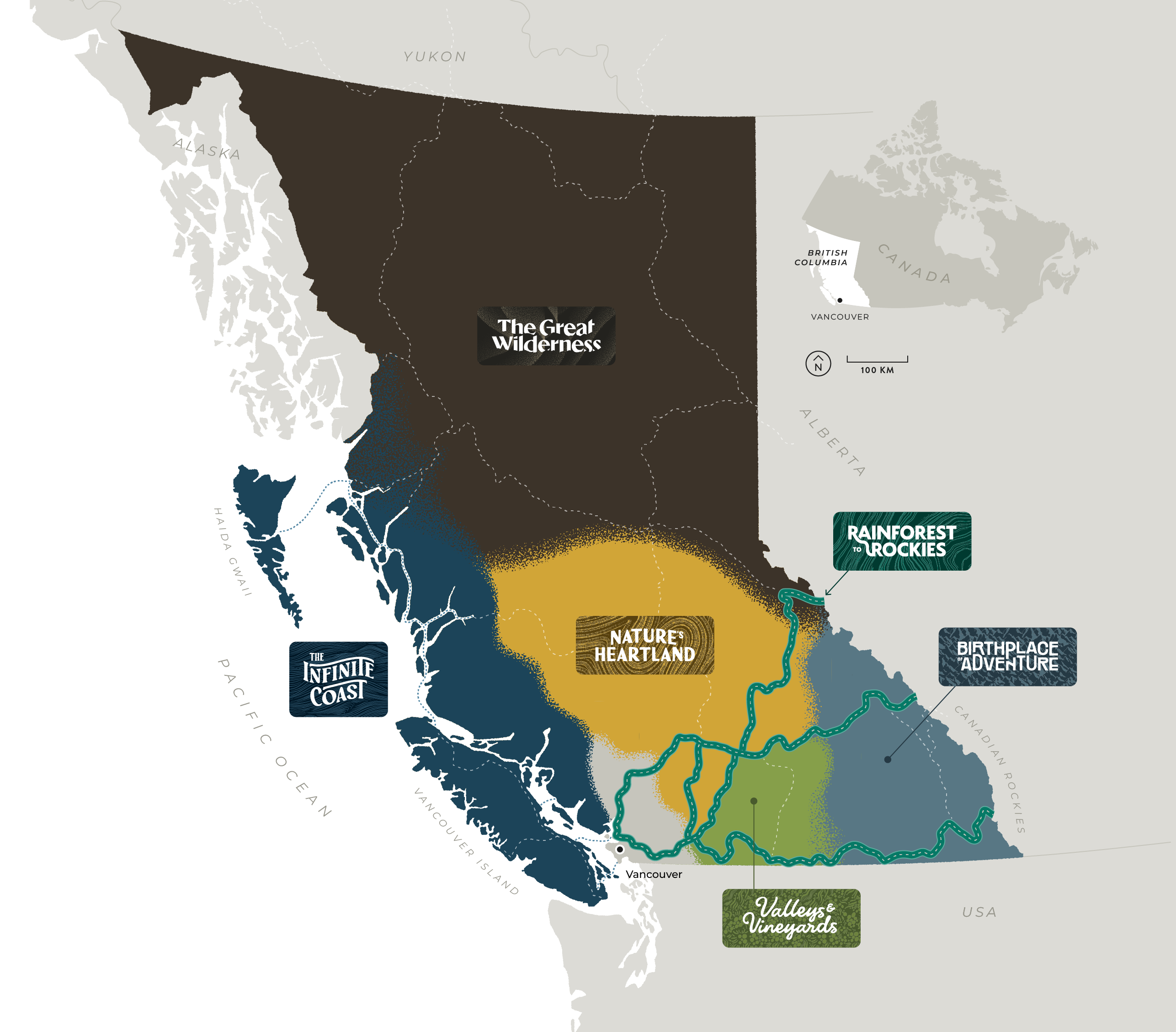
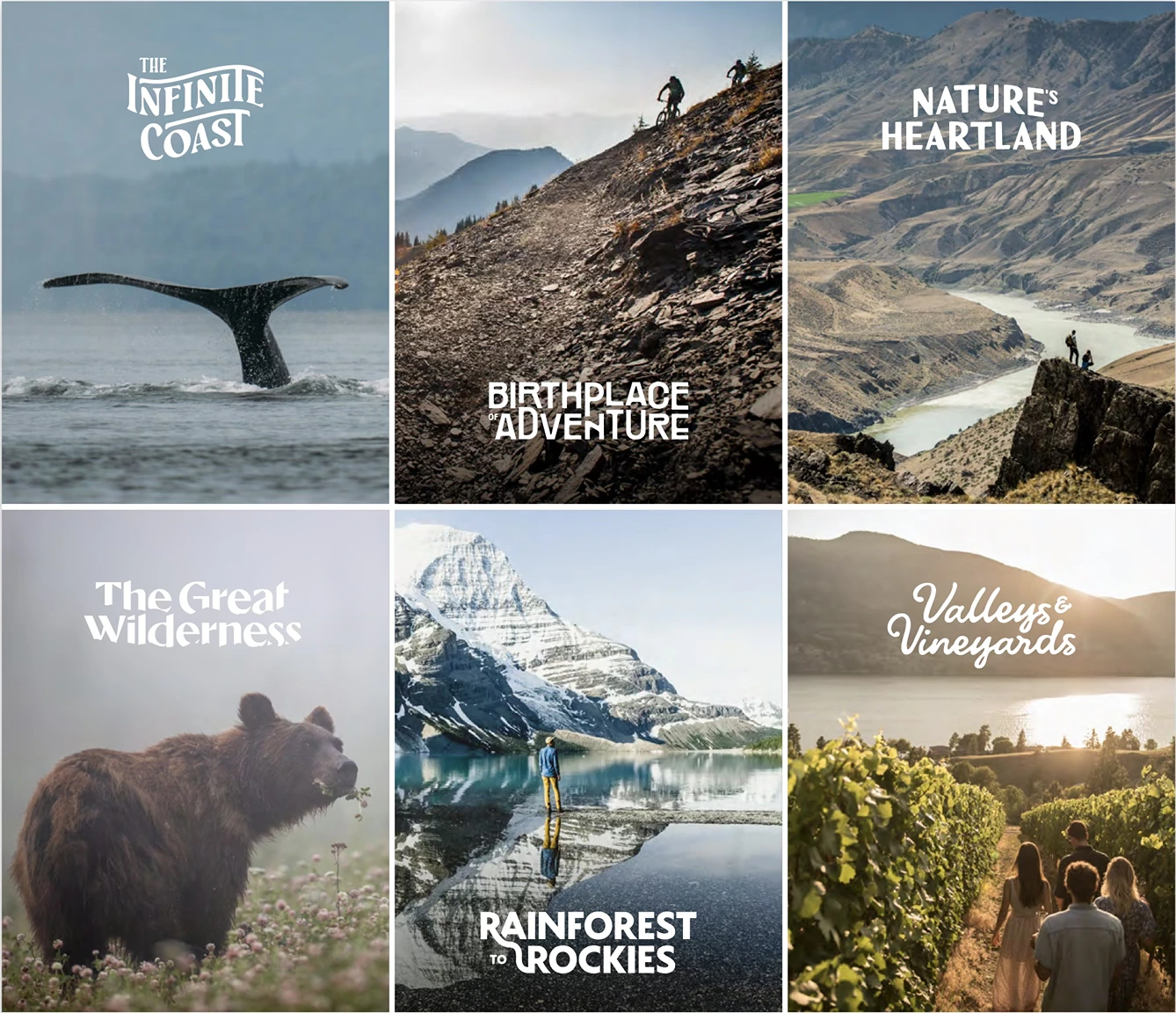
Destination British Columbia shows what that looks like in practice. Its parent brand, Super, Natural British Columbia, now sits above six Iconic destination brands: Rainforest to Rockies, The Great Wilderness, The Infinite Coast, Nature’s Heartland, Valleys & Vineyards and Birthplace of Adventure. Together they are the engine Destination BC uses to grow and manage tourism. 

Source: Destination BC

Growth that Spreads and Lasts

In British Columbia, the pattern of where and when people visit has barely changed over the past 20 years. Most visitors gather in a handful of places through the peak summer months, which leaves rural operators quiet for much of the year and piles pressure on the busiest spots. 

A brand strategy is one of the few things that can shift that. With visitors often interested in visiting the same famous sights, having a family of regional brands gives a series of compelling reasons to explore further afield, towards a quieter coast or an inland valley they had not previously considered. The same brands can pull demand into the shoulder season. 

Spreading visitors like this does more than ease pressure on the busiest places. The same shift carries income to more communities, protects the natural assets tourism depends on and lets the province prioritise value over volume. Destination BC is aiming to lift average spend per international visit towards C$2,050 and to keep at least seven in ten residents feeling that tourism is good for where they live. 

Its three pathways to growth turn that ambition into a plan that aims to double tourism revenue by 2036, intending to achieve a C$48 billion visitor economy:

  1. Stronger Tourism Brand
  2. Enabling the Development of Iconic Brand-Aligned Experiences
  3. Uniting BC's Tourism Sector for Shared Success

Creating a Stronger Tourism Brand

A brand family needs a strong centre. Super, Natural British Columbia has anchored the province for decades. In September 2025, Destination BC refreshed it under a new creative platform called Let the Outside In. Framed around the reality that people are spending more of their lives indoors and on screens, what British Columbia is really selling is the feeling of stepping back outside. This positioning turns that into a small promise that the more time you spend outdoors, the more you find within. 

That platform matters because it gives the whole brand family one thread to pull on. Every Iconic beneath it and every regional partner ends up telling a version of the same story about getting back to nature, which keeps the province feeling like one place, even as the individual brands head off in their own directions.

To carry that idea beyond promotion, Destination BC built The Nature Rating, a digital tool that scores films, TV shows, books and songs for how much nature they contain, then points people towards other content featuring more nature and recommended outdoor activities. That gives the platform a life of its own and a clear reason to engage, helping to shift behaviour before a visitor arrives.

Source: The Nature Rating

The Logic of a Brand Family

Running a family of sub-brands beneath the parent is a deliberate choice about where brand equity collects over time. The parent, Super, Natural British Columbia, carries a reputation built up over many years and lends every sub-brand instant credibility. The six Iconics, on the other hand, give travellers something specific to picture and plan around.

The brands follow British Columbia’s natural geography and are all underpinned by the core pillars of Nature, Culture and Adventure: 

  1. Rainforest to Rockies is positioned as an iconic journey between the Pacific Ocean and the Canadian Rockies, where landscapes unfold at every turn. This route highlights ever-changing nature, a connection to cultures and ease of choice for a personalised adventure on the route's offshoots that reveal numerous local gems.
  2. The Great Wilderness is centred on the province’s remote north, championing the vast scale of the wilderness that surrounds adventurers and the transformative power of nature. This Iconic is built upon the towering lands and charismatic wildlife, strength and wisdom of First Nations and limitless adventure.
  3. The Infinite Coast is designed to be a journey along the Pacific edge, where ocean, rainforest and mountains converge, and cultures are shaped by land and sea. The focus is on intersecting landscapes and interconnected biodiversity, life in sync with the ocean and multi-modal coastal journeys.
  4. Valleys & Vineyards is emblematic of a generous land, where water nourishes both soil and soul. Built to showcase the hills, valleys and shining waters that nurture more than two hundred vineyards and a food and wine culture, the region is positioned as a gathering place for shared meals and year-round soft adventure.
  5. Nature’s Heartland concentrates on a rugged soul-stirring landscape, where layers of nature and living history meet hands-on adventure. Guided by the land, tradition and kinship are centrepieces of the resourceful cowboy spirit that endures in the lakes and ranch land of the interior.
  6. Birthplace of Adventure carries the province’s endless peaks, shaping generations of adventurers. Representing four ranges and rivers that connect valleys, awe-inspiring encounters with nature and wildlife are at the heart of this Iconic, spotlighting mountain town vibes, bold authenticity and world-class outdoor experiences.
Source: Destination BC

Behind each brand sits a destination development strategy that maps where new investment and experience development should be directed, developed by Destination BC, Indigenous Tourism BC and the regional DMOs. The strategic opportunities have been clearly stipulated for each Iconic, so investors and experience providers can see where a region wants to grow. Tying a marketing brand to a development plan is the most consequential part of the whole approach. That is also the hardest thing to deliver, because the experience has to catch up with the story.

Marketing the Iconic Brands

Destination BC’s media budget shows where it expects the growth to come from, with 65% behind the Iconic brands and 35% behind the parent platform. Being distinctive and coherent at the same time is the oldest tension in any brand family. Weighting the money towards the specific places is a confident way to tackle this challenge. 

This brand family was launched in phases. This sequencing enabled a gradual roll-out, letting each brand arrive with its own moment, preventing them from competing for attention at once. Destination BC lists Vancouver & Area and Destination Ski as still to come, signalling that the brand family is likely to expand further. This model effectively showcases the approach regional and national DMOs can take to support place-based destination development.

With this phased development, initial campaigns aimed to build awareness. Rainforest to Rockies was launched at the start of 2024 through the BC Wall of Wonder in London and Sydney, showcasing the brand to commuters through a 26-foot-wide and 8-foot-high screen. This was followed by the launch of The Great Wilderness in June 2024, focused on travel trade and media activations in May-June 2024 in California and in Germany during autumn 2024, supported by an activation at a car wash in Hamburg, which was transformed to showcase the region’s wilderness landscapes. These initial brand launches gave an early opportunity to gauge audience reception to the brand messaging and ensure that the full brand family was designed to resonate.

Building upon these initial launches, the six brands went to market together for the first time in autumn 2025. This was followed by the first global content programmes in April 2026, all running across YouTube, Meta and Pinterest and directing engaged audiences to plan their trip. The rollout is designed market by market, based on Destination Canada’s traveller segments. In the UK, Refined Globetrotters are the main target, while for Germany the priority is Outdoor Explorers. California, as a short-haul source market, is reached through a hybrid approach targeting both segments. On the other hand, other core international markets, including Australia, Mexico and China, are reached through owned, earned and trade channels.

With content aligned with brand attributes, distinct storytelling is tailored to audience interests and travel motivations:

  • BC Beyond the Plate: Vancouver-based chef Ned Bell takes viewers on a culinary journey along the Rainforest to Rockies route. Over six evocative episodes, the series weaves together the flavours, people and shifting seasons that define the region to encourage trips in the autumn. 
  • Harness the Harvest: A three-part exploration of the deep-rooted ties between land, community, and food. By stepping into the Valleys & Vineyards, this series shifts travel from sightseeing to a restorative experience, inviting visitors to “nourish both body and mind” through meaningful travel experiences.
  • Journeys Across the Infinite Coast: Demonstrating the unique ways visitors can explore the Infinite Coast, this three-episode series captures its sheer scale. By showcasing travel by land, sea and air, it turns the journey itself into the ultimate coastal adventure and fully showcases the breadth of experiences.
  • Locals: Through intimate, long-form profiles on Indigenous artists, lodge owners and local guides, this series offers audiences an authentic, human lens on The Great Wilderness, Birthplace of Adventure and Nature’s Heartland regions.

Uniting the Sector Behind One Story

A brand family is only ever as strong as the number of people using it. This is the hard part of the whole strategy, because it rests on hundreds of businesses and every regional DMO choosing to market through the same brands. Destination BC’s answer is to simplify how to join in, with a planning-area look-up tool telling operators which Iconic and region it belongs to. These businesses get toolkits, maps and window decals, enabling small businesses to put themselves under a brand without needing a design team.

To support coordination, a committee has been set up for each Iconic to keep partners aligned, while Destination BC has expanded shared digital marketing tools through the provincial Tourism Data Hub. For the Birthplace of Adventure, Destination BC even launched a mentorship programme in partnership with the Kootenay Rockies Tourism Association and the Tourism Innovation Lab, matching three selected entrepreneurs with a mentor and awarding a C$3,000 grant.

Source: Destination BC

While Destination British Columbia is the most thorough example, encouraging regional DMOs to work collaboratively has become a mainstay for many destinations. Destination Canada’s tourism corridors group regions into journeys that cross the usual boundaries, with its new national tourism investment hub directing investors to funding opportunities to support them. Meanwhile, in the UK, scattered towns are being combined into regional Local Visitor Economy Partnerships.

Destination British Columbia is applying the same idea at the scale of one province. Keeping all of this going takes sustained effort as six brands are a lot to keep distinct and well funded across many markets, year after year. The Iconics may end up doing much of their work inside the industry, as the shared structures partners build on, as much as in the public mind. In the end, the strategy will only pay off if the province’s own operators keep choosing to market through the brands, which is why it was so important to gradually scale up the branding and ensure regional DMOs are fully involved in the creation of coherent destination management plans.

DTTT Take

The brand family is the working engine of destination management, used to build a stronger provincial brand, decide what each region develops and pull an industry together behind it. That convergence of marketing and management is where the value truly sits.

  • Build brands with the place and its people: A place brand only rings true when residents, operators and Indigenous partners shape it from the start, because the values and the sense of place have to come from the ground. Built that way, a brand carries authentic character and wins the local support that the rest of the work leans on. 
  • Use brands to spread growth across regions and seasons: Point audiences and timing at the regions and seasons that need them, so the same demand relieves the busy places, reaches more communities and protects what a destination is known for. Judge it on the value and goodwill a visitor leaves behind.
  • Make each brand a brief for what to build: Use it to agree where the on-the-ground experience can be enhanced, then focus investment and new product on those gaps. When a brand shapes development and marketing, the promise is one the place can keep.
  • Run many brands off one shared framework: Give every sub-brand the same core ideas and one parent platform, then let each fill them with its own place, so a small team can hold a wide portfolio together and partners can produce their own work on brand. Weight the investment towards the specific brands, where the growth comes from. 
  • Make partner adoption the goal and build the systems that drive it: A brand system only pays off once regional bodies and operators intentionally choose to market through it. Give partners shared audiences, common data, toolkits and a clear voice in shaping future direction, so joining in becomes the simplest option. This coordination is what makes a brand family hold.
Subscribe to our Newsletter

Thank you! Your submission has been received!
Oops! Something went wrong while submitting the form.

Spreading the benefits of tourism across a whole region is one of the hardest things a DMO is asked to do. Achieving it means changing where people go, when they travel and where the value and impact are created, which rarely happens on its own.

A strong brand is one of the few tools that can influence those things, giving travellers reasons to look beyond the familiar and shaping how different regions develop. A destination brand works differently from a product brand, because it cannot be drawn up in a studio and stamped onto a place. What a destination brand really carries is the values, the stories and the sense of place that its communities hold, which is why it rings true only when those communities help build it. A strong destination brand becomes the way a place is managed, giving an entire industry one story to tell. That is destination management, carried out through a brand.

Destination British Columbia shows what that looks like in practice. Its parent brand, Super, Natural British Columbia, now sits above six Iconic destination brands: Rainforest to Rockies, The Great Wilderness, The Infinite Coast, Nature’s Heartland, Valleys & Vineyards and Birthplace of Adventure. Together they are the engine Destination BC uses to grow and manage tourism. 

Source: Destination BC

Growth that Spreads and Lasts

In British Columbia, the pattern of where and when people visit has barely changed over the past 20 years. Most visitors gather in a handful of places through the peak summer months, which leaves rural operators quiet for much of the year and piles pressure on the busiest spots. 

A brand strategy is one of the few things that can shift that. With visitors often interested in visiting the same famous sights, having a family of regional brands gives a series of compelling reasons to explore further afield, towards a quieter coast or an inland valley they had not previously considered. The same brands can pull demand into the shoulder season. 

Spreading visitors like this does more than ease pressure on the busiest places. The same shift carries income to more communities, protects the natural assets tourism depends on and lets the province prioritise value over volume. Destination BC is aiming to lift average spend per international visit towards C$2,050 and to keep at least seven in ten residents feeling that tourism is good for where they live. 

Its three pathways to growth turn that ambition into a plan that aims to double tourism revenue by 2036, intending to achieve a C$48 billion visitor economy:

  1. Stronger Tourism Brand
  2. Enabling the Development of Iconic Brand-Aligned Experiences
  3. Uniting BC's Tourism Sector for Shared Success

Creating a Stronger Tourism Brand

A brand family needs a strong centre. Super, Natural British Columbia has anchored the province for decades. In September 2025, Destination BC refreshed it under a new creative platform called Let the Outside In. Framed around the reality that people are spending more of their lives indoors and on screens, what British Columbia is really selling is the feeling of stepping back outside. This positioning turns that into a small promise that the more time you spend outdoors, the more you find within. 

That platform matters because it gives the whole brand family one thread to pull on. Every Iconic beneath it and every regional partner ends up telling a version of the same story about getting back to nature, which keeps the province feeling like one place, even as the individual brands head off in their own directions.

To carry that idea beyond promotion, Destination BC built The Nature Rating, a digital tool that scores films, TV shows, books and songs for how much nature they contain, then points people towards other content featuring more nature and recommended outdoor activities. That gives the platform a life of its own and a clear reason to engage, helping to shift behaviour before a visitor arrives.

Source: The Nature Rating

The Logic of a Brand Family

Running a family of sub-brands beneath the parent is a deliberate choice about where brand equity collects over time. The parent, Super, Natural British Columbia, carries a reputation built up over many years and lends every sub-brand instant credibility. The six Iconics, on the other hand, give travellers something specific to picture and plan around.

The brands follow British Columbia’s natural geography and are all underpinned by the core pillars of Nature, Culture and Adventure: 

  1. Rainforest to Rockies is positioned as an iconic journey between the Pacific Ocean and the Canadian Rockies, where landscapes unfold at every turn. This route highlights ever-changing nature, a connection to cultures and ease of choice for a personalised adventure on the route's offshoots that reveal numerous local gems.
  2. The Great Wilderness is centred on the province’s remote north, championing the vast scale of the wilderness that surrounds adventurers and the transformative power of nature. This Iconic is built upon the towering lands and charismatic wildlife, strength and wisdom of First Nations and limitless adventure.
  3. The Infinite Coast is designed to be a journey along the Pacific edge, where ocean, rainforest and mountains converge, and cultures are shaped by land and sea. The focus is on intersecting landscapes and interconnected biodiversity, life in sync with the ocean and multi-modal coastal journeys.
  4. Valleys & Vineyards is emblematic of a generous land, where water nourishes both soil and soul. Built to showcase the hills, valleys and shining waters that nurture more than two hundred vineyards and a food and wine culture, the region is positioned as a gathering place for shared meals and year-round soft adventure.
  5. Nature’s Heartland concentrates on a rugged soul-stirring landscape, where layers of nature and living history meet hands-on adventure. Guided by the land, tradition and kinship are centrepieces of the resourceful cowboy spirit that endures in the lakes and ranch land of the interior.
  6. Birthplace of Adventure carries the province’s endless peaks, shaping generations of adventurers. Representing four ranges and rivers that connect valleys, awe-inspiring encounters with nature and wildlife are at the heart of this Iconic, spotlighting mountain town vibes, bold authenticity and world-class outdoor experiences.
Source: Destination BC

Behind each brand sits a destination development strategy that maps where new investment and experience development should be directed, developed by Destination BC, Indigenous Tourism BC and the regional DMOs. The strategic opportunities have been clearly stipulated for each Iconic, so investors and experience providers can see where a region wants to grow. Tying a marketing brand to a development plan is the most consequential part of the whole approach. That is also the hardest thing to deliver, because the experience has to catch up with the story.

Marketing the Iconic Brands

Destination BC’s media budget shows where it expects the growth to come from, with 65% behind the Iconic brands and 35% behind the parent platform. Being distinctive and coherent at the same time is the oldest tension in any brand family. Weighting the money towards the specific places is a confident way to tackle this challenge. 

This brand family was launched in phases. This sequencing enabled a gradual roll-out, letting each brand arrive with its own moment, preventing them from competing for attention at once. Destination BC lists Vancouver & Area and Destination Ski as still to come, signalling that the brand family is likely to expand further. This model effectively showcases the approach regional and national DMOs can take to support place-based destination development.

With this phased development, initial campaigns aimed to build awareness. Rainforest to Rockies was launched at the start of 2024 through the BC Wall of Wonder in London and Sydney, showcasing the brand to commuters through a 26-foot-wide and 8-foot-high screen. This was followed by the launch of The Great Wilderness in June 2024, focused on travel trade and media activations in May-June 2024 in California and in Germany during autumn 2024, supported by an activation at a car wash in Hamburg, which was transformed to showcase the region’s wilderness landscapes. These initial brand launches gave an early opportunity to gauge audience reception to the brand messaging and ensure that the full brand family was designed to resonate.

Building upon these initial launches, the six brands went to market together for the first time in autumn 2025. This was followed by the first global content programmes in April 2026, all running across YouTube, Meta and Pinterest and directing engaged audiences to plan their trip. The rollout is designed market by market, based on Destination Canada’s traveller segments. In the UK, Refined Globetrotters are the main target, while for Germany the priority is Outdoor Explorers. California, as a short-haul source market, is reached through a hybrid approach targeting both segments. On the other hand, other core international markets, including Australia, Mexico and China, are reached through owned, earned and trade channels.

With content aligned with brand attributes, distinct storytelling is tailored to audience interests and travel motivations:

  • BC Beyond the Plate: Vancouver-based chef Ned Bell takes viewers on a culinary journey along the Rainforest to Rockies route. Over six evocative episodes, the series weaves together the flavours, people and shifting seasons that define the region to encourage trips in the autumn. 
  • Harness the Harvest: A three-part exploration of the deep-rooted ties between land, community, and food. By stepping into the Valleys & Vineyards, this series shifts travel from sightseeing to a restorative experience, inviting visitors to “nourish both body and mind” through meaningful travel experiences.
  • Journeys Across the Infinite Coast: Demonstrating the unique ways visitors can explore the Infinite Coast, this three-episode series captures its sheer scale. By showcasing travel by land, sea and air, it turns the journey itself into the ultimate coastal adventure and fully showcases the breadth of experiences.
  • Locals: Through intimate, long-form profiles on Indigenous artists, lodge owners and local guides, this series offers audiences an authentic, human lens on The Great Wilderness, Birthplace of Adventure and Nature’s Heartland regions.

Uniting the Sector Behind One Story

A brand family is only ever as strong as the number of people using it. This is the hard part of the whole strategy, because it rests on hundreds of businesses and every regional DMO choosing to market through the same brands. Destination BC’s answer is to simplify how to join in, with a planning-area look-up tool telling operators which Iconic and region it belongs to. These businesses get toolkits, maps and window decals, enabling small businesses to put themselves under a brand without needing a design team.

To support coordination, a committee has been set up for each Iconic to keep partners aligned, while Destination BC has expanded shared digital marketing tools through the provincial Tourism Data Hub. For the Birthplace of Adventure, Destination BC even launched a mentorship programme in partnership with the Kootenay Rockies Tourism Association and the Tourism Innovation Lab, matching three selected entrepreneurs with a mentor and awarding a C$3,000 grant.

Source: Destination BC

While Destination British Columbia is the most thorough example, encouraging regional DMOs to work collaboratively has become a mainstay for many destinations. Destination Canada’s tourism corridors group regions into journeys that cross the usual boundaries, with its new national tourism investment hub directing investors to funding opportunities to support them. Meanwhile, in the UK, scattered towns are being combined into regional Local Visitor Economy Partnerships.

Destination British Columbia is applying the same idea at the scale of one province. Keeping all of this going takes sustained effort as six brands are a lot to keep distinct and well funded across many markets, year after year. The Iconics may end up doing much of their work inside the industry, as the shared structures partners build on, as much as in the public mind. In the end, the strategy will only pay off if the province’s own operators keep choosing to market through the brands, which is why it was so important to gradually scale up the branding and ensure regional DMOs are fully involved in the creation of coherent destination management plans.

DTTT Take

The brand family is the working engine of destination management, used to build a stronger provincial brand, decide what each region develops and pull an industry together behind it. That convergence of marketing and management is where the value truly sits.

  • Build brands with the place and its people: A place brand only rings true when residents, operators and Indigenous partners shape it from the start, because the values and the sense of place have to come from the ground. Built that way, a brand carries authentic character and wins the local support that the rest of the work leans on. 
  • Use brands to spread growth across regions and seasons: Point audiences and timing at the regions and seasons that need them, so the same demand relieves the busy places, reaches more communities and protects what a destination is known for. Judge it on the value and goodwill a visitor leaves behind.
  • Make each brand a brief for what to build: Use it to agree where the on-the-ground experience can be enhanced, then focus investment and new product on those gaps. When a brand shapes development and marketing, the promise is one the place can keep.
  • Run many brands off one shared framework: Give every sub-brand the same core ideas and one parent platform, then let each fill them with its own place, so a small team can hold a wide portfolio together and partners can produce their own work on brand. Weight the investment towards the specific brands, where the growth comes from. 
  • Make partner adoption the goal and build the systems that drive it: A brand system only pays off once regional bodies and operators intentionally choose to market through it. Give partners shared audiences, common data, toolkits and a clear voice in shaping future direction, so joining in becomes the simplest option. This coordination is what makes a brand family hold.

Subscribe to our Newsletter

Thank you! Your submission has been received!
Oops! Something went wrong while submitting the form.