Monitoring How AI Reshapes Organisational Processes

AI adoption is a change management question. Our AI Transparency Framework's organisational intelligence instruments offer benchmarkable insights into monitoring AI readiness, what employees can achieve and how the change is affecting team morale.

The benefits of AI are easy to state, including faster research and content production and more time for work that needs human judgement. Senior leaders hear these promises all the time. Inside an organisation, though, the results often fall short of what was described.

When an organisation gains access to AI tools and encourages people to use them, it is often hard to see whether work has changed or simply sped up in a few places. While some people become AI literate quickly, others are more hesitant to change. Six months on, leadership teams often can't answer basic questions about whether the organisation is further along than a year ago, who is using AI well, who is still stuck and whether it is helping or quietly adding to workloads. This makes AI adoption an organisational change management question.

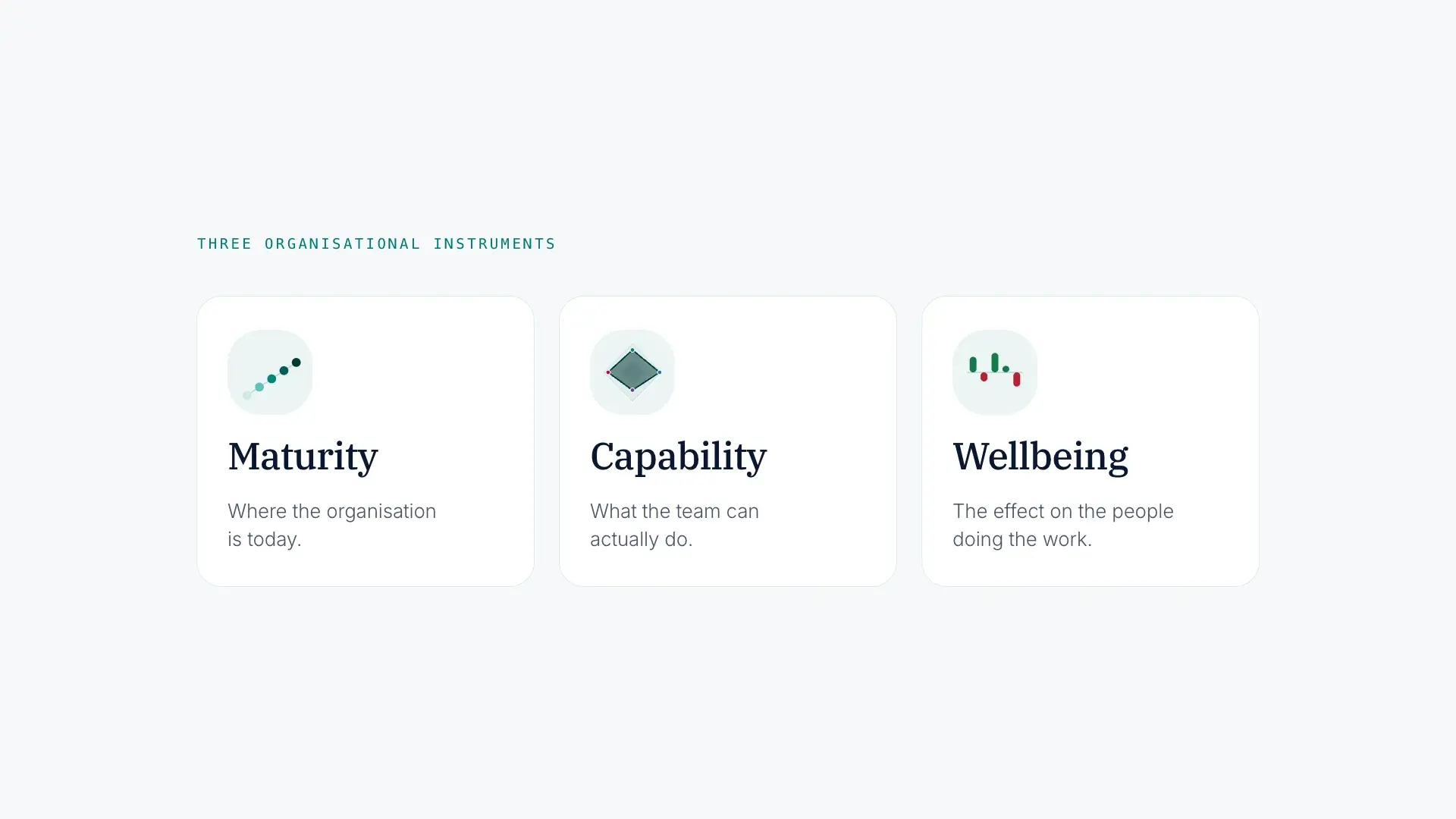
Monitoring is what turns AI adoption from something that happens to an organisation into something it can steer. Without a process for evaluating how AI is being used, a team ends up bolting new tools onto existing workflows instead of redesigning them around new AI-enabled capabilities. DTTT's AI Transparency Framework was built to close that gap through a set of open instruments. The three organisational intelligence instruments each offer a different view, providing benchmarkable insights into an organisation's AI readiness, what its employees can do and how the change is affecting team morale.

Mapping AI Maturity

Any effective AI strategy must start with a clear view of your organisation's starting point, since AI use tends to grow quietly and unevenly. What looks like steady progress in one team often contrasts enormously with other teams who have barely started their AI journey. Without a shared understanding of this, leaders end up setting direction, funding training and judging progress on guesswork. As AI works its way into core processes that becomes a costly way to manage an organisation.

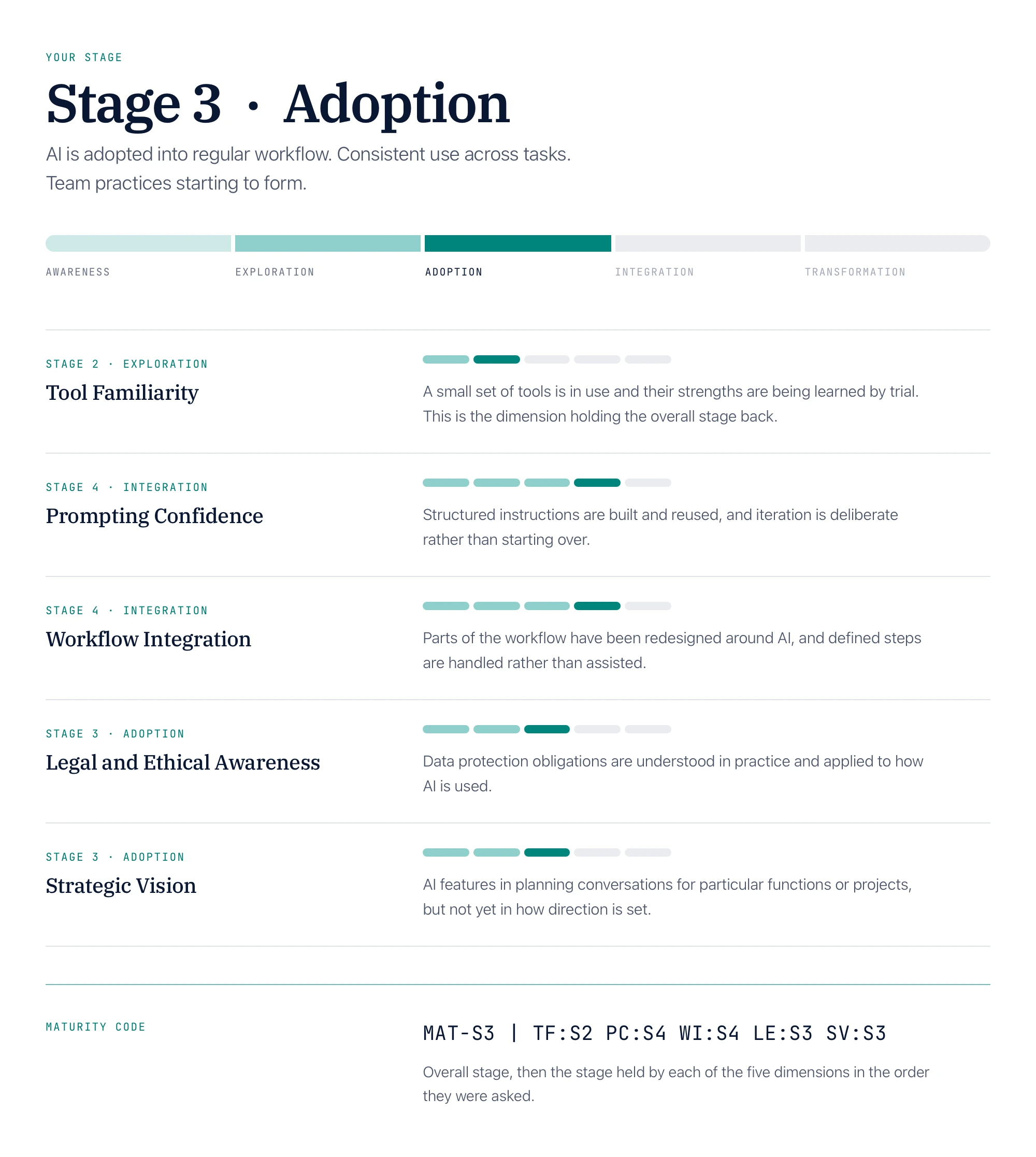
The Maturity Model establishes a clear reference point for an organisation's progress in adopting AI. It works across five stages, from an early stage of awareness through exploration, adoption and integration to full transformation, where AI reshapes what the organisation can achieve. Five dimensions cover how familiar teams are with AI tools and how confident people are at instructing them, how deeply AI is woven into daily work, how well teams handle the legal and ethical side of AI use and how clearly leadership has connected technology to organisational goals.

Source: DTTT AI Transparency Framework

Broad maturity labels mask an uneven reality. A destination might sit at Stage 3 (Adoption) overall, while its content team is closer to Stage 4 (Integration) and its market development team remains at Stage 2 (Exploration). Mapping those internal gaps is what drives progress and reveals where investment and support are needed most.

Knowledge about what works with AI tends to stay trapped inside the team that developed it. Establishing a shared picture of maturity equips leadership teams with the rationale for developing a roadmap designed to elevate capabilities across the entire organisation. When an organisation can clearly see that one team is further ahead on workflow integration, it can take the crucial steps to streamline the sharing of insights between teams. This is one of the more practical ways to break down organisational silos.

Advancing Team Capability

Once a team is using AI, people pull ahead in different directions. Most organisations rely on AI champions, acting as individuals who share knowledge about best practice. When this expertise remains informal, it leaves businesses vulnerable every time a key person is away. Formally mapping these implicit skills enables managers to understand where the strengths of each team member lie.

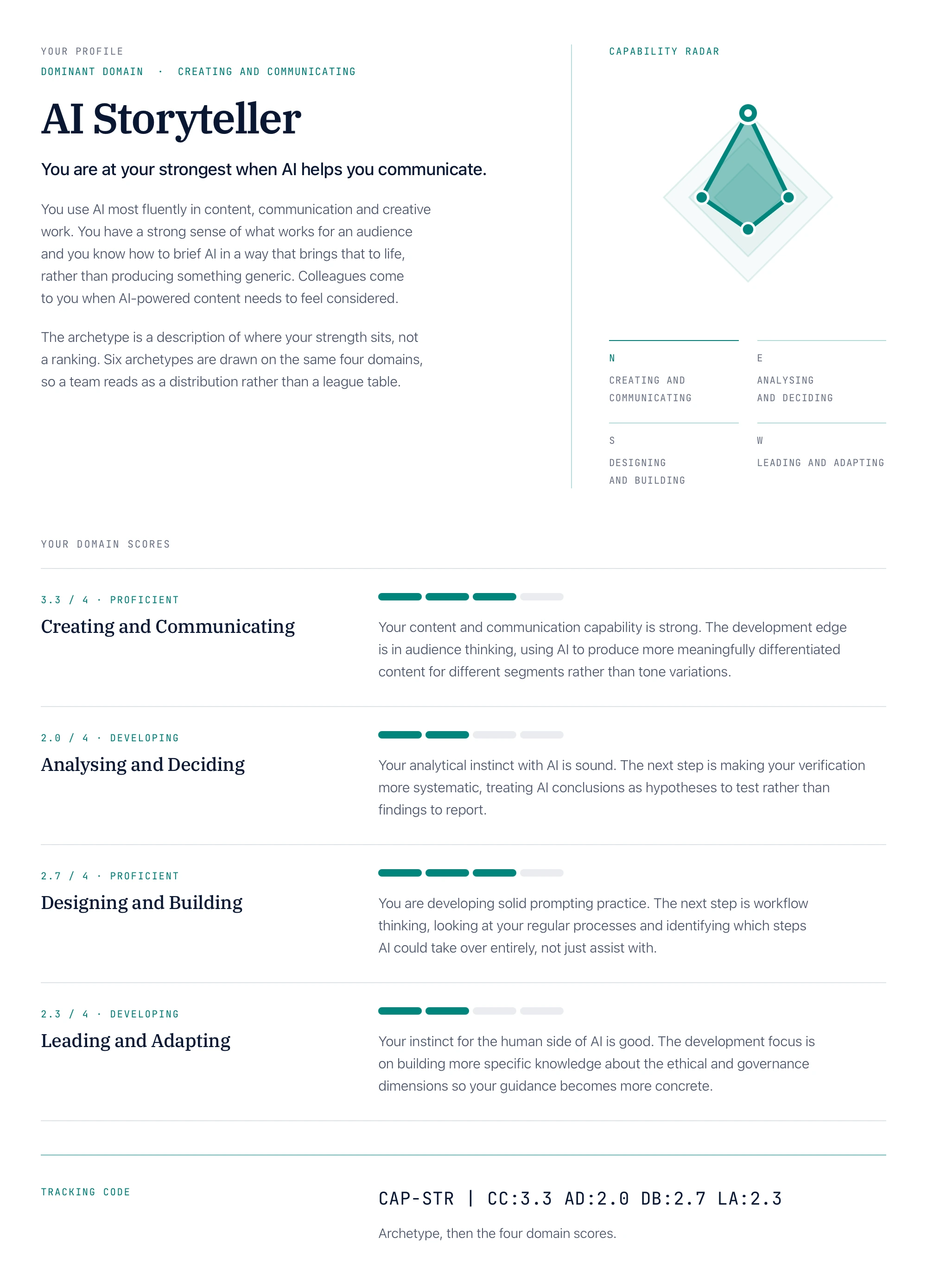
Where the Maturity Model looks at the organisation, the Capability Model looks at people. It judges what an individual can do with AI across sixteen capabilities, from producing and shaping content through to analysing information and designing better workflows. Each capability is assessed at one of four levels, from occasional use up to the point where someone builds tools and templates that the rest of the team relies on, corresponding with six AI archetypes:

  • AI Storyteller
  • AI Analyst
  • AI Architect
  • AI Catalyst
  • AI Pioneer
  • AI Generalist

Source: DTTT AI Transparency Framework

This detail enables targeted skills development that matches a capability profile with the expertise that matters most for a particular job. Instead of generic AI training, understanding where the gaps sit means that continued progress becomes meaningful to the context of each employee's role.

The same insight changes how projects are run. When a manager can see the capability profile of each team member, they can build project teams that combine complementary skills. Making these profiles visible also helps people work together because it supports teams in sharing workload in a way that plays to individual strengths.

Protecting Team Wellbeing

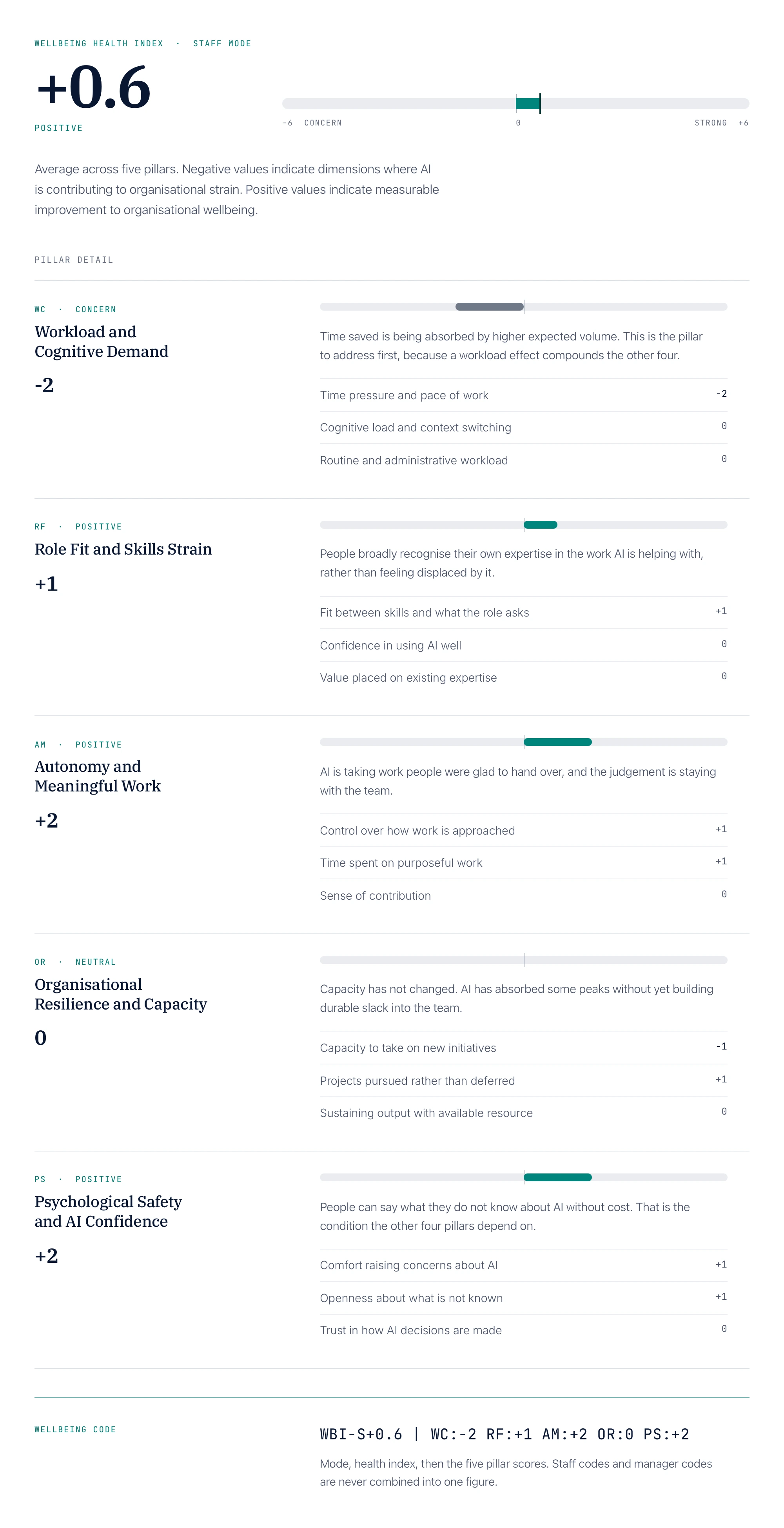
AI changes how work feels as much as what gets done. Some people find it a relief, while others are more reserved about its use. This rarely shows up in performance figures and stays hidden until it has already done damage to a team's mental health. The Job Demands-Resources model in occupational psychology acts as a key input for the Organisational Wellbeing Instrument, respecting that every job comes with two broad forces:

  • Demands: The things that cost effort, including heavy workload, time pressure or emotional strain
  • Resources: The things that help people cope and stay motivated, including autonomy, support, training and useful tools.

Wellbeing and burnout sit at opposite ends of the spectrum. Strain builds when demands climb without matching resources, while people stay engaged when resources are strong enough to carry the demands placed on them. This offers a powerful perspective on team morale, highlighting how a shifting workplace culture dramatically amplifies AI’s human impact. The early warning signs are deceptively subtle. Without proper tracking, this hidden pressure only surfaces when a valued team member burns out or hands in their notice.

Examining five areas, the Organisational Wellbeing Instrument measures AI's impact on workload sustainability, role fit, job meaning, an organisation's capacity for change and how safe employees feel to admit when struggling. With parallel versions for employees and managers, it mirrors both perspectives to reveal where there is alignment and where a disconnect remains.

Source: DTTT AI Transparency Framework

The simplest way to prioritise AI wellbeing is routinely incorporating it into employee appraisals. Building a short wellbeing check into periodic reviews gives managers and team members a regular opportunity to talk openly about how AI is affecting workloads and whether people still feel valued. This opens up a more honest conversation about where AI belongs in a team's culture.

The people who find AI unsettling or unhelpful are often the quietest, so tracking wellbeing gives their experience a place in discussions. It is also a reason to build AI working groups that reflect the full range of views, enabling decisions to be made that have been tested against doubts instead of built around them.

Steering AI Adoption

A single assessment offers a static snapshot, with true leadership value coming from tracking changing organisational performance. Establishing a baseline today provides the clarity needed to track structural changes, using consistent metrics to prove whether strategic shifts are delivering the expected results.

The importance of setting that baseline is easiest to see in an experience almost every organisation has already faced numerous times. Frequent restructuring often leaves teams in a state of perpetual realignment, forever tweaking reporting structures without ever striking the right balance in how teams work. Using data to pinpoint where AI adds value protects team dynamics from regular disruption. Reporting AI maturity, capability and wellbeing acts as an early warning system, highlighting where projects and teams need extra support.

The habits an organisation forms around AI now will dictate its productivity for years to come. Early practices harden fast, and once embedded, they are notoriously difficult to unpick. Destinations that benchmark adoption the quickest will be the ones best placed to build a resilient foundation as AI moves deeper into their daily operations.
Subscribe to our Newsletter

Thank you! Your submission has been received!
Oops! Something went wrong while submitting the form.

The benefits of AI are easy to state, including faster research and content production and more time for work that needs human judgement. Senior leaders hear these promises all the time. Inside an organisation, though, the results often fall short of what was described.

When an organisation gains access to AI tools and encourages people to use them, it is often hard to see whether work has changed or simply sped up in a few places. While some people become AI literate quickly, others are more hesitant to change. Six months on, leadership teams often can't answer basic questions about whether the organisation is further along than a year ago, who is using AI well, who is still stuck and whether it is helping or quietly adding to workloads. This makes AI adoption an organisational change management question.

Monitoring is what turns AI adoption from something that happens to an organisation into something it can steer. Without a process for evaluating how AI is being used, a team ends up bolting new tools onto existing workflows instead of redesigning them around new AI-enabled capabilities. DTTT's AI Transparency Framework was built to close that gap through a set of open instruments. The three organisational intelligence instruments each offer a different view, providing benchmarkable insights into an organisation's AI readiness, what its employees can do and how the change is affecting team morale.

Mapping AI Maturity

Any effective AI strategy must start with a clear view of your organisation's starting point, since AI use tends to grow quietly and unevenly. What looks like steady progress in one team often contrasts enormously with other teams who have barely started their AI journey. Without a shared understanding of this, leaders end up setting direction, funding training and judging progress on guesswork. As AI works its way into core processes that becomes a costly way to manage an organisation.

The Maturity Model establishes a clear reference point for an organisation's progress in adopting AI. It works across five stages, from an early stage of awareness through exploration, adoption and integration to full transformation, where AI reshapes what the organisation can achieve. Five dimensions cover how familiar teams are with AI tools and how confident people are at instructing them, how deeply AI is woven into daily work, how well teams handle the legal and ethical side of AI use and how clearly leadership has connected technology to organisational goals.

Source: DTTT AI Transparency Framework

Broad maturity labels mask an uneven reality. A destination might sit at Stage 3 (Adoption) overall, while its content team is closer to Stage 4 (Integration) and its market development team remains at Stage 2 (Exploration). Mapping those internal gaps is what drives progress and reveals where investment and support are needed most.

Knowledge about what works with AI tends to stay trapped inside the team that developed it. Establishing a shared picture of maturity equips leadership teams with the rationale for developing a roadmap designed to elevate capabilities across the entire organisation. When an organisation can clearly see that one team is further ahead on workflow integration, it can take the crucial steps to streamline the sharing of insights between teams. This is one of the more practical ways to break down organisational silos.

Advancing Team Capability

Once a team is using AI, people pull ahead in different directions. Most organisations rely on AI champions, acting as individuals who share knowledge about best practice. When this expertise remains informal, it leaves businesses vulnerable every time a key person is away. Formally mapping these implicit skills enables managers to understand where the strengths of each team member lie.

Where the Maturity Model looks at the organisation, the Capability Model looks at people. It judges what an individual can do with AI across sixteen capabilities, from producing and shaping content through to analysing information and designing better workflows. Each capability is assessed at one of four levels, from occasional use up to the point where someone builds tools and templates that the rest of the team relies on, corresponding with six AI archetypes:

  • AI Storyteller
  • AI Analyst
  • AI Architect
  • AI Catalyst
  • AI Pioneer
  • AI Generalist

Source: DTTT AI Transparency Framework

This detail enables targeted skills development that matches a capability profile with the expertise that matters most for a particular job. Instead of generic AI training, understanding where the gaps sit means that continued progress becomes meaningful to the context of each employee's role.

The same insight changes how projects are run. When a manager can see the capability profile of each team member, they can build project teams that combine complementary skills. Making these profiles visible also helps people work together because it supports teams in sharing workload in a way that plays to individual strengths.

Protecting Team Wellbeing

AI changes how work feels as much as what gets done. Some people find it a relief, while others are more reserved about its use. This rarely shows up in performance figures and stays hidden until it has already done damage to a team's mental health. The Job Demands-Resources model in occupational psychology acts as a key input for the Organisational Wellbeing Instrument, respecting that every job comes with two broad forces:

  • Demands: The things that cost effort, including heavy workload, time pressure or emotional strain
  • Resources: The things that help people cope and stay motivated, including autonomy, support, training and useful tools.

Wellbeing and burnout sit at opposite ends of the spectrum. Strain builds when demands climb without matching resources, while people stay engaged when resources are strong enough to carry the demands placed on them. This offers a powerful perspective on team morale, highlighting how a shifting workplace culture dramatically amplifies AI’s human impact. The early warning signs are deceptively subtle. Without proper tracking, this hidden pressure only surfaces when a valued team member burns out or hands in their notice.

Examining five areas, the Organisational Wellbeing Instrument measures AI's impact on workload sustainability, role fit, job meaning, an organisation's capacity for change and how safe employees feel to admit when struggling. With parallel versions for employees and managers, it mirrors both perspectives to reveal where there is alignment and where a disconnect remains.

Source: DTTT AI Transparency Framework

The simplest way to prioritise AI wellbeing is routinely incorporating it into employee appraisals. Building a short wellbeing check into periodic reviews gives managers and team members a regular opportunity to talk openly about how AI is affecting workloads and whether people still feel valued. This opens up a more honest conversation about where AI belongs in a team's culture.

The people who find AI unsettling or unhelpful are often the quietest, so tracking wellbeing gives their experience a place in discussions. It is also a reason to build AI working groups that reflect the full range of views, enabling decisions to be made that have been tested against doubts instead of built around them.

Steering AI Adoption

A single assessment offers a static snapshot, with true leadership value coming from tracking changing organisational performance. Establishing a baseline today provides the clarity needed to track structural changes, using consistent metrics to prove whether strategic shifts are delivering the expected results.

The importance of setting that baseline is easiest to see in an experience almost every organisation has already faced numerous times. Frequent restructuring often leaves teams in a state of perpetual realignment, forever tweaking reporting structures without ever striking the right balance in how teams work. Using data to pinpoint where AI adds value protects team dynamics from regular disruption. Reporting AI maturity, capability and wellbeing acts as an early warning system, highlighting where projects and teams need extra support.

The habits an organisation forms around AI now will dictate its productivity for years to come. Early practices harden fast, and once embedded, they are notoriously difficult to unpick. Destinations that benchmark adoption the quickest will be the ones best placed to build a resilient foundation as AI moves deeper into their daily operations.
Subscribe to our Newsletter

Thank you! Your submission has been received!
Oops! Something went wrong while submitting the form.