
Log in
Oops! Something went wrong while submitting the form.
Create an account
Oops! Something went wrong while submitting the form.


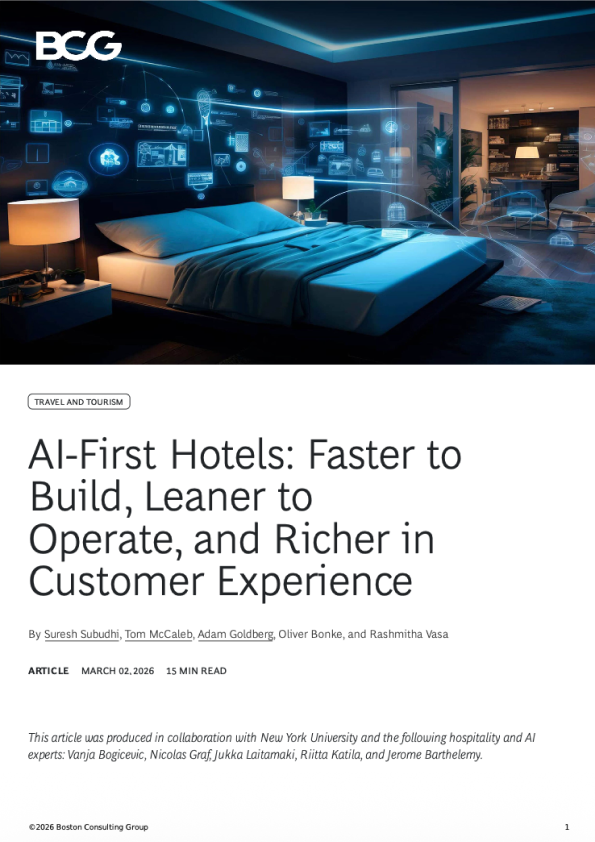
Published by Boston Consulting Group in March 2026, in collaboration with hospitality and AI experts from New York University, this article-length report examines how AI is moving beyond isolated applications in hospitality towards reshaping the entire operating model of hotel companies. The authors argue that the window for catching up is narrowing: those that rework core operations will become AI-first hotels, while those making incremental fixes risk falling permanently behind.
The report identifies three interlocking transformation pillars. The first is commercial and customer excellence at scale, covering how AI is disrupting discovery and distribution as OTAs face potential disintermediation by AI-powered digital assistants embedded in banks, credit cards and search platforms. Hotels must make their content machine-readable and optimise for algorithmic relevance to remain visible in AI-driven recommendation environments.
The second pillar is operational efficiency, covering how AI tools reduce labour costs through predictive housekeeping, automated procurement and AI-driven scheduling, with some hotels already reporting 20% improvements in room-turnaround times. The third pillar addresses construction and expansion, where AI-assisted design, modular building systems and 3D printing are compressing development timelines.
For destination organisations, the report's discussion of AI-driven guest discovery is particularly relevant: it argues that brand equity is shifting from name recognition to algorithmic relevance, and that hotels without machine-readable content and multi-source digital footprints risk disappearing from AI recommendations entirely.
Published by Boston Consulting Group in March 2026, in collaboration with hospitality and AI experts from New York University, this article-length report examines how AI is moving beyond isolated applications in hospitality towards reshaping the entire operating model of hotel companies. The authors argue that the window for catching up is narrowing: those that rework core operations will become AI-first hotels, while those making incremental fixes risk falling permanently behind.
The report identifies three interlocking transformation pillars. The first is commercial and customer excellence at scale, covering how AI is disrupting discovery and distribution as OTAs face potential disintermediation by AI-powered digital assistants embedded in banks, credit cards and search platforms. Hotels must make their content machine-readable and optimise for algorithmic relevance to remain visible in AI-driven recommendation environments.
The second pillar is operational efficiency, covering how AI tools reduce labour costs through predictive housekeeping, automated procurement and AI-driven scheduling, with some hotels already reporting 20% improvements in room-turnaround times. The third pillar addresses construction and expansion, where AI-assisted design, modular building systems and 3D printing are compressing development timelines.
For destination organisations, the report's discussion of AI-driven guest discovery is particularly relevant: it argues that brand equity is shifting from name recognition to algorithmic relevance, and that hotels without machine-readable content and multi-source digital footprints risk disappearing from AI recommendations entirely.


