The way visitors choose destinations is shifting from search results to conversations with AI assistants and autonomous agents on their behalf.
The way visitors find and choose destinations is shifting from search results to conversations with AI assistants, and (further out) to autonomous agents acting on a visitor's behalf. At X. Design Week 2026, two sessions explored what this shift means in practice. The discussions addressed how destinations remain visible, trustworthy and useful when the interface to the visitor changes.
Why Travel Assistants Matter
Visitors arrive with long questions about their trip, travel companions and interests. They expect answers shaped around their context. Static websites struggle to meet this demand, since the information visitors need sits across many pages in scattered formats. A conversational assistant gives destinations a way to surface trusted information through dialogue, which suits how mobile users prefer to interact.
Continue reading...
Get access to 100s of case studies, workshop templates, industry leading events and more.
The way visitors find and choose destinations is shifting from search results to conversations with AI assistants, and (further out) to autonomous agents acting on a visitor's behalf. At X. Design Week 2026, two sessions explored what this shift means in practice. The discussions addressed how destinations remain visible, trustworthy and useful when the interface to the visitor changes.
Why Travel Assistants Matter
Visitors arrive with long questions about their trip, travel companions and interests. They expect answers shaped around their context. Static websites struggle to meet this demand, since the information visitors need sits across many pages in scattered formats. A conversational assistant gives destinations a way to surface trusted information through dialogue, which suits how mobile users prefer to interact.
Continue reading...
Get access to 100s of case studies, workshop templates, industry leading events and more.
The way visitors find and choose destinations is shifting from search results to conversations with AI assistants, and (further out) to autonomous agents acting on a visitor's behalf. At X. Design Week 2026, two sessions explored what this shift means in practice. The discussions addressed how destinations remain visible, trustworthy and useful when the interface to the visitor changes.
Why Travel Assistants Matter
Visitors arrive with long questions about their trip, travel companions and interests. They expect answers shaped around their context. Static websites struggle to meet this demand, since the information visitors need sits across many pages in scattered formats. A conversational assistant gives destinations a way to surface trusted information through dialogue, which suits how mobile users prefer to interact.
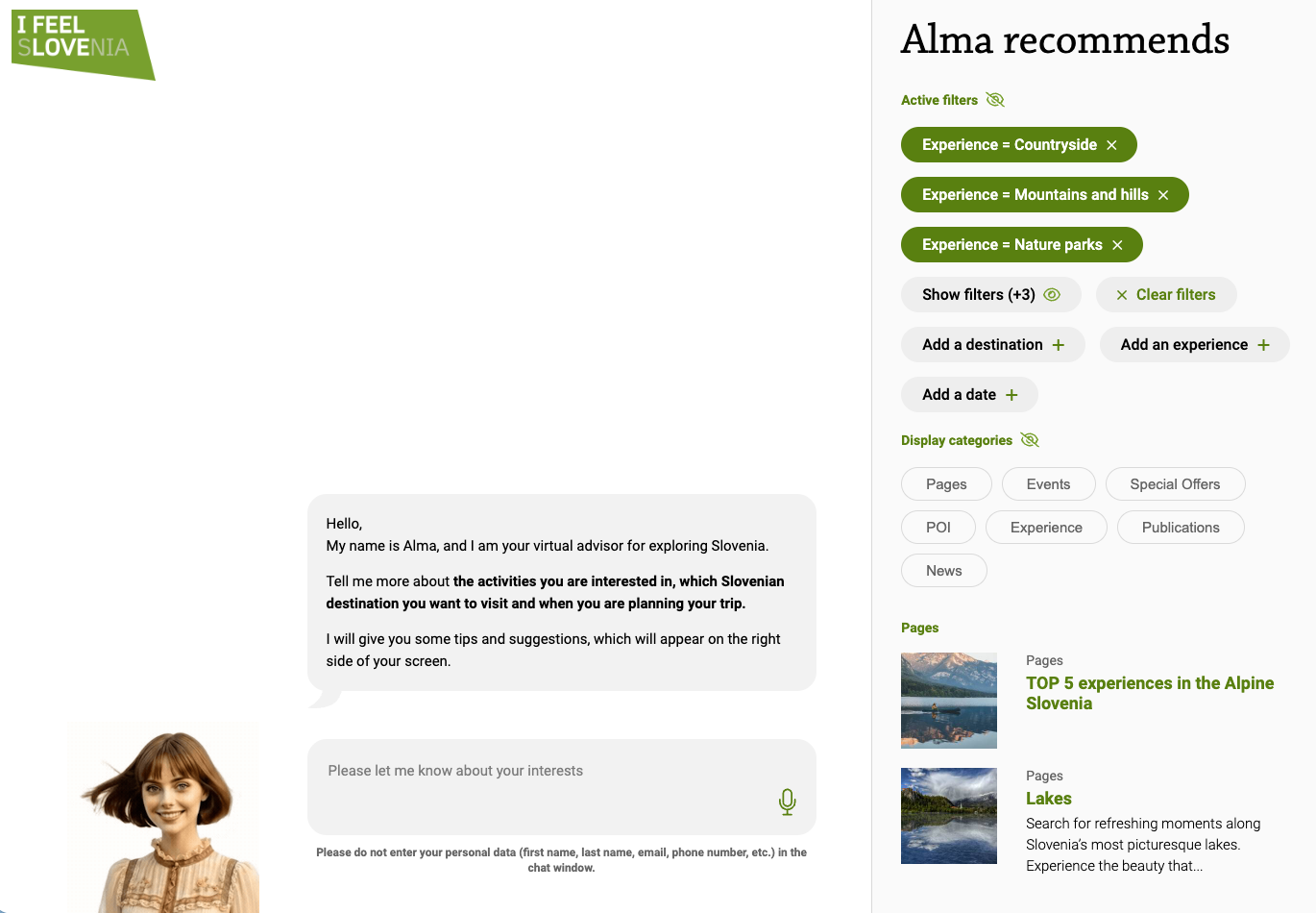
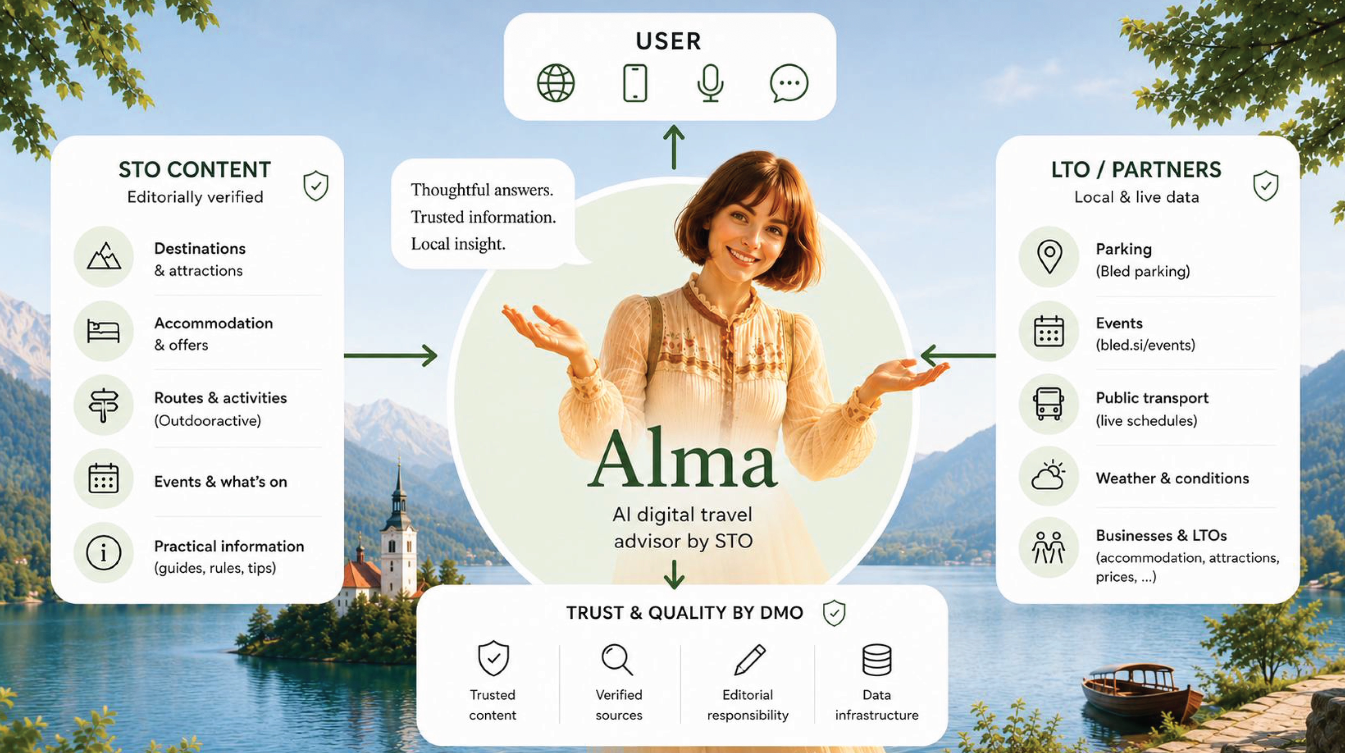
Aleksandra Jerebic Topolovec from the Slovenian Tourist Board (STB) shared the journey behind Alma, the DMO's conversational AI that was launched in 2024. Alma asks visitors about their preferred activity, time and location when offering recommendations, giving enough context to produce structured itineraries. The starting point was a small team and a clear motivation to provide visitors with useful, structured information through a tool that felt naturally engaging, while resisting the wave of agency pitches selling pre-packaged solutions. Aleksandra and her colleagues took the view that the role of a DMO sits exactly where trusted information needs to be held, which made an in-house pilot the right development pathway.
Over two years, Alma has undergone several upgrades shaped by what visitors asked. Integrations with Google Maps and Outdooractive address two of the most common visitor questions, on routing and curated hiking and cycling trails. The Outdooractive integration filters out user-uploaded content and includes only trails curated by Slovenian destinations, which protects Alma from recommending unsubstantiated material. However, this integration initially encountered challenges because the content sat outside STB's own content management system. When Alma was asked about routes in the Julian Alps, she returned information from Austrian and Italian trails alongside Slovenian ones, because the white-label solution wasn't separating content by destination. The fix required a direct API with the curated Slovenian content, which restored editorial control.
Voice input functionality was also added because most visitors access Alma on their mobile phones, where typing can be a barrier for some people. When adding capability, measurement of new features needs to be added as an embedded part of the process. This emerged as a clear oversight in STB's approach, with the lack of data currently being addressed through the addition of new metrics.
Yet, while granular data on individual features is unavailable, satisfaction with Alma's answers has moved from 82% positive ratings in 2025 to nearly 92% in the first half of 2026. Alma has also become a vital feedback loop into STB's content strategy. Year-on-year comparison across the first five months of 2025 and 2026 has begun to show how visitor interests are changing. Any negative ratings are analysed to identify content gaps, with monthly reporting bringing these findings to the editorial, social media and PR teams.
This improved satisfaction comes from grounding Alma's answers in trusted sources, with Alma also indexing the websites of regional Slovenian destinations. Where previously only content in English was being analysed due to cost considerations, now content in Slovenian is also being read by Alma. The Slovenian content carries 60% more information than the English equivalent, so indexing it improves the quality of Alma's responses. For destinations whose websites cannot be indexed cleanly, for example, because they lack a sitemap or block AI crawlers, a separate tool is being built to let those destinations upload structured information directly.
Accessibility upgrades to the wider STB website have also contributed to a 9% annual increase in organic visitors, at a time when many destinations are seeing declines. The connection between accessibility, content quality and discoverability means that the same content updates that improve a website also make it more readable by both visitors and AI systems.
Legal Frameworks For Responsible Deployment
Working with conversational AI brings obligations that sit alongside technological development. The EU AI Act and the European Accessibility Act both shape what destinations can offer through an AI interface, particularly when personal data enters the picture. STB paused planned features, such as the option for users to email itineraries to themselves, while the legal and privacy requirements were worked through. As a result of this process, additional sections were published in the DMO's legal and privacy notices on its website and Alma has been registered on the Slovenian register of public AI systems.
Aleksandra reflected on how the internal legal team supported the process without taking the lead. Detailed answers had to come from the team building Alma, since they held the operational knowledge that legal advisors needed before they could form a view. The practical lesson that emerged from the discussion is the need to independently invest time in understanding which requirements apply and bringing these insights to the conversation with legal departments.
Looking forward, Alma's development roadmap will see the AI assistant added to other Slovenian destination websites, where interest from regional DMOs has been strong. However, the legal framework still needs to be defined. Each destination will need to publish appropriate legal disclaimers and notices, while the integration model will need to differ from the main deployment on STB's website. The current thinking is to provide an embed code, keeping the core data stored on STB's servers, while giving each partner access to relevant editorial content about their destination.
Curation as the Emerging DMO Role
Mark Merrywest from Selfe complemented the discussion by sharing insights from the company's recent green paper on why content curation is becoming important again. Selfe began as an app in 2023 that let travellers share content from social platforms to build trips. The user journey did not work as intended because matching images to inventory is incredibly difficult. However, this learning surfaced that travellers were building data profiles of themselves, but destinations had no equivalent profile that AI could read.
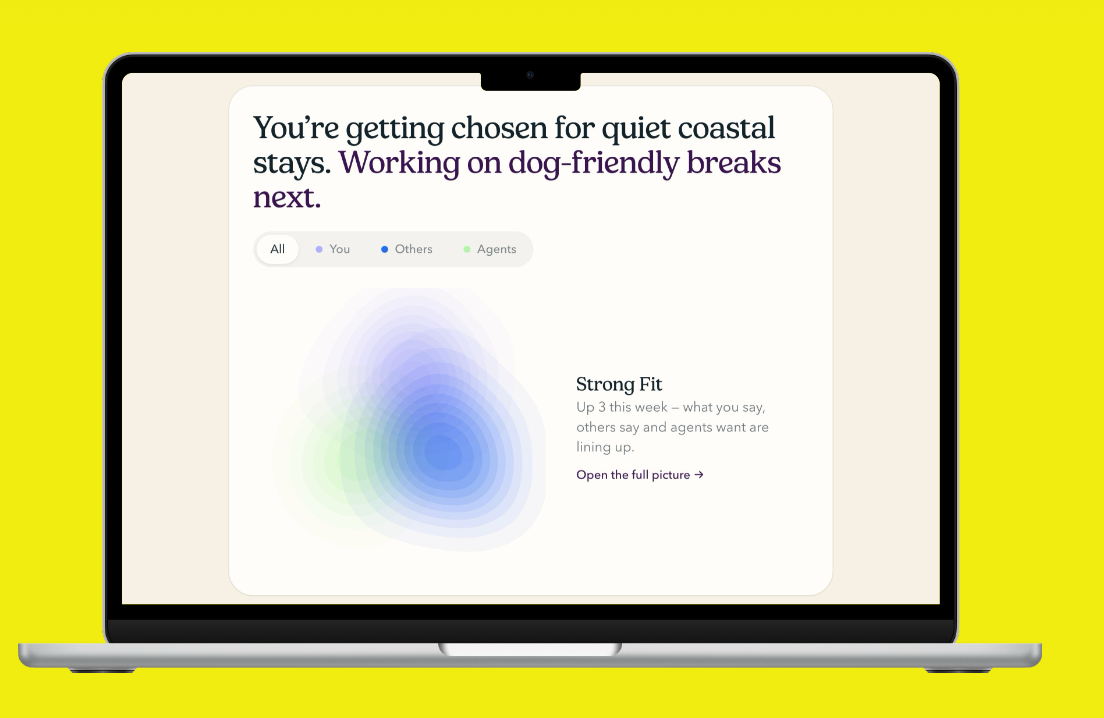
This is where the shift to agentic discovery comes in. Google has launched Personal Intelligence and Gemini Spark, both of which let users set tasks for an agent to carry out without opening a browser. The agent searches the internet, finds an answer and acts on the user's behalf. For destinations, the implication is that future visitors may not visit a website before deciding where to go. Their agent will read whatever it can find and assemble an answer. If a destination's content is not machine-readable, it sits outside that conversation.
To make considered recommendations, AI needs to know the destination at a granular level, with information structured so an agent can easily read and summarise it. Yet, AI also needs to weigh that information against what other sources are saying, which is where DMOs play a strong authoritative role. A DMO can confirm what is true because it has public accountability and local relationships. Agents that read that confirmation can then weight their recommendations accordingly.
Selfe's approach treats a destination as a set of stories. No agent needs another listing of a hotel or attraction, since they already appear across multiple booking platforms with broadly the same information. What is missing is the texture of a place, with three formats carrying the human content that distinguishes one destination from another:
Makers: The human centre of a story.
Moments: Real actions that get captured and shared, becoming intertwined with a destination's character.
Establishing trust becomes a central component of placemaking. The credential layer Mark describes lets a venue make a claim, with a DMO or third-party certification body confirming what they can. This means an agent can tell the difference between something said independently and something that has been verified.
The commercial justification follows the visibility case. A DMO that holds the matching layer above the booking transaction can see which stories attract which travellers, which businesses are being discovered and where alignment across the destination has drifted from the truth of a place.
The central pillar of this strategy is the realisation that a destination is exposed to many voices at once, with truth sitting in the convergence of those voices. The role of holding that convergence is what gives AI something it can safely repeat.
Key Takeaways
Ground answers in trusted content: Conversational AI is only as good as the content it can read. A destination that structures and indexes its own content for retrieval will produce answers visitors can rely on. Interfaces also provide regular feedback for content strategy based on what visitors are searching for. Indexing settings, language coverage and integrations with curated third-party data all shape the quality of the experience, and each of them is an editorial decision before it is a technical one.
Build measurement alongside features: Every new capability creates a new question about how it is being used and whether it is delivering value. Setting up that measurement at the point of development is much simpler than retrofitting it later. Without measurement, decisions about what to invest in next rely on instinct and anecdote, which loses credibility as the system grows.
Legal considerations shape development: The teams closest to interface design and development hold the operational knowledge that legal advisors need to form a view on compliance with regulation. This means that the practical work of understanding which requirements apply belongs equally to the people doing the development work and a destination's legal team.
Curation has become a core role: AI agents working on a visitor's behalf weigh what they read against what other sources say. Curating this layer of corroborated content is where a DMO's role sits. Destinations whose stories are told from several angles give AI systems the convergence they need to cite a place with confidence.
Own content and systems: Content that lives only on an external platform cannot be edited or retrieved on a destination's own terms. When the integration breaks, the content sits beyond reach. Building API integrations to a destination's own system gives the DMO a working position that survives changes in the wider technology stack.
Created for destinations around the world, this programme will provide the insight to help you become a sustainability leader within your organisation.
Designed to teach you how to master must-have tools and acquire essential skills to succeed in managing your destination or organisation, be ready to challenge all of your assumptions.
Designed to teach you how to master must-have tools and acquire essential skills to succeed in managing your destination or organisation, be ready to challenge all of your assumptions.