Strong SEO performance no longer translates into presence in AI answers, which means that destination content strategies need to evolve.
For the last 25 years, destination marketing has been organised around Google. The work for your website to be found, ranked and visited was clear, even if it was demanding. Now, AI Overviews and LLMs have added new variables into the destination discovery process. At X. Design Week 2026, three connected sessions explored what has shifted as AI-driven search reshapes how people discover destinations.
State of AI Search
Two years ago, the pages ranking well on Google were largely the same pages cited in AI overviews, with around 70% overlap between top search results and AI sources. That overlap has collapsed to below 20%. Strong SEO performance no longer translates into presence in AI answers, which means destinations that invested heavily in search optimisation are finding themselves absent from where travellers now look first.
Continue reading...
Get access to 100s of case studies, workshop templates, industry leading events and more.
For the last 25 years, destination marketing has been organised around Google. The work for your website to be found, ranked and visited was clear, even if it was demanding. Now, AI Overviews and LLMs have added new variables into the destination discovery process. At X. Design Week 2026, three connected sessions explored what has shifted as AI-driven search reshapes how people discover destinations.
State of AI Search
Two years ago, the pages ranking well on Google were largely the same pages cited in AI overviews, with around 70% overlap between top search results and AI sources. That overlap has collapsed to below 20%. Strong SEO performance no longer translates into presence in AI answers, which means destinations that invested heavily in search optimisation are finding themselves absent from where travellers now look first.
Continue reading...
Get access to 100s of case studies, workshop templates, industry leading events and more.
For the last 25 years, destination marketing has been organised around Google. The work for your website to be found, ranked and visited was clear, even if it was demanding. Now, AI Overviews and LLMs have added new variables into the destination discovery process. At X. Design Week 2026, three connected sessions explored what has shifted as AI-driven search reshapes how people discover destinations.
State of AI Search
Two years ago, the pages ranking well on Google were largely the same pages cited in AI overviews, with around 70% overlap between top search results and AI sources. That overlap has collapsed to below 20%. Strong SEO performance no longer translates into presence in AI answers, which means destinations that invested heavily in search optimisation are finding themselves absent from where travellers now look first.
Research from the University of Toronto in 2025 shows that 94% of AI citations come from earned media, with brand-owned content only accounting for 6%. AI systems look for authority and corroboration, which is something a destination cannot supply about itself by writing on its own website. Toby Morris from Tiki extended this picture by highlighting the impact on website traffic, citing DTTT research showing that AI overviews have contributed to one in three destinations reporting a 30% decrease in traffic since AI overviews appeared. This decline is a result of the overview having already answered the question.
Toby framed the scale of the change by quoting Matthew Prince from Cloudflare, noting that over the last decade, it has gotten 10 times harder to get traffic from Google. Yet, getting traffic from OpenAI is around 750 times more difficult than it was from Google a decade ago. The marker of success that destinations have used for two decades, organic search traffic, no longer reflects whether they are being seen.
Layers of Visibility
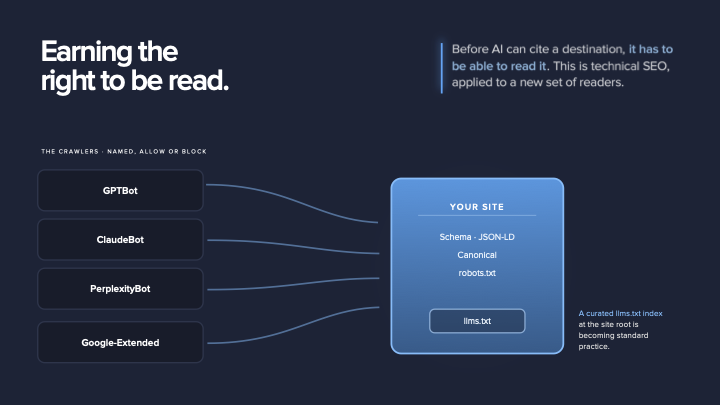
The foundation for visibility is technical. Schema markup, structured content and machine-readable information allow models to extract answers from a page. They enable a destination to be seen and act as a gateway to citation.
The narrative layer is where strategic work sits, and this is a core strength of many destination teams. While this experience has been built up over years, AI discoverability opens up two clear choices for DMOs to decide the direction of their content approach:
The reactive route is to map the highest-volume queries in AI tools and write authoritative content against them, accepting that the destination will be one voice among many.
The proactive route is to shape a smaller set of themes that the destination wants to be known for, building depth around them. This protects the destination's voice but takes longer to influence the narrative.
However, following the proactive route cannot be done in isolation. A documented narrative on its own is self-assertion. Industry, media and partners also need to communicate the same message to corroborate the narrative, which is what AI models look for. The implication of following this strategy is that content creation and experience development must be interconnected.
This re-centres consumer research as a strategic input. Understanding what specific audiences are interested in gives destinations the basis on which to develop product, build content and align partners around the same themes. Destinations that can do this are well-positioned to influence what AI says about them, but those that cannot will inherit whatever opinion LLMs already hold.
Measurement and Attribution
The metrics that have defined destination marketing performance for two decades (clicks, sessions, keyword rankings) are becoming weaker indicators of success. Most AI search is zero-click, so click-based analytics undercount presence. Destinations that want a clear picture of their visibility need different measures and they need to manage leadership expectations about what those measures will look like.
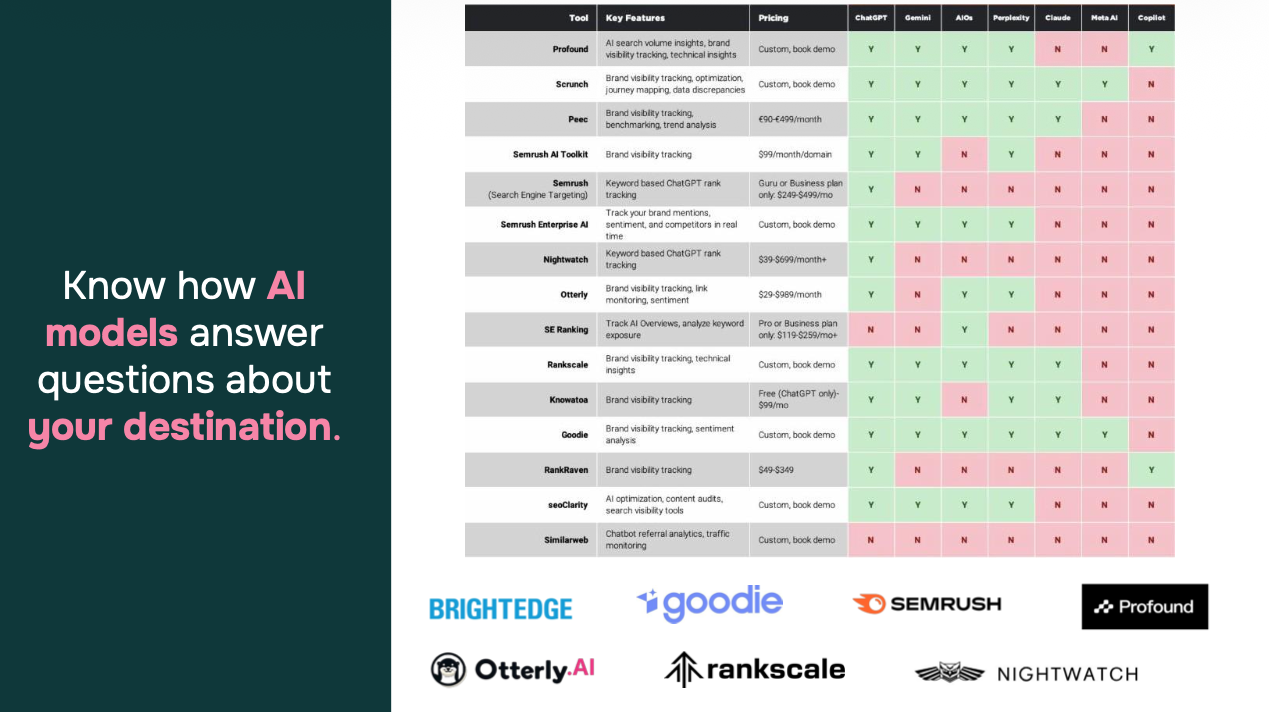
AI-referred traffic, while currently smaller in volume than organic search, tends to be much higher quality. Yet as an emerging metric, for many DMOs, measuring this traffic often remains buried in analytics platforms. Toby outlined a working set of indicators that destinations can use to begin tracking influence and visibility:
AI answer share captures how often a destination is referenced in AI answers for category prompts.
AI citation and attribution frequency evaluates how often destination content is cited, linked or paraphrased by LLMs and AI assistants.
Narrative alignment measures how closely AI descriptions match a destination's intended positioning.
Prompt coverage monitors destination presence in AI responses across the different stages of the visitor journey.
Zero-click influence assesses the impact of AI responses in shaping consideration.
A second category of indicators sits around trust and demand creation, revealing how travellers are engaging before they reach a website:
First-party intent signal growth monitors increases in AI driven signals such as conversational queries, planner interactions, and saved itineraries.
AI trust and authority score evaluates how often the destination is positioned as "best" or "recommended" by AI.
Content extractability rate measures the volume of owned content that is easily summarised and reused by LLMs.
Brand-to-category association strength assesses how strongly the destination is linked to specific experiences in AI outputs.
AI-driven demand lift captures the lift in intent, awareness or downstream visitation attributed to AI exposure.
Tiki's work with amsterdam&partners showed this in practice. In a campaign that ran from November 2025 to March 2026, queries shifted from inspirational ("what is there to do" and "When should I come") to logistical ("how close is this hotel to Dam Square" and "How much is a city card") as the planning window narrowed. Leveraging Tiki's Envoy ad unit, the intelligence value is high because the conversation is happening before the visitor has even reached the destination's own website.
However, it is important to note that attribution remains the most difficult part to solve. The connection between AI exposure, a later site visit and an eventual booking is not yet traceable at the level destinations are used to reporting on. Tools are emerging to close that gap, but they are still in early development. For now, destinations have to accept that some of their influence is happening upstream of where they can measure it, and adjust how they explain performance to senior leadership accordingly.
AI Content as a Visibility Channel
Generative Engine Optimisation (GEO) is one channel, not a complete strategy. The foundational and narrative work earns a destination the right to be cited, but it does not generate attention in itself. Paid media, social and earned content remain important components of marketing strategies, with AI-generated content opening up new routes to visibility that directly create attention.
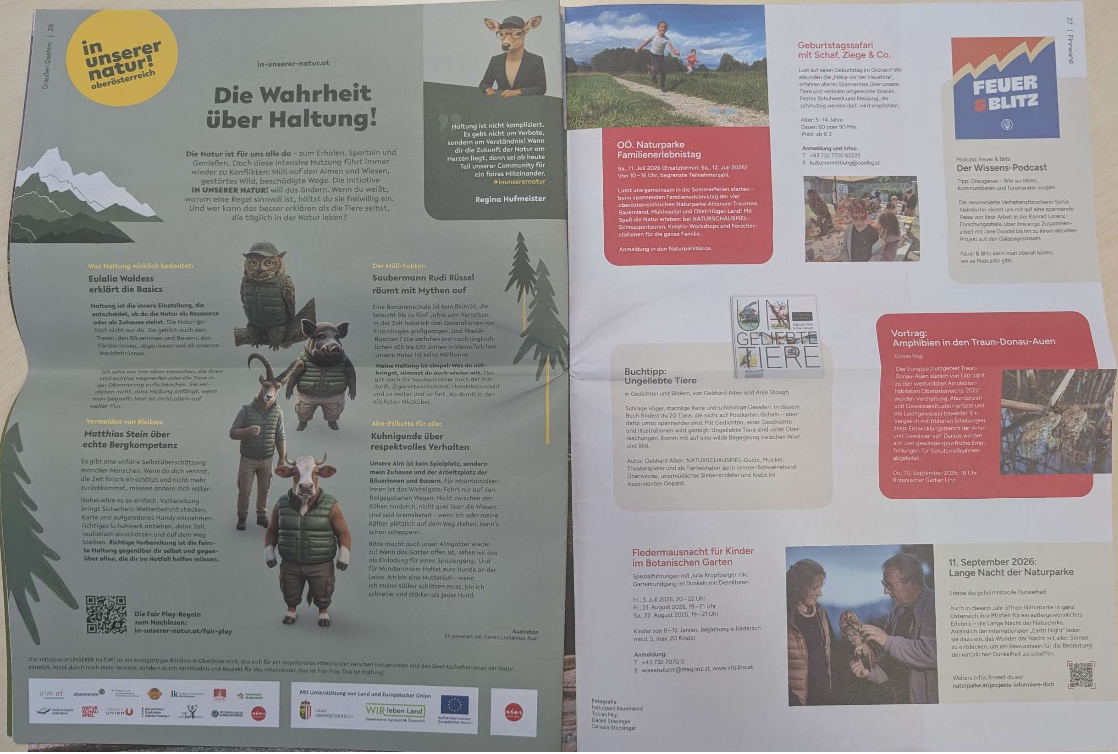
Johannes Auer from Oberösterreich Tourismus showed what this looks like in practice with In Unserer Natur, a campaign built around an AI-generated deer that raises awareness about respectful behaviour in nature. The campaign reached 1.5 million views, becoming the most-liked content the destination had ever published on YouTube. Nevertheless, it is important to recognise that channel match matters as much as the content itself. While the campaign performed strongly on YouTube, TikTok and the destination's own website, the video did not work on Instagram, where creator audiences are currently sceptical of AI content.
The content creation process shows how iteratively this kind of work develops. Early experiments on Veo in April and May 2025 struggled with subtitles, character consistency and the eight-second clip limit. The release of Google Flow into Europe allowed consistent characters to be carried across multiple shots, which a core requirement for building a coherent story. ChatGPT handled the base character images that Veo then animated. Local-accent voiceovers came from in-house staff because AI voices in mid-2025 defaulted to standard German rather than the Upper Austrian accent the campaign needed to reach its local audience. Crucially, storyline development worked alongside the capabilities of the tools, which kept the production grounded in what could be delivered.
Building out from the initial campaign and the follow-up winter campaign, the characters were featured in the DMO's print magazine, expanding the storytelling and sustainability awareness into another channel.
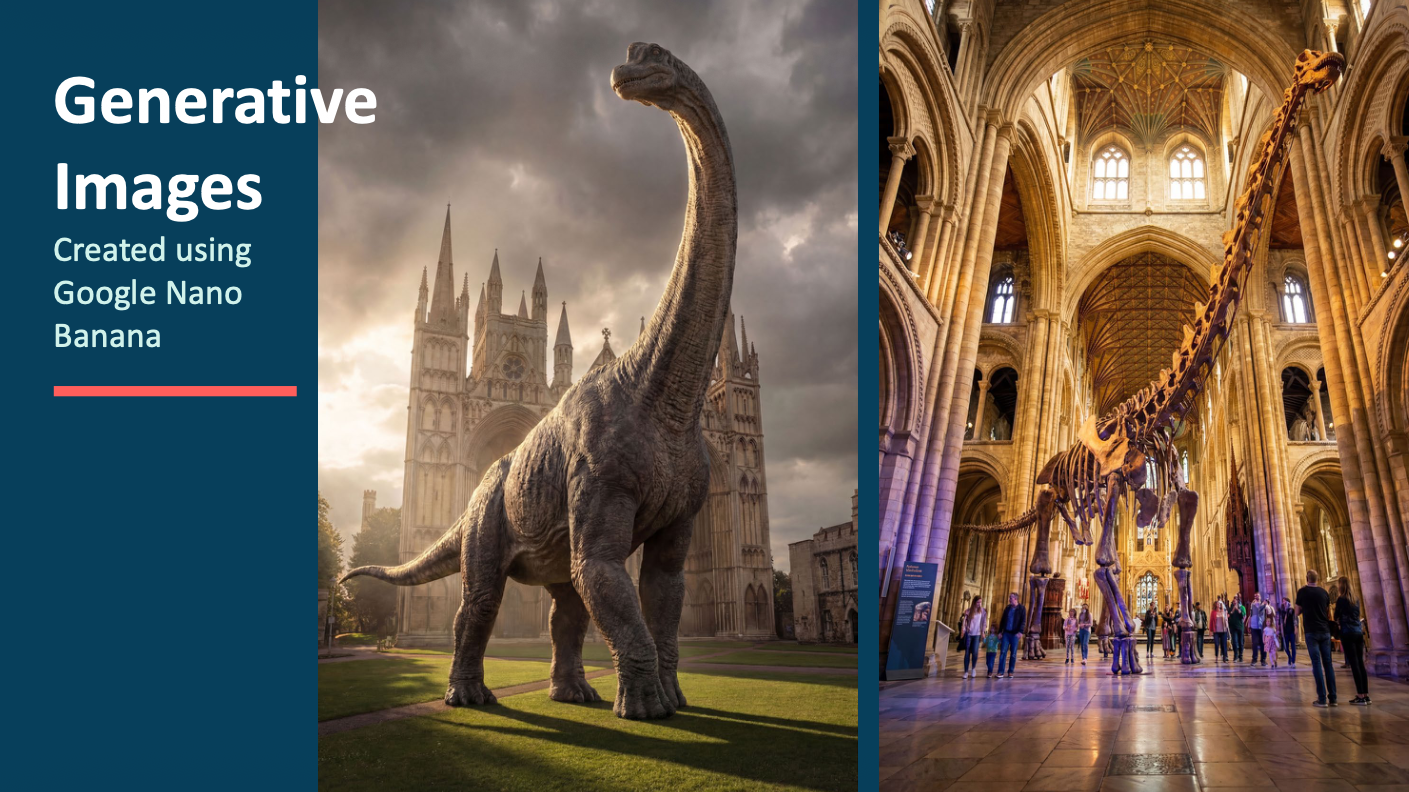
Stewart Howe from Discover Peterborough described a parallel approach with the Dinosaur City campaign, where AI is being used to bring the destination's Jurassic heritage to life. Nano Banana was used to create AI-generated dinosaurs, which were then merged with real photographs of the city using Veo to create a hero video. Palaeontologists from the Natural History Museum reviewed the imagery for anatomical accuracy, resulting in improvements to how the dinosaur's front feet were visualised. This acted as an important moderation process to keep AI-generated content credible.
Suno generated the campaign music, while short social snippets were developed with Kling AI. Alongside AI discoverability, experience development was also considered. Claude was used to design floor decals to place around the fossils located in the city's shopping centre. These link via QR codes to the vibe coded campaign website, featuring detailed educational information about dinosaurs and the related experiences in Peterborough.
Both campaigns show that AI-generated content produces attention at a scale and price point that would have been out of reach eighteen months ago. The speed of advancement in AI video capability over the past year is part of what makes this work interesting. An enhanced level of realism is now available, where in Oberösterreich Tourismus’ latest campaign iteration, the video includes a reflection of the deer in the glass of the display case. For destination teams, the production gap between in-house content creation and a high-end agency output is closing fast.
Key Takeaways
Strong SEO no longer guarantees AI visibility: The overlap between top-ranking search pages and the sources cited in AI answers has fallen significantly. Destinations that invested heavily in search optimisation need to treat AI presence as a separate channel, with its own foundations and techniques to learn.
Earned media has become more important: Most citations in AI answers come from third-party sources, not brand-owned content. Building authority now means getting operators, partners, press and visitor reviews speaking about the same themes in their own voices. This is why DMOs now need to work on strengthening their content ecosystems.
Aligning narrative and product development: A documented narrative is only one voice. Themes that the wider ecosystem can speak to need product and experience development behind them. Gaining a clear reputation among a small number of themes and building depth around them will generate stronger GEO performance than attempting to spread effort broadly across many category prompts.
Measurement has to shift: Zero-click discovery means traditional analytics undercount the impact of a DMO's work. Share of voice, citation sentiment, narrative alignment and AI-referred traffic give a clearer picture of visibility in today's digital landscape. Senior leadership needs to be supported in learning what the new indicators mean and how they should be interpreted.
AI-generated content captures attention: With channel choice, content moderation and brand control in place, AI-generated video and imagery can reach audiences at a scale that smaller destination teams were previously unable to achieve. In doing so, campaign development shifts from production to direction, with marketing teams acting as editors and curators of the output.
Created for destinations around the world, this programme will provide the insight to help you become a sustainability leader within your organisation.
Designed to teach you how to master must-have tools and acquire essential skills to succeed in managing your destination or organisation, be ready to challenge all of your assumptions.
Designed to teach you how to master must-have tools and acquire essential skills to succeed in managing your destination or organisation, be ready to challenge all of your assumptions.