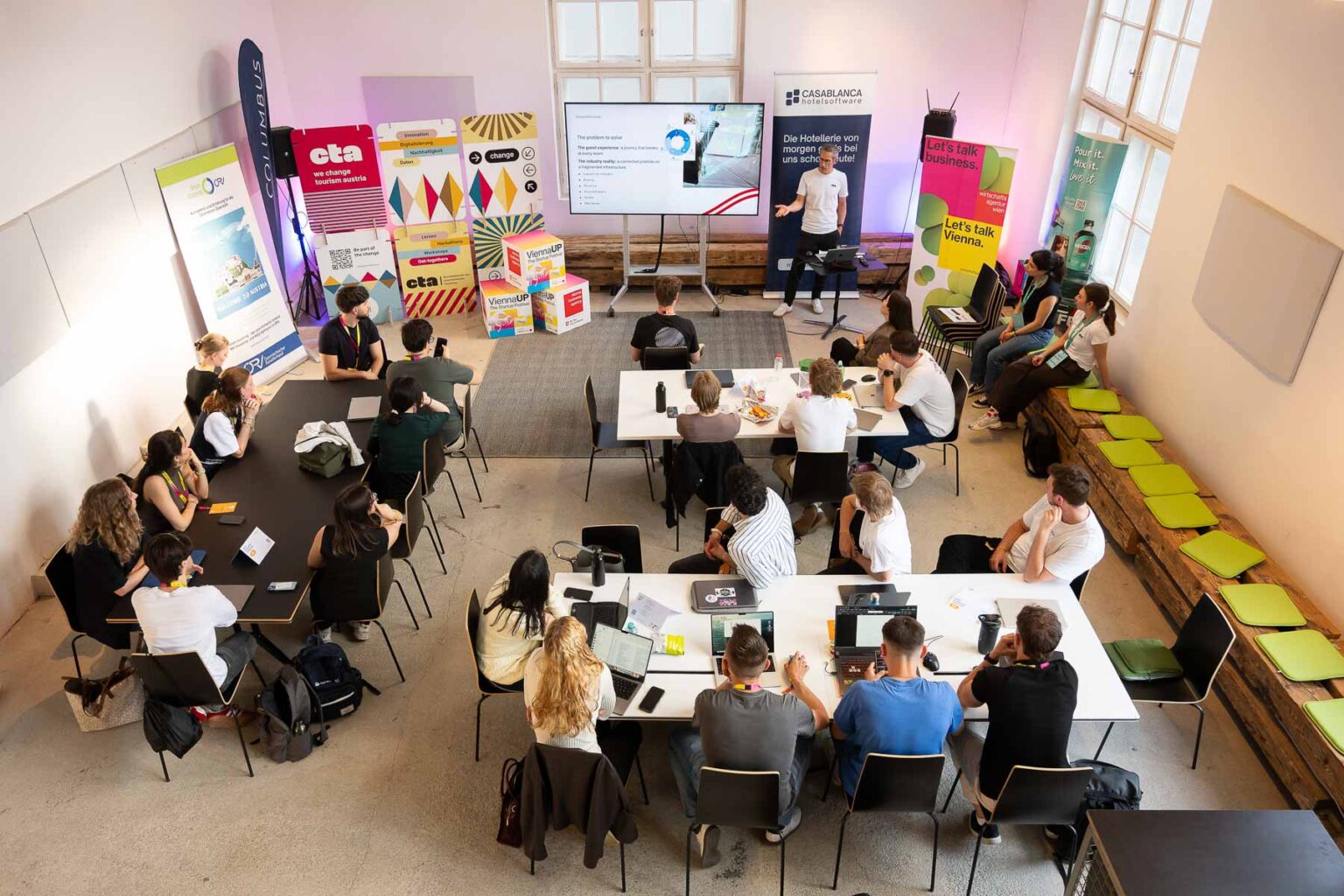
Supporting Industry AI Transformation: Building the Change Tourism Austria Platform
Supported an entire industry through a period of fast change, Change Tourism Austria centres on helping an industry build the confidence to act.
By the time a traveller arrives in Austria, an AI assistant has often already shaped the trip and now sits between a destination and its visitors, whether or not the destination has prepared for it. Teresa Karan, Head of Digital, Innovation and AI at Austria Tourism, used this starting point to explain how the organisation has supported an entire industry through a period of fast change. The work she described centres on helping an industry build the confidence to act, with the technology following from that.
Three Shifts Reshaping Tourism
Teresa framed AI through three shifts that are already underway. Each one changes a different part of how tourism works, and together they explain why a destination cannot treat AI as a side project.
Continue reading...
Get access to 100s of case studies, workshop templates, industry leading events and more.
By the time a traveller arrives in Austria, an AI assistant has often already shaped the trip and now sits between a destination and its visitors, whether or not the destination has prepared for it. Teresa Karan, Head of Digital, Innovation and AI at Austria Tourism, used this starting point to explain how the organisation has supported an entire industry through a period of fast change. The work she described centres on helping an industry build the confidence to act, with the technology following from that.
Three Shifts Reshaping Tourism
Teresa framed AI through three shifts that are already underway. Each one changes a different part of how tourism works, and together they explain why a destination cannot treat AI as a side project.
Continue reading...
Get access to 100s of case studies, workshop templates, industry leading events and more.
By the time a traveller arrives in Austria, an AI assistant has often already shaped the trip and now sits between a destination and its visitors, whether or not the destination has prepared for it. Teresa Karan, Head of Digital, Innovation and AI at Austria Tourism, used this starting point to explain how the organisation has supported an entire industry through a period of fast change. The work she described centres on helping an industry build the confidence to act, with the technology following from that.
Three Shifts Reshaping Tourism
Teresa framed AI through three shifts that are already underway. Each one changes a different part of how tourism works, and together they explain why a destination cannot treat AI as a side project.
The first shift sits with the guest. AI is already planning and booking through conversations, where a list of search results once did the work. Phocuswright found that 40% of US travellers used AI for at least one trip in 2025, up eleven percentage points year-on-year. When an assistant plans a journey, it draws on information it can read and trust. High-quality machine-readable data becomes the condition for staying visible and bookable in a world where an AI agent often influences choice.
The second shift sits with workflows. Automation handles the repetitive parts of a job and frees people for the parts that need judgement. Teresa described this as freeing capable people from processes to help them make space for what is relevant. AI causes fear when people assume it replaces them, so the framing matters. Woven into daily workflows, AI offers relief in an industry short on talent and heavy on complexity. It makes room for new work without removing the people who do it.
The third shift sits with skills. Teresa pointed to the barrier that holds most organisations back. UN Tourism reported in 2025 that 68.8% of national tourism organisations name missing skills as their top barrier to AI. Tools are available to almost everyone. Know-how and enablement are the bottleneck. This finding shaped everything that followed because it highlighted that the problem to solve was capability across an industry.
Building a Strategy
Austria Tourism organised its response around three areas:
Guest experience: This depends on data an assistant can read, so the work begins with clean structured information that keeps the destination relevant to a guest at the right moment.
Process: This depends on automation that removes drudgery and returns time to staff, which steadies the people who fear AI by showing them what it lifts from their workload.
People: This depends on access and agency, which means making AI available across the industry and raising each person's capacity to act on it.
The three shifts add up to a call to act, which rests on working together. None of the three areas can be solved by a single organisation alone. A destination can publish its own data and automate its own processes, but an industry only becomes AI-ready when thousands of operators, regions and small teams move at once. That recognition led Austria Tourism to build Change Tourism Austria, a community-first platform for Austrian tourism.
The Change Tourism Austria Platform
Change Tourism Austria began with a small group of followers and grew over three years into a community of 2,500 members. With early participants giving others the confidence to join, it now runs as the place where the Austrian industry learns about AI together. In leveraging the first-follower principle, the platform has gradually scaled and grown, adding a range of content formats to support its user base. This is an important consideration because people learn in different ways, so a single educational resource will always leave someone behind.
Knowledge in AI also dates quickly, so consistent and regular sharing matters more than any singular event. This insight influenced the engagement strategy, which focuses on inspiration, use cases and collaboration. Blending a digital platform and physical networking to drive AI literacy forward at scale means the platform keeps a timely, relevant feed of what currently matters, sparking conversations that continue in person. This dual approach is a core part of the platform's success, with the following outputs being delivered:
AI Radar is a monthly 30-minute briefing call that covers what is new in AI for tourism.
Blog posts tackle the topics the community is wrestling with at any moment, from agents to automation.
Hackathons pair motivated student teams with practitioners, placing industry challenges as a focal point for ideation. Industry partners set the challenges and write the problem statements with care and remain present through the event, which keeps the work accountable. For example, during InnoDays #ConnectedJourney in May 2026, 130 students, supported by 40 mentors, produced 24 prototypes against five challenges built around the themes of inclusive arrival, mobility, sustainable stays, connected regions and open ecosystems. Crucially, AI has shortened the path to a working prototype, with teams using vibe coding to demonstrate an idea quickly and improve it through testing. Hackathons once belonged to coders, but now they bring together mixed perspectives, which is what produces useful results.
AI Challenges are being curated, with the platform currently holding a library of 35 use cases, with each one being specific, actionable and playful.
"Stammtisch-Style" [table for regulars], where the same people gather for honest conversations about what they are working on. These mini communities carry much of the platform's weight. People experiment with AI more readily when they trust the people around them. A member who fears being automated out of a job will not share an honest account of what they are trying, so Austria Tourism treats psychological safety as a condition for taking part. Underneath the format sits the simple principle that everyone is learning every day. This is what steadily lifts AI literacy across the community, because nobody is expected to have all the answers and everybody shares what they are finding.
Results, Measurement and Lessons
Through creating a shared habit of experimenting in the open, the clearest results are seen in how AI knowledge continually develops and spreads through the community. Sharing between Austria Tourism and other DMOs has become streamlined, with a sharing mindset that pulls everyone along together.
Austria Tourism measures the community impact against signals that matter most in the context of knowledge sharing. It works with objectives and key results (OKRs) tied to indicators inside Google Analytics, such as the number of stories shared by the community and which topics resonate most. These signals show whether members are taking part, with engagement becoming a core indicator alongside monitoring the growth of the community. This focus on quality signals is essential because lots of information about AI is shared online, which is often overwhelming. This is precisely why a dedicated platform for a country's industry makes sense to help support industry development.
What the Future Looks Like
Adoption inside Austria Tourism itself follows the same pattern as adoption across the industry, needing both a bottom-up push and a top-down ambition. It is eye-opening to see what AI can do once you work with it directly, which carries more weight than telling. As people adopt AI once they feel what it can do for themselves, the conversation needs a personal tone, where people can relax, listen and try things. With agentic AI becoming more capable, AI is starting to act more autonomously, a direction Austria Tourism is watching closely.
The vision Teresa set out holds AI to three conditions. It delivers its greatest value when it is anchored in strategy, kept human-centred and shaped together as a community. Austria Tourism is treating that preparation as shared work, carried out in the open with the people who will live with the results.
Key Takeaways
Capability is the constraint: AI tools are within reach of almost everyone. What holds organisations back is the skill to use them well, so the work a destination needs to focus on is building that capability at scale across their industry.
Clean data keeps you visible: As assistants plan and book through conversation, machine-readable information about your experiences decides whether you stay in the recommendation or drop from view. Structured, consistent and current data is essential and this foundational work pays off before larger-scale initiatives can add additional value.
Frame automation as employee relief: AI causes fear when people assume it removes them from the process and will make them obsolete. This stalls adoption before it starts. Instead, AI strategies need to be presented as a way to free capable people from low-value processes and highlight how it empowers people. This reframes the discussion away from technological capabilities to the real impact it has on organisations.
Community creates momentum: A platform that gives members formats to learn, build and meet helps an industry move together. This requires a mix of formats because people learn in different ways. Meeting face-to-face has the biggest impact on sparking inspiration, with routine engagement important for keeping discussions flowing between events. Small accountable groups also build trust faster than large open forums, where few will risk looking unsure in front of a crowd.
Measure participation: Objectives and key results tied to analytics signals show whether a community is taking part. These signals show where attention sits, so you can steer formats and content towards what the community cares about.
Created for destinations around the world, this programme will provide the insight to help you become a sustainability leader within your organisation.
Designed to teach you how to master must-have tools and acquire essential skills to succeed in managing your destination or organisation, be ready to challenge all of your assumptions.
Designed to teach you how to master must-have tools and acquire essential skills to succeed in managing your destination or organisation, be ready to challenge all of your assumptions.