The pace of AI adoption has dominated boardroom conversations across the tourism sector for two years.
The pace of AI adoption has dominated boardroom conversations across the tourism sector for two years. At X. Design Week 2026, this discussion was reframed to focus on the precursors that enable long-term AI integration to thrive. What followed across three connected sessions was a working picture of what readiness looks like for DMOs, focusing on the need for shared systems for AI to build from, communities to enable collective progress and how AI champions drive transformation forward.
State of Adoption
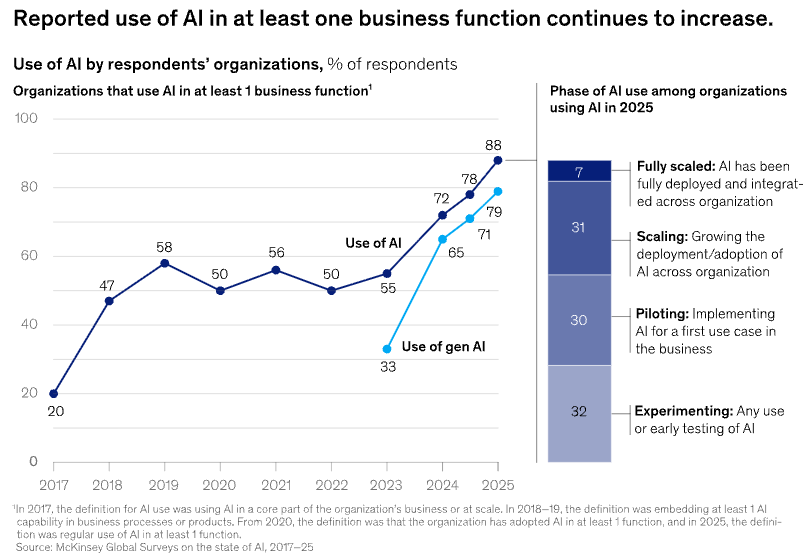
The statistics that opened the discussion show just how far we have already come with AI adoption, but also how much further we need to go to truly derive AI-driven advantages. McKinsey's 2025 State of AI research found that 88% of people are using AI day-to-day, while only 21% have rebuilt a workflow around it. This perfectly demonstrates why speed of implementation is the wrong metric to prioritise, because while adoption is everywhere, effective integration is extremely rare. MIT's NANDA report reiterates this perspective by highlighting how 95% of enterprise generative AI pilots produced no measurable return for businesses.
Continue reading...
Get access to 100s of case studies, workshop templates, industry leading events and more.
The pace of AI adoption has dominated boardroom conversations across the tourism sector for two years. At X. Design Week 2026, this discussion was reframed to focus on the precursors that enable long-term AI integration to thrive. What followed across three connected sessions was a working picture of what readiness looks like for DMOs, focusing on the need for shared systems for AI to build from, communities to enable collective progress and how AI champions drive transformation forward.
State of Adoption
The statistics that opened the discussion show just how far we have already come with AI adoption, but also how much further we need to go to truly derive AI-driven advantages. McKinsey's 2025 State of AI research found that 88% of people are using AI day-to-day, while only 21% have rebuilt a workflow around it. This perfectly demonstrates why speed of implementation is the wrong metric to prioritise, because while adoption is everywhere, effective integration is extremely rare. MIT's NANDA report reiterates this perspective by highlighting how 95% of enterprise generative AI pilots produced no measurable return for businesses.
Continue reading...
Get access to 100s of case studies, workshop templates, industry leading events and more.
The pace of AI adoption has dominated boardroom conversations across the tourism sector for two years. At X. Design Week 2026, this discussion was reframed to focus on the precursors that enable long-term AI integration to thrive. What followed across three connected sessions was a working picture of what readiness looks like for DMOs, focusing on the need for shared systems for AI to build from, communities to enable collective progress and how AI champions drive transformation forward.
State of Adoption
The statistics that opened the discussion show just how far we have already come with AI adoption, but also how much further we need to go to truly derive AI-driven advantages. McKinsey's 2025 State of AI research found that 88% of people are using AI day-to-day, while only 21% have rebuilt a workflow around it. This perfectly demonstrates why speed of implementation is the wrong metric to prioritise, because while adoption is everywhere, effective integration is extremely rare. MIT's NANDA report reiterates this perspective by highlighting how 95% of enterprise generative AI pilots produced no measurable return for businesses.
Efficiency gains do not sit at the task level. When AI is layered on top of processes that were designed for a pre-AI world, the gains are marginal. These gaps keep widening as technological capability advances. That makes AI readiness an organisational question rather than an individual or departmental one. The work to do is AI-first digital transformation, where strategy, workflows, teams and data are redesigned around what AI now makes possible.
Systems That AI Can Build From
Trends rise, peak and return to where they began. Structural shifts hold, with each step becoming the new floor. AI belongs to the second category. Organisations that are layering AI on top of yesterday's processes are responding to a trend. Organisations that are rebuilding strategy, workflows, teams and data around AI are responding to a structural shift. Three shifts matter most when it comes to the structural conditions that determine whether AI delivers value.
The first is the move from individual to team AI. When people work with AI in private, each conversation reflects personal preferences, vocabulary and context. Output diverges across the team even when the prompt is similar, causing brand voice to drift. A shared base of taxonomies, documented workflows and brand knowledge gives AI common ground to work from, so the output stays aligned regardless of who initiated the request.
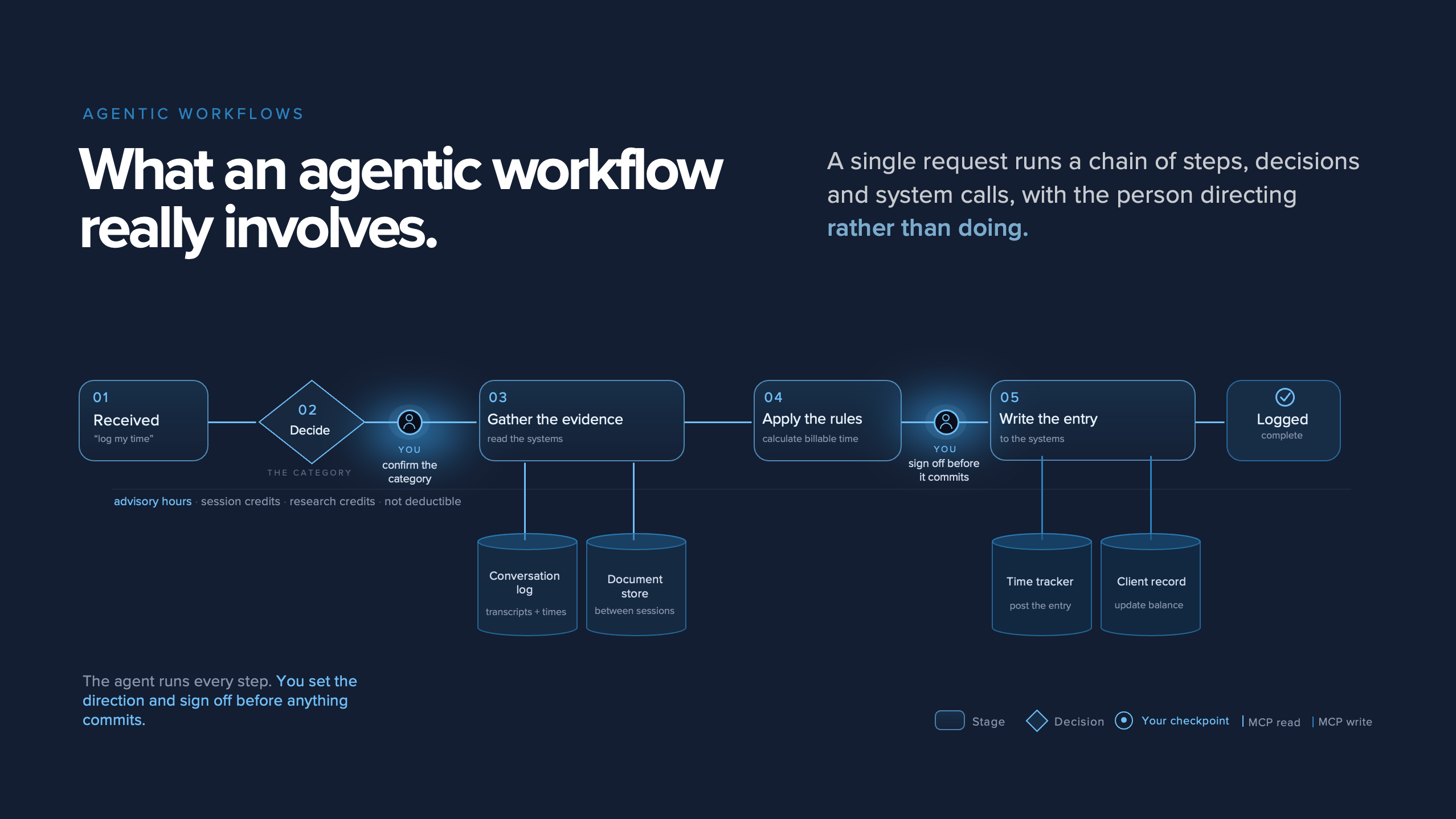
The second shift is the move from answers to autonomy. Most teams today use AI for obtaining answers, where AI responds and a person decides what to do next. The next stage is decisions, where AI proposes the next step and a person approves it. The stage beyond that is autonomy, where AI acts within bounds that a person has set. This is where an agentic workflow, if designed with sufficient guardrails, can drive immeasurable benefits. An agentic workflow runs a chain of steps, decisions and system calls in response to a single request. A person directs the work rather than doing it, with checkpoints to confirm and sign off decisions before anything is committed to a system of record.
The third shift is the rise of context as infrastructure. Without grounded context, AI reaches past what it knows and produces hallucinations or generic output. With brand knowledge, approved sources, workflow rules and tone of voice held in a structured layer behind the AI, the output stays on brand and on topic. Knowledge that used to sit in people's heads or in scattered documents now needs to be retrievable, current and structured for AI to use. The technical barrier to using AI has fallen for most teams, so judgement becomes the scarce skill that separates good output from poor output. This people-first approach to AI is where destinations must focus their attention.
To achieve these structural shifts, a three-step process should be prioritised:
Audit: See where you are across tools, skills and workflows, and where the gaps sit between them.
Adopt: Put AI into everyday workflows with knowledge structured behind it.
Augment: Redesign the work itself around what AI now makes possible.
By late 2025, Claude usage patterns show that the balance has tipped from automation (45%) to augmentation (52%). This reinforces how AI is increasingly being used to improve the capability of people, not to replace tasks.
Communities Driving AI Adoption
Teresa Karan from Austria Tourism extended the conversation by showing what readiness looks like at the level of a national tourism organisation working to support its industry. Process automation frees people from repetitive work, yet knowledge and enablement remain the bottleneck. UN Tourism's 2025 study found that 68.8% of national tourism organisations identify missing skills as their primary barrier to AI.
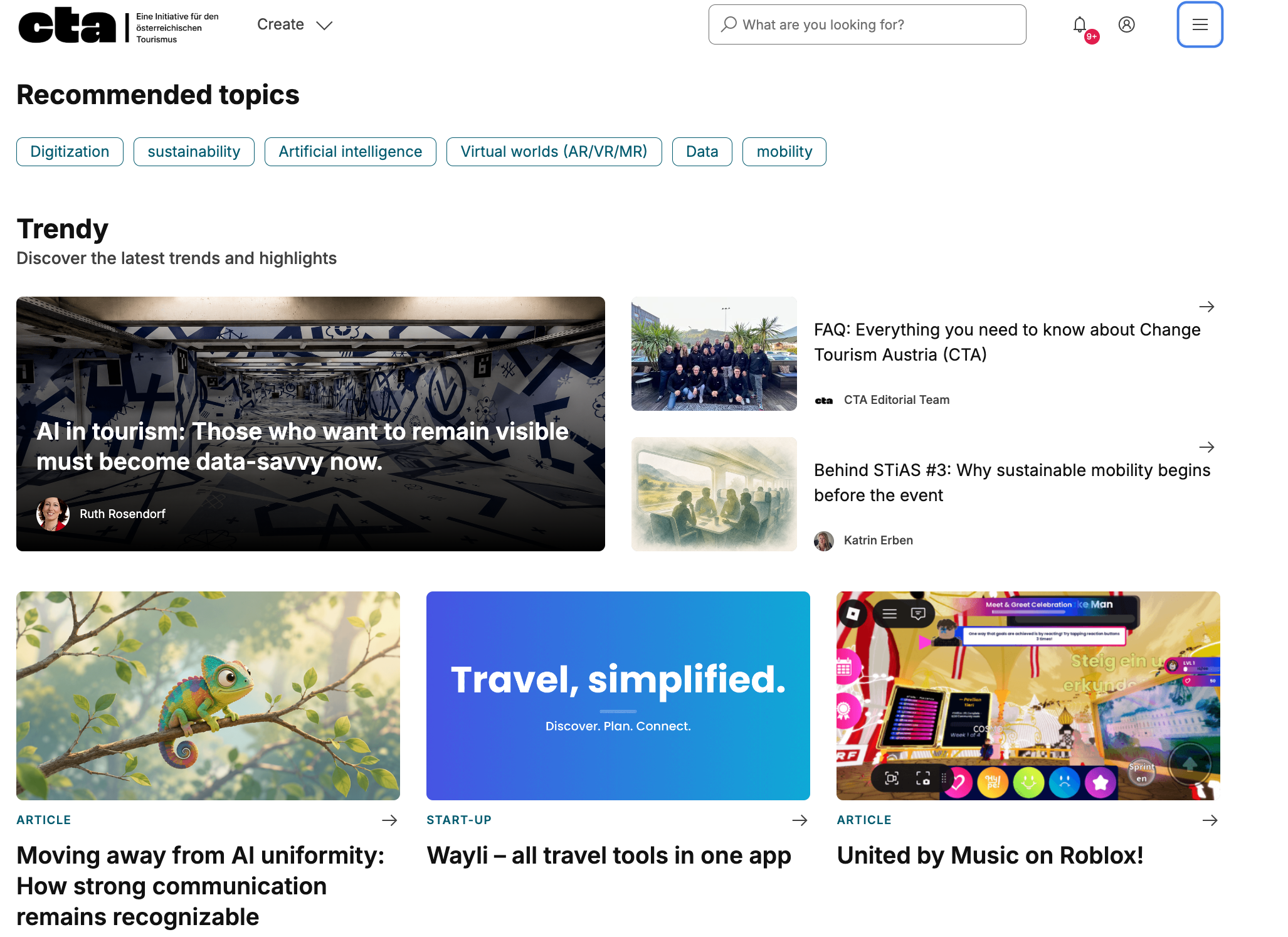
Austria Tourism's response was to develop the Change Tourism Austria (CTA) platform. Community-first by design, the platform is built on the recognition that AI delivers its greatest value when it is strategically anchored, human-centred and shaped together by the people who use it. Over three years, the community has grown to 2,500 members from a starting point of a handful of early adopters.
Inspiration comes through AI Radar, a monthly 30-minute briefing on what is new in AI for tourism, alongside blog posts on the topics the community is wrestling with at any given moment.
Use cases and collaborations include hackathons that pair student teams with industry practitioners on problems that partners have defined. Vibe coding lets teams reach a working prototype much faster than before, so the conversation moves quickly from idea to demonstration, with mixed perspectives mattering more than coding skill, because the tools have lowered the barrier to building.
Small communities that meet regularly, in the style of a regular table at a familiar place. These mini-communities create the conditions for people to feel safe to share what is not working, ask questions and hold each other accountable. The fear of being automated tomorrow is one of the most common barriers to adoption inside organisations, and small groups working through the questions together have proved more effective than corporate training programmes.
AI experiments need relationships behind them and knowledge sharing between DMOs is uplifting. Embedding AI into the DMO itself remains a work in progress, requiring both bottom-up energy from people experimenting and top-down support from leadership who have felt what the tools can do rather than only being told about them.
Champions, Tools and Discipline
The third session brought together Panos Kokkalis from Marketing Greece and Tomas Andersson from Stockholm Business Region, who shared the reality of internal AI transformation. AI is a non-deterministic system, which means readiness involves becoming comfortable with risk-taking. Experimentation to build small things, break them, learn and make bigger things is often the approach that drives the development of new AI-supported tools.
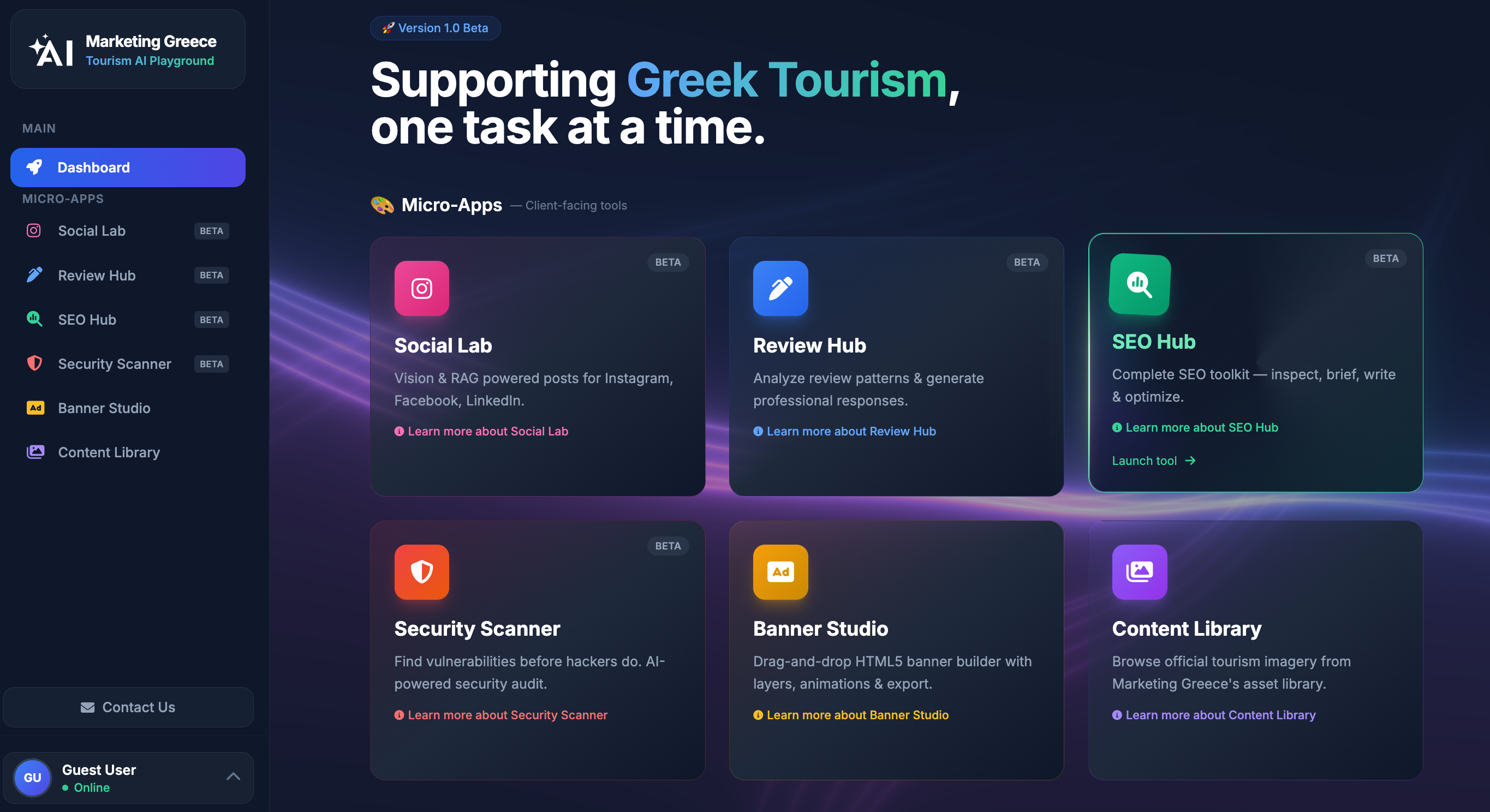
Exemplifying this approach, Marketing Greece built the Tourism AI Playground as an experimental space for practical AI applications that support Greek tourism businesses. The tool clusters micro-apps for client-facing use, with tools that prove their value becoming core products:
Social Lab: Generating image, text or quizzes for social posts
Review Hub: Analysing review patterns and generating professional responses
SEO Hub: Inspecting, briefing and writing optimised content
Security Scanner: Identifying vulnerabilities for an AI-powered security audit
Banner Studio: Generating on-brand campaign banners, hero images and social creatives
Content Library: Browsing official tourism imagery from Marketing Greece's asset library
The technical structure behind the Tourism AI Playground is worth exploring because it addresses the hallucination problem that holds many tourism organisations back from going further with AI. Marketing Greece built two Retrieval-Augmented Generation (RAG) systems, one holding all of Discover Greece's online content and another holding around 500 content briefs developed in-house. Using self-reflection in the RAG process, the system recognises when it lacks knowledge from the trusted sources and, only as a last resort, refers to an external database.
Content creation with AI can be risky, with Marketing Greece developing a briefing guide to help users understand how to use the tool. Importantly, every output should still be treated as a draft, with human review built in. With the initiative primarily focused on hoteliers, Marketing Greece is also working to build a partnership with the Hellenic Chamber of Hotels. This partnership angle brings long-term advantages as it is intended to help prevent the friction that often occurs when destinations launch isolated AI initiatives.
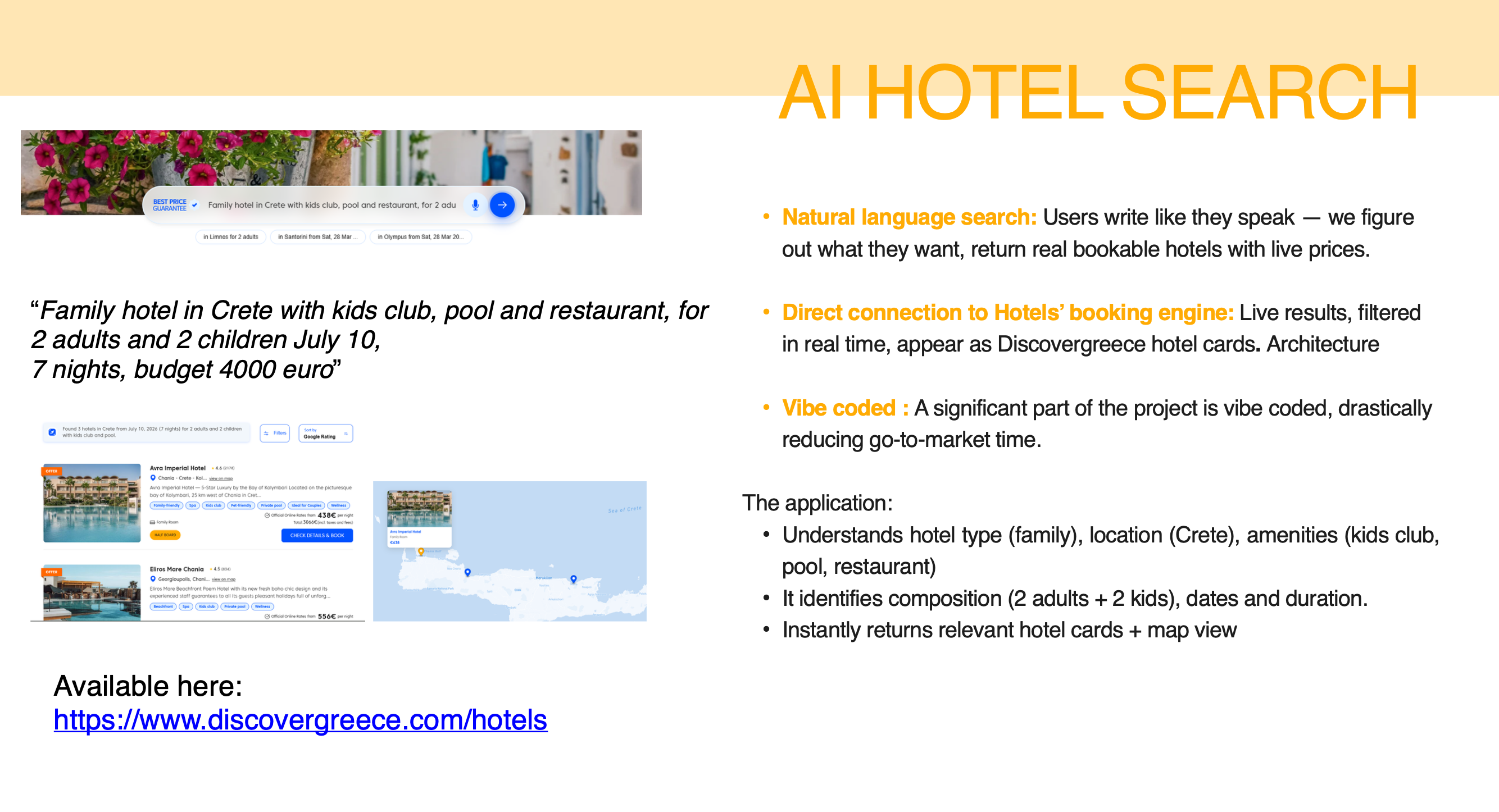
Alongside the Tourism AI Playground, internal operations tools automate content and analytics workflows for Marketing Greece's team. A live AI Hotel Search was also vibe coded on the Discover Greece website, which lets visitors write in natural language and return bookable hotels with live prices, filtered through the hotels' own booking engine.
However, it is important to reflect on the fact that the cost structure of building AI solutions is uneven. The conceptual work behind Marketing Greece's Tourism AI Playground was done in personal time, while securing the legal framework to move forward cost €3,000 - €4,000, which is a meaningful sum for something that is positioned as a free product. These factors mean that the continuous development of AI infrastructure is an iterative process based on feedback loops and a clear vision. This is particularly important given that designing an AI tool requires understanding people's daily tasks to ensure it is suited to their needs. With building personalised apps now achievable, AI literacy has become a competitive advantage for destinations and tourism businesses.
Yet, while AI is a great assistant for supporting problem-solving, Tomas reflected on how there is an undeniable need to balance tactical AI adoption with strategic decisions. Stockholm Business Region moved quickly into AI when an employee with strong personal enthusiasm joined the team. The early momentum was useful, but a conscious decision was taken to shift gears and slow down to ensure integration is done well.
Tomas estimated that around 60% of the organisation is actively favouring AI usage, with another 20-30% watching developments closely. Yet, the management team has historically been the most reluctant. This realisation set in motion a process, co-facilitated by our team of experts at the DTTT, to coalesce the entire DMO around an agreed set of desired outcomes to shape the strategy going forward. This required reflecting on exploring the current situation within the organisation and identifying the implications of the most important strategic considerations to identify the priorities going forward.
Going from divergent individual output to aligned organisational output requires more than enthusiastic individuals. At some point, work will inevitably hit a ceiling that personal energy cannot push past, because the questions become organisational. This is why it is so important to consider what workflows need to be rebuilt to get to the desired endpoint. Champions are essential for getting started, but champions alone cannot answer the strategic questions that senior leadership needs answered before they will commit resources. This is why we can't rush AI implementation and need to take time to slow down and answer the strategic questions properly.
Key Takeaways
Efficiency gains do not sit at a task level: Most organisations use AI day-to-day. Far fewer have rebuilt a workflow around it. Yet, layering AI on top of yesterday's processes only produces marginal results. Organisations that want measurable returns from AI need to redesign their strategy, workflows, teams and data.
Shared systems are essential: Brand knowledge, taxonomies, documented workflows and tone of voice held in a structured layer give AI common ground to work from. Without it, output drifts across the team, even when the people are highly talented.
Communities turn experiments into collective progress: Combining regular briefings, topical articles, hackathons and small peer groups creates the conditions for AI adoption to spread. Knowledge sharing between organisations works fastest when people feel safe to openly share successes, failures and outstanding questions.
Grounded context prevents hallucination: RAGs that draw on approved sources, with self-reflection built into the process and human review at the output stage, keep AI grounded in trusted knowledge. This human-in-the-loop approach is essential for ensuring accuracy, while, ultimately, agentic workflows from clearly documenting processes will help to improve efficiency in repetitive and routine tasks.
Legal and governance investment is non-negotiable: A strong legal framework is needed for every AI tool or AI-assisted process to establish the basis for responsible use of the technology. This involves documented limits on what the tool will and will not do. This protects the organisation from liability when AI behaves in ways no one fully anticipated. It also clearly sets out how user data is collected, processed and stored, which matters where inputs are passed through third-party model providers.
Champions get the work started, but cannot finish it alone: Fast momentum is useful, but a deliberate slowdown often becomes necessary when the work meets questions that require organisational answers. Bringing leadership in to engage with those questions is what unlocks the next phase, where AI moves from individual experiments to organisational capability.
Manager Corporate Communication and Digital Development
Stockholm Business Region
SUSTAINABILITY LEADERSHIP PROGRAMME
Become a certified Sustainability Advocate
Created for destinations around the world, this programme will provide the insight to help you become a sustainability leader within your organisation.
Designed to teach you how to master must-have tools and acquire essential skills to succeed in managing your destination or organisation, be ready to challenge all of your assumptions.
Designed to teach you how to master must-have tools and acquire essential skills to succeed in managing your destination or organisation, be ready to challenge all of your assumptions.