AI Search and Destination Discovery: What’s Changing
AI-powered search is reshaping how travellers discover destinations. Falling click-through rates, shifting behaviour and AI-generated answers are eroding content value, forcing DMOs to rethink visibility, strategy and performance measurement.
The search landscape has changed dramatically over the past couple of years. What started with Google’s AI Overviews in May 2024 has evolved into a fundamental shift in how people find information online. For DMOs, this represents both a challenge and an opportunity that requires immediate attention.
The scale of change is now clear. AI Overviews reached 1.5 billion monthly users by mid-2025 and are available in more than 200 countries. Research from the Pew Research Center, tracking nearly 69,000 search queries, found click-through rates dropped from 15% to 8% when AI summaries appeared. Broad queries about “best time to visit” or “things to do” are increasingly answered directly by AI, with users finding what they need without clicking through to websites.
User behaviour is shifting beyond Google’s changes. ChatGPT now processes almost 1 billion queries daily, with travel and hospitality ranking as the top industry for AI recommendations. Around 40% of travellers globally are already using AI tools for trip planning. Whilst Google still handles vastly more searches than AI alternatives, the gap is narrowing faster than predicted.
In early 2025, AI Overviews were upgraded with Gemini 2.5 to better respond to complex queries. More recently, Gemini 3 became the default model globally on mobile, delivering smarter, longer and better-structured responses. Crucially, users can now move seamlessly from a static AI Overview into a full conversational experience within AI Mode, without switching tabs or starting over. For destinations, this means the line between quick answers and deep exploration is blurring and the content that feeds both needs to work harder than ever.
AI Mode and Beyond
AI Mode represents Google’s most significant evolution in how search results are delivered. The feature goes beyond static summaries, offering advanced reasoning and multimodal capabilities that handle the type of questions travellers ask, queries requiring exploration, comparisons and nuanced recommendations.
The system uses a “query fan-out” technique, issuing multiple related searches across subtopics and data sources simultaneously, then synthesising everything into a single, coherent response. A user asking about planning a trip to a destination could trigger searches across accommodation, attractions, weather, transport and local events, all woven together without them ever visiting your website.
For DMOs, this changes the game. Content that once drove discovery traffic now feeds AI responses instead. The question becomes: how do you ensure your destination is represented accurately and compellingly when AI mediates the conversation?
What Our Research Reveals: DMO Experiences and Patterns
To understand how the industry is responding to these changes, we surveyed CMOs from leading DMOs worldwide about their experiences with declining organic traffic, changing user behaviour and the strategies they're implementing to stay relevant. The responses reveal interesting patterns about how different destinations are experiencing and adapting to this shift, providing insights that extend well beyond the headline statistics to illuminate the strategic choices destinations face.
Traffic Impact: A Mixed but Concerning Picture
Our research shows that DMOs are experiencing varied impacts, suggesting that brand strength, content quality, digital maturity, and crucially, geographic market composition all play significant roles in weathering this transition. Three distinct patterns are emerging across the industry, each outlining different lessons for destination marketers.
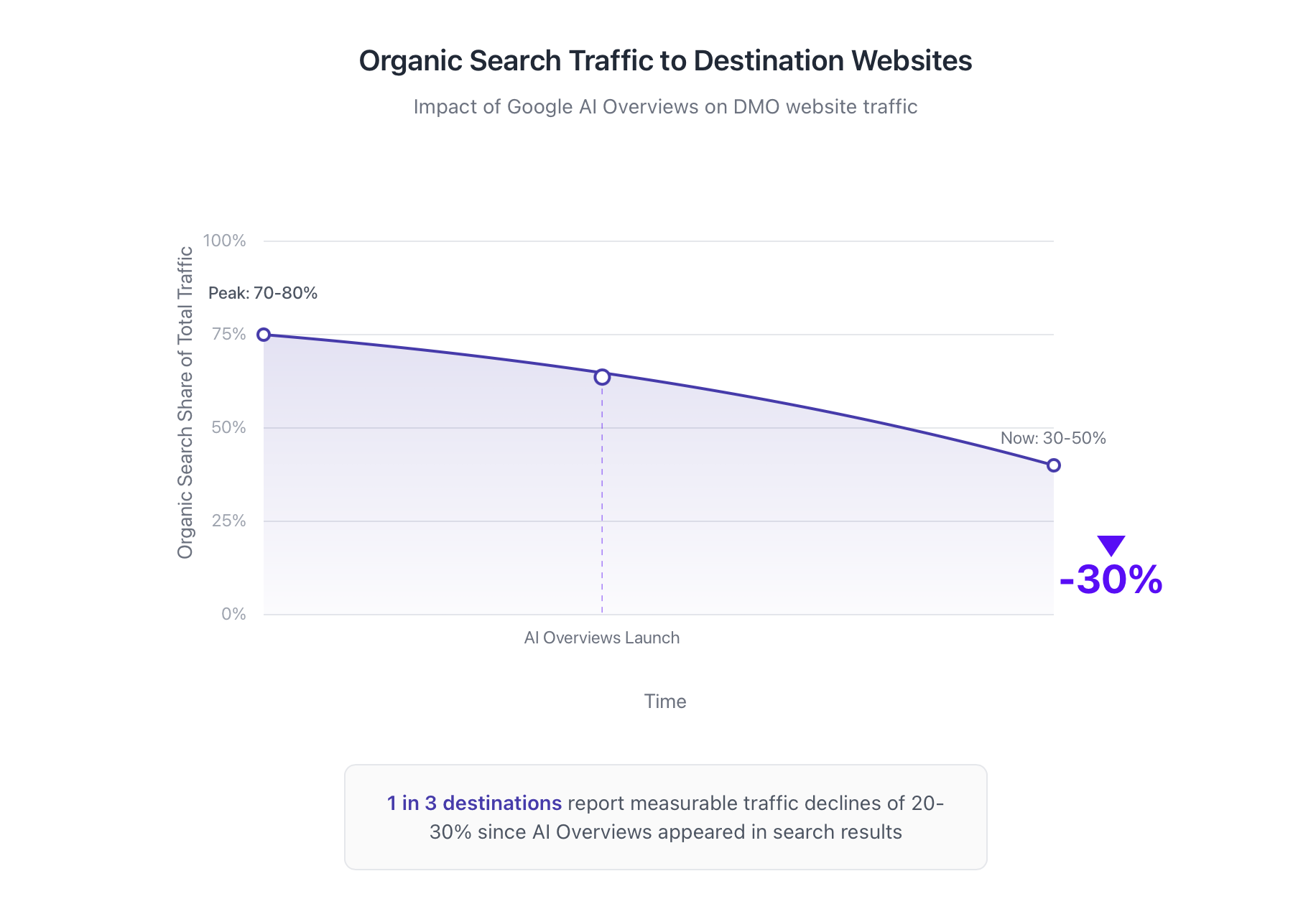
A third of surveyed destinations report clear, measurable traffic declines of between 20% and 30%, characterised as a general trend rather than concentrated in specific query types. This represents a fundamental shift in long-established patterns. For some, organic search now contributes roughly 30% to 50% of total traffic, compared with 70% to 80% during peak seasons previously. These are not just minor shifts but rather disruptions to digital strategies that have delivered consistent results for years.
Source: Claude.ai Generated
However, not every destination is feeling the same impact, and the reasons for these differences are informative. A third of respondents continue to report stable or growing traffic, though the underlying factors vary considerably. In one case, significant organic growth was recorded, roughly 600,000 additional clicks year-on-year, achieved through aggressive technical optimisation. Yet volume metrics alone may not capture the full picture, as declining click-through rates can persist even as total traffic grows.
Other destinations maintaining traffic stability attribute this to increased investment in paid search and brand building rather than organic resilience. This highlights how paid media can mask underlying organic decline and create a false sense of security about AI search impact.
AI Readiness: Lessons from Early-Adopting Markets
Throughout 2024 and early 2025, the severity of AI search impact varied dramatically by market. Destinations with primary European visitor bases experienced less immediate disruption than those focused on US and UK markets, where AI Overviews launched first. However, with AI Overviews now live in more than 200 countries, this geographic buffer has largely disappeared.
The patterns observed in early-adopting markets, declining click-through rates on broad informational queries and resilience in specific practical content, now manifest globally. DMOs that used this transitional period to prepare are better positioned; those that viewed stable traffic as a sign of resilience now face the same pressures those targeting British and American travellers experienced months earlier.
The question is no longer whether AI will affect destination visibility, but how prepared DMOs are to respond. That readiness depends largely on the type of content that DMOs prioritise and whether it can withstand AI’s ability to summarise and satisfy user queries without a click.
Content Performance: What Still Works
Our research reveals that certain types of content continue to perform well despite AI search growth, providing insights into both user behaviour patterns and AI system limitations. DMOs are seeing resilience in content that proves difficult for AI to condense effectively.
Map-related content and pages continue to perform strongly across destinations experiencing declining traffic otherwise. The resilience likely reflects that these pages offer practical, visual content that AI summaries cannot present as effectively as interactive map interfaces. Users seeking geographic context or wanting to visualise destinations spatially still find value in clicking through to full mapping visualisations rather than accepting text-based AI responses.
Highly specific practical queries demonstrate similar resilience. Questions about exact dates for seasonal sales, regulatory information such as vehicle emission requirements or detailed operational information for specific attractions remain strong performers. Users searching for specific, action-oriented information tend to rely more on authoritative sources and remain likely to click through, partly because these queries prove more difficult for AI systems to accurately summarise with the necessary precision.
This pattern reveals that while AI excels at synthesising broad informational content, it struggles with highly specific, practical and visual information. Content requiring trust, precision and often real-time accuracy remains resistant to AI summarisation, creating a natural barrier to certain content types.
Understanding what AI systems prioritise and what they struggle to replicate is essential. Techniques like reverse prompt engineering, where destinations analyse how AI responds to queries about their location, can reveal critical gaps in content depth or structure. The destinations performing best are those creating comprehensive, authoritative content that AI systems want to cite rather than summarise.
Conversely, the vulnerable content categories prove equally instructive. Broad informational queries about “best times to visit” or general “top attractions” lists show universal vulnerability across all destinations. These queries represent exactly the type of summary-friendly content AI systems handle effectively, providing users with satisfactory answers without requiring website visits. Destinations continuing to invest heavily in this type of summary-style content without adapting their approach risk diminishing returns as AI search becomes more popular.
Fewer Clicks, Higher Intent
Despite overall traffic declines, an intriguing countertrend is emerging in visitor quality metrics. Among users who click through from AI-enhanced search results, engagement levels appear higher than historical averages. This indicates potentially enhanced traffic quality from large language models compared to traditional search engines. This is observed through visitors viewing more pages per session than typical organic search arrivals. Such findings suggest that users who navigate past AI-generated summaries to reach destination websites arrive with clearer intent and higher motivation, potentially offsetting volume losses with improved conversion potential.
The quality versus quantity dynamic creates strategic tension for destinations. Declining traffic creates stakeholder concerns and complicates performance reporting, yet the visitors who do arrive may prove more valuable. This idea resists easy resolution through optimistic reframing. Destinations cannot simply declare victory in quality metrics whilst traffic volumes fall. However, understanding this dynamic helps frame strategic responses. Rather than attempting to maintain traffic volumes through increasingly costly acquisition channels, destinations might focus on ensuring the content and experiences they offer serve these higher-intent visitors exceptionally well, maximising value from fewer but more engaged sessions.
The trend also suggests that AI search may ultimately serve a beneficial filtering function, pre-qualifying visitors who need more depth than AI summaries can provide, whilst satisfying those seeking only basic information without requiring website visits. Whether this evolution ultimately benefits or harms destinations likely depends on business models and strategic positioning, with those focused on deep engagement potentially faring better than those relying on high-volume, low-engagement traffic patterns.
The Measurement Challenge: A Fundamental Blind Spot
One of the most significant issues our research uncovered is the difficulty destinations face in measuring AI search impact accurately. Nearly half of the respondents explicitly identified measurement as a critical operational problem affecting strategic decision-making at the highest level.
The picture has improved for Google's AI features. Websites appearing in AI Overviews and AI Mode are now included in overall search traffic in Google Search Console, reported within the Performance report under the "web" search type. Combined with Google Analytics data on conversions and time spent on site, DMOs can now track at least part of their AI-influenced traffic. Google has also noted that clicks from search results pages with AI Overviews tend to be higher quality, with users more likely to spend additional time on the site, aligning with the findings from our research about higher engagement from AI-referred visitors.
However, significant gaps remain. Traffic from third-party AI platforms - ChatGPT, Perplexity, Gemini outside of Google Search - often appears in referral categories rather than organic search data, meaning it frequently goes unnoticed in standard performance reviews. This categorisation problem compounds measurement difficulties, making it challenging to understand the full scope of traffic source evolution. Additionally, consent and cookie complications create attribution gaps that make determining the true source of AI-influenced traffic even more difficult.
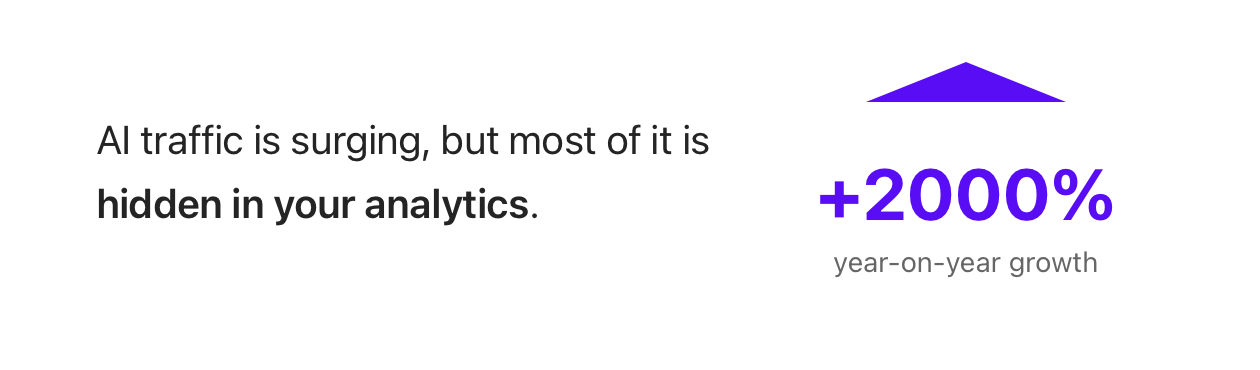
The growth metrics themselves prove misleading. Whilst AI agent traffic numbers remain relatively small, year-on-year increases of more than 2,000% have been observed. Such significant percentage growth from tiny bases makes trend interpretation challenging and forecasting nearly impossible using traditional analytical approaches.
Source: Claude.ai Generated
Without visibility into AI-driven traffic, destinations cannot accurately assess whether their optimisation strategies are working, cannot benchmark performance against peers and cannot make informed decisions about where to invest limited resources. This creates a situation where organisations navigate fundamental disruption with incomplete visibility into the effectiveness of their responses.
The measurement landscape is beginning to evolve. New tools are emerging that track brand visibility within AI responses, measuring citation, frequency and share of voice. For DMOs, the practical step now is to ensure Google Search Console and Analytics are properly configured to capture AI Overview traffic, whilst monitoring referral patterns for signals from third-party AI platforms. Until measurement capabilities mature further, destinations will continue making some strategic decisions with incomplete visibility into AI-influenced performance.
Infrastructure and Operational Impacts: Beyond Marketing Budgets
Whilst much discussion of AI search focuses on content strategy and traffic acquisition, our research revealed that technical infrastructure represents an often-overlooked dimension of AI impact. AI scraping from various LLMs and search systems increases pressure on servers, creating performance challenges that require infrastructure investment. Destinations are consequently moving to more robust hosting infrastructure specifically to handle sudden loads from automated AI tools crawling and processing their content. This represents operational costs sitting outside marketing budgets, making the full cost of AI adaptation potentially higher than surface analysis suggests.
The infrastructure demands create particular challenges for smaller destinations. Those with limited IT resources or constrained budgets may find themselves unable to maintain the server capacity necessary to support both human visitors and intensive AI crawling simultaneously. This potentially creates performance issues that harm user experience at precisely the moment when retaining visitor engagement becomes most critical.
Server pressure represents just one dimension of technical operational impact. Destinations are also discovering that their content management systems, analytics configurations and technical architectures designed for traditional search patterns may not serve AI-era requirements effectively. Adapting these systems requires technical expertise and investment that many organisations struggle to convene, particularly when the returns remain uncertain and difficult to measure. The DMOs succeeding in this environment are already experimenting, adapting and building new capabilities whilst the AI search landscape continues to evolve.
Oops! Something went wrong while submitting the form.
The search landscape has changed dramatically over the past couple of years. What started with Google’s AI Overviews in May 2024 has evolved into a fundamental shift in how people find information online. For DMOs, this represents both a challenge and an opportunity that requires immediate attention.
The scale of change is now clear. AI Overviews reached 1.5 billion monthly users by mid-2025 and are available in more than 200 countries. Research from the Pew Research Center, tracking nearly 69,000 search queries, found click-through rates dropped from 15% to 8% when AI summaries appeared. Broad queries about “best time to visit” or “things to do” are increasingly answered directly by AI, with users finding what they need without clicking through to websites.
User behaviour is shifting beyond Google’s changes. ChatGPT now processes almost 1 billion queries daily, with travel and hospitality ranking as the top industry for AI recommendations. Around 40% of travellers globally are already using AI tools for trip planning. Whilst Google still handles vastly more searches than AI alternatives, the gap is narrowing faster than predicted.
In early 2025, AI Overviews were upgraded with Gemini 2.5 to better respond to complex queries. More recently, Gemini 3 became the default model globally on mobile, delivering smarter, longer and better-structured responses. Crucially, users can now move seamlessly from a static AI Overview into a full conversational experience within AI Mode, without switching tabs or starting over. For destinations, this means the line between quick answers and deep exploration is blurring and the content that feeds both needs to work harder than ever.
AI Mode and Beyond
AI Mode represents Google’s most significant evolution in how search results are delivered. The feature goes beyond static summaries, offering advanced reasoning and multimodal capabilities that handle the type of questions travellers ask, queries requiring exploration, comparisons and nuanced recommendations.
The system uses a “query fan-out” technique, issuing multiple related searches across subtopics and data sources simultaneously, then synthesising everything into a single, coherent response. A user asking about planning a trip to a destination could trigger searches across accommodation, attractions, weather, transport and local events, all woven together without them ever visiting your website.
For DMOs, this changes the game. Content that once drove discovery traffic now feeds AI responses instead. The question becomes: how do you ensure your destination is represented accurately and compellingly when AI mediates the conversation?
What Our Research Reveals: DMO Experiences and Patterns
To understand how the industry is responding to these changes, we surveyed CMOs from leading DMOs worldwide about their experiences with declining organic traffic, changing user behaviour and the strategies they're implementing to stay relevant. The responses reveal interesting patterns about how different destinations are experiencing and adapting to this shift, providing insights that extend well beyond the headline statistics to illuminate the strategic choices destinations face.
Traffic Impact: A Mixed but Concerning Picture
Our research shows that DMOs are experiencing varied impacts, suggesting that brand strength, content quality, digital maturity, and crucially, geographic market composition all play significant roles in weathering this transition. Three distinct patterns are emerging across the industry, each outlining different lessons for destination marketers.
A third of surveyed destinations report clear, measurable traffic declines of between 20% and 30%, characterised as a general trend rather than concentrated in specific query types. This represents a fundamental shift in long-established patterns. For some, organic search now contributes roughly 30% to 50% of total traffic, compared with 70% to 80% during peak seasons previously. These are not just minor shifts but rather disruptions to digital strategies that have delivered consistent results for years.
Source: Claude.ai Generated
However, not every destination is feeling the same impact, and the reasons for these differences are informative. A third of respondents continue to report stable or growing traffic, though the underlying factors vary considerably. In one case, significant organic growth was recorded, roughly 600,000 additional clicks year-on-year, achieved through aggressive technical optimisation. Yet volume metrics alone may not capture the full picture, as declining click-through rates can persist even as total traffic grows.
Other destinations maintaining traffic stability attribute this to increased investment in paid search and brand building rather than organic resilience. This highlights how paid media can mask underlying organic decline and create a false sense of security about AI search impact.
AI Readiness: Lessons from Early-Adopting Markets
Throughout 2024 and early 2025, the severity of AI search impact varied dramatically by market. Destinations with primary European visitor bases experienced less immediate disruption than those focused on US and UK markets, where AI Overviews launched first. However, with AI Overviews now live in more than 200 countries, this geographic buffer has largely disappeared.
The patterns observed in early-adopting markets, declining click-through rates on broad informational queries and resilience in specific practical content, now manifest globally. DMOs that used this transitional period to prepare are better positioned; those that viewed stable traffic as a sign of resilience now face the same pressures those targeting British and American travellers experienced months earlier.
The question is no longer whether AI will affect destination visibility, but how prepared DMOs are to respond. That readiness depends largely on the type of content that DMOs prioritise and whether it can withstand AI’s ability to summarise and satisfy user queries without a click.
Content Performance: What Still Works
Our research reveals that certain types of content continue to perform well despite AI search growth, providing insights into both user behaviour patterns and AI system limitations. DMOs are seeing resilience in content that proves difficult for AI to condense effectively.
Map-related content and pages continue to perform strongly across destinations experiencing declining traffic otherwise. The resilience likely reflects that these pages offer practical, visual content that AI summaries cannot present as effectively as interactive map interfaces. Users seeking geographic context or wanting to visualise destinations spatially still find value in clicking through to full mapping visualisations rather than accepting text-based AI responses.
Highly specific practical queries demonstrate similar resilience. Questions about exact dates for seasonal sales, regulatory information such as vehicle emission requirements or detailed operational information for specific attractions remain strong performers. Users searching for specific, action-oriented information tend to rely more on authoritative sources and remain likely to click through, partly because these queries prove more difficult for AI systems to accurately summarise with the necessary precision.
This pattern reveals that while AI excels at synthesising broad informational content, it struggles with highly specific, practical and visual information. Content requiring trust, precision and often real-time accuracy remains resistant to AI summarisation, creating a natural barrier to certain content types.
Understanding what AI systems prioritise and what they struggle to replicate is essential. Techniques like reverse prompt engineering, where destinations analyse how AI responds to queries about their location, can reveal critical gaps in content depth or structure. The destinations performing best are those creating comprehensive, authoritative content that AI systems want to cite rather than summarise.
Conversely, the vulnerable content categories prove equally instructive. Broad informational queries about “best times to visit” or general “top attractions” lists show universal vulnerability across all destinations. These queries represent exactly the type of summary-friendly content AI systems handle effectively, providing users with satisfactory answers without requiring website visits. Destinations continuing to invest heavily in this type of summary-style content without adapting their approach risk diminishing returns as AI search becomes more popular.
Fewer Clicks, Higher Intent
Despite overall traffic declines, an intriguing countertrend is emerging in visitor quality metrics. Among users who click through from AI-enhanced search results, engagement levels appear higher than historical averages. This indicates potentially enhanced traffic quality from large language models compared to traditional search engines. This is observed through visitors viewing more pages per session than typical organic search arrivals. Such findings suggest that users who navigate past AI-generated summaries to reach destination websites arrive with clearer intent and higher motivation, potentially offsetting volume losses with improved conversion potential.
The quality versus quantity dynamic creates strategic tension for destinations. Declining traffic creates stakeholder concerns and complicates performance reporting, yet the visitors who do arrive may prove more valuable. This idea resists easy resolution through optimistic reframing. Destinations cannot simply declare victory in quality metrics whilst traffic volumes fall. However, understanding this dynamic helps frame strategic responses. Rather than attempting to maintain traffic volumes through increasingly costly acquisition channels, destinations might focus on ensuring the content and experiences they offer serve these higher-intent visitors exceptionally well, maximising value from fewer but more engaged sessions.
The trend also suggests that AI search may ultimately serve a beneficial filtering function, pre-qualifying visitors who need more depth than AI summaries can provide, whilst satisfying those seeking only basic information without requiring website visits. Whether this evolution ultimately benefits or harms destinations likely depends on business models and strategic positioning, with those focused on deep engagement potentially faring better than those relying on high-volume, low-engagement traffic patterns.
The Measurement Challenge: A Fundamental Blind Spot
One of the most significant issues our research uncovered is the difficulty destinations face in measuring AI search impact accurately. Nearly half of the respondents explicitly identified measurement as a critical operational problem affecting strategic decision-making at the highest level.
The picture has improved for Google's AI features. Websites appearing in AI Overviews and AI Mode are now included in overall search traffic in Google Search Console, reported within the Performance report under the "web" search type. Combined with Google Analytics data on conversions and time spent on site, DMOs can now track at least part of their AI-influenced traffic. Google has also noted that clicks from search results pages with AI Overviews tend to be higher quality, with users more likely to spend additional time on the site, aligning with the findings from our research about higher engagement from AI-referred visitors.
However, significant gaps remain. Traffic from third-party AI platforms - ChatGPT, Perplexity, Gemini outside of Google Search - often appears in referral categories rather than organic search data, meaning it frequently goes unnoticed in standard performance reviews. This categorisation problem compounds measurement difficulties, making it challenging to understand the full scope of traffic source evolution. Additionally, consent and cookie complications create attribution gaps that make determining the true source of AI-influenced traffic even more difficult.
The growth metrics themselves prove misleading. Whilst AI agent traffic numbers remain relatively small, year-on-year increases of more than 2,000% have been observed. Such significant percentage growth from tiny bases makes trend interpretation challenging and forecasting nearly impossible using traditional analytical approaches.
Source: Claude.ai Generated
Without visibility into AI-driven traffic, destinations cannot accurately assess whether their optimisation strategies are working, cannot benchmark performance against peers and cannot make informed decisions about where to invest limited resources. This creates a situation where organisations navigate fundamental disruption with incomplete visibility into the effectiveness of their responses.
The measurement landscape is beginning to evolve. New tools are emerging that track brand visibility within AI responses, measuring citation, frequency and share of voice. For DMOs, the practical step now is to ensure Google Search Console and Analytics are properly configured to capture AI Overview traffic, whilst monitoring referral patterns for signals from third-party AI platforms. Until measurement capabilities mature further, destinations will continue making some strategic decisions with incomplete visibility into AI-influenced performance.
Infrastructure and Operational Impacts: Beyond Marketing Budgets
Whilst much discussion of AI search focuses on content strategy and traffic acquisition, our research revealed that technical infrastructure represents an often-overlooked dimension of AI impact. AI scraping from various LLMs and search systems increases pressure on servers, creating performance challenges that require infrastructure investment. Destinations are consequently moving to more robust hosting infrastructure specifically to handle sudden loads from automated AI tools crawling and processing their content. This represents operational costs sitting outside marketing budgets, making the full cost of AI adaptation potentially higher than surface analysis suggests.
The infrastructure demands create particular challenges for smaller destinations. Those with limited IT resources or constrained budgets may find themselves unable to maintain the server capacity necessary to support both human visitors and intensive AI crawling simultaneously. This potentially creates performance issues that harm user experience at precisely the moment when retaining visitor engagement becomes most critical.
Server pressure represents just one dimension of technical operational impact. Destinations are also discovering that their content management systems, analytics configurations and technical architectures designed for traditional search patterns may not serve AI-era requirements effectively. Adapting these systems requires technical expertise and investment that many organisations struggle to convene, particularly when the returns remain uncertain and difficult to measure. The DMOs succeeding in this environment are already experimenting, adapting and building new capabilities whilst the AI search landscape continues to evolve.
Continue reading...
Get access to 100s of case studies, workshop templates, industry leading events and more.



.svg)