
Log in
Oops! Something went wrong while submitting the form.
Create an account
Oops! Something went wrong while submitting the form.



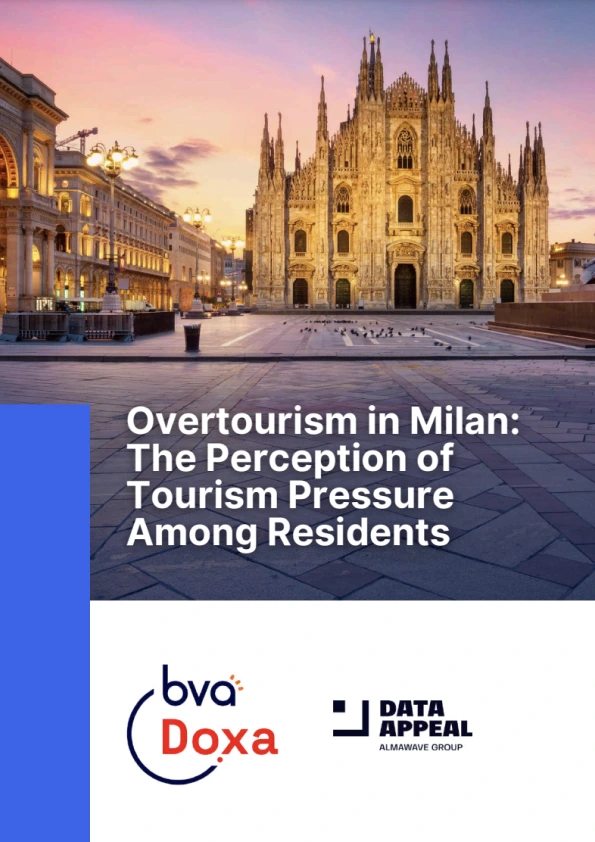
Today, excessive tourism pressure poses a serious challenge to the well-being of many Italian destinations. Venice, the Cinque Terre, Florence, and Rome are just a few of the places under the most strain, where quality of life for residents is often affected by overcrowding and the concentration of visitor flows—whether seasonal or year-round.
Constant exposure to this issue, widely known as "overtourism, " has created a complex and varied scenario for each destination and its local community. There is an urgent need to take action to safeguard social, economic, and environmental balance.
The Data Appeal Company and Doxa have joined forces to analyse the city of Milan, exploring how both residents and visitors perceive quality of life and the impact of tourism.
The findings are presented in this white paper, designed to help destinations, institutions, and local authorities of all sizes better understand the issue. The goal is to offer a clearer perspective and support the development of strategies and tools that can promote a more balanced form of tourism— one that brings value and well-being to both visitors and locals.
The Data Appeal Company and Doxa partnership
To support institutions and tourism stakeholders in addressing issues like quality of life and tourism pressure, The Data Appeal Company and Doxa have launched an innovative collaboration, combining their expertise to develop an integrated analytical approach.
This initiative aims to offer a multidimensional view of how tourism pressure is perceived, combining up-to-date qualitative and quantitative data with direct insights from residents.
This partnership has resulted in a replicable method that captures how tourism is perceived from different angles, particularly on issues like overcrowding and gentrification.
The model doesn’t merely describe Milan’s specific situation—it serves as a pilot for other destinations seeking to manage visitor flows sustainably and ensure a high quality of life.
Milan as a case study: Insights from real data
The analysis of Milan takes a twofold approach to understanding the impact of tourism. On one side, The Data Appeal Company monitored and interpreted various tourism pressure indicators: visitor concentration (Popularity Index), the saturation rate and spatial concentration of short-term rentals, the number of online reviews, and the seasonality index.
Meanwhile, Doxa carried out a survey to capture residents’ perceptions, seeking to understand how locals experience the city’s changes in quality of life, daily livability, and sustainability.
The integrated analysis enabled an in-depth exploration of the relationship between tourism pressure and residents’ perceived well-being, revealing how —and to what extent—tourism influences urban quality of life. Is tourism regarded as an asset or a source of discomfort? Is the coexistence between residents and visitors harmonious, or does it tend to generate tensions?
Milan serves as an important case study, offering valuable insights into dynamics now being observed in other Italian cities. Ranked third globally in 2023 for the ratio of visitors to residents, according to The Economist, Milan remains a major cultural and tourism hub.
This approach has transformed data and perceptions into a strategic tool that supports public policy and tourism planning decisions. It’s not merely about measuring impact—it’s about guiding choices toward a model of tourism that’s more sustainable, inclusive, and aligned with the well-being of the local community.
Today, excessive tourism pressure poses a serious challenge to the well-being of many Italian destinations. Venice, the Cinque Terre, Florence, and Rome are just a few of the places under the most strain, where quality of life for residents is often affected by overcrowding and the concentration of visitor flows—whether seasonal or year-round.
Constant exposure to this issue, widely known as "overtourism, " has created a complex and varied scenario for each destination and its local community. There is an urgent need to take action to safeguard social, economic, and environmental balance.
The Data Appeal Company and Doxa have joined forces to analyse the city of Milan, exploring how both residents and visitors perceive quality of life and the impact of tourism.
The findings are presented in this white paper, designed to help destinations, institutions, and local authorities of all sizes better understand the issue. The goal is to offer a clearer perspective and support the development of strategies and tools that can promote a more balanced form of tourism— one that brings value and well-being to both visitors and locals.
The Data Appeal Company and Doxa partnership
To support institutions and tourism stakeholders in addressing issues like quality of life and tourism pressure, The Data Appeal Company and Doxa have launched an innovative collaboration, combining their expertise to develop an integrated analytical approach.
This initiative aims to offer a multidimensional view of how tourism pressure is perceived, combining up-to-date qualitative and quantitative data with direct insights from residents.
This partnership has resulted in a replicable method that captures how tourism is perceived from different angles, particularly on issues like overcrowding and gentrification.
The model doesn’t merely describe Milan’s specific situation—it serves as a pilot for other destinations seeking to manage visitor flows sustainably and ensure a high quality of life.
Milan as a case study: Insights from real data
The analysis of Milan takes a twofold approach to understanding the impact of tourism. On one side, The Data Appeal Company monitored and interpreted various tourism pressure indicators: visitor concentration (Popularity Index), the saturation rate and spatial concentration of short-term rentals, the number of online reviews, and the seasonality index.
Meanwhile, Doxa carried out a survey to capture residents’ perceptions, seeking to understand how locals experience the city’s changes in quality of life, daily livability, and sustainability.
The integrated analysis enabled an in-depth exploration of the relationship between tourism pressure and residents’ perceived well-being, revealing how —and to what extent—tourism influences urban quality of life. Is tourism regarded as an asset or a source of discomfort? Is the coexistence between residents and visitors harmonious, or does it tend to generate tensions?
Milan serves as an important case study, offering valuable insights into dynamics now being observed in other Italian cities. Ranked third globally in 2023 for the ratio of visitors to residents, according to The Economist, Milan remains a major cultural and tourism hub.
This approach has transformed data and perceptions into a strategic tool that supports public policy and tourism planning decisions. It’s not merely about measuring impact—it’s about guiding choices toward a model of tourism that’s more sustainable, inclusive, and aligned with the well-being of the local community.


