Reports
/
AI
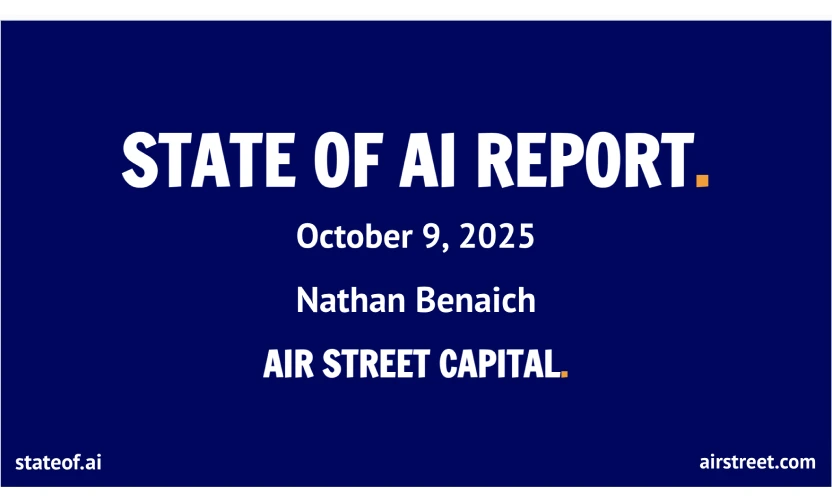
State of AI Report 2025
This report reviews State of AI 2025, covering advances in reasoning models, industry growth, geopolitics and safety risks.
Summary
Research
- Reasoning defined the year, with OpenAI, Google, Anthropic, and DeepSeek trading leads and pushing visible “think-then-answer” methods into real products.
- Open models improved fast and China’s open-weight ecosystem surged, yet the top models remain closed and keep widening their capability-per-dollar edge.
- Benchmarks buckled under contamination and variance, while agents, world models, and domain tools (code, science, medicine) became actually useful.
Industry
- Real revenue arrived at scale as AI-first companies crossed tens of billions, and flagship labs stretched their lead with better capability-to-cost curves.
- NVIDIA ripped past $4T and 90% ownership of AI research papers while custom chips and neoclouds rose. Circular mega-deals funded huge build-outs.
- Power became the new bottleneck as multi-GW clusters moved from slideware to site plans and grid constraints started to shape roadmaps and margins.
Politics
- The AI race heats up as the U.S. leans into “America-first AI” with export gyrations while China accelerates self-reliance ambitions and domestic silicon.
- Regulation takes a back seat in the face of turbo-investments: international diplomacy stalls and the AI Act runs into implementation hurdles.
- “AI goes global” became concrete, with petrodollars and national programs funding gigantic data centers and model access as job loss data trickles in.
Safety
- AI labs activated unprecedented protections for bio and scheming risks, others missed self-imposed deadlines, or quietly abandoned testing protocols.
- External safety organizations operate on annual budgets smaller than what leading labs collectively spend in a single day.
- Cyber capabilities doubled every 5 months outpacing defensive measures. Criminals orchestrated ransomware using AI agents infiltrate F500 companies.
Premium content, included with Evolve membership and above.
What it covers
- Introduction
- Research
- Industry
- Politics
- Safety
- Survey
- Predictions
Why it matters

Additional resources