
Log in
Oops! Something went wrong while submitting the form.
Create an account
Oops! Something went wrong while submitting the form.


In recent years, cities across Europe have increasingly turned to sustainability certifications and indexes as tools to demonstrate commitment, monitor progress, and enhance their positioning as sustainable destinations.
This whitepaper examines how such tools are being used in practice, highlighting both their contributions and the challenges they present. Based on a City Destinations Alliance (CityDNA) survey, comparative survey data, and 20 interviews with tourism professionals, academics, and sustainability strategists, the report provides an informed analysis of sustainability frameworks in urban tourism management.
The findings reflect a growing recognition that while tourism can support sustainable development, it is not inherently sustainable—nor are the methods used to assess it always comprehensive. Certifications and rankings can offer useful guidelines, foster benchmarking, and encourage collaboration among stakeholders. At the same time, they may not fully capture the diverse realities, complexities, and specific contexts of each destination.
Certifications and rankings can offer useful guidelines, foster benchmarking, and encourage collaboration among stakeholders.
Strategic Implications
This paper proposes a shift in perspective: certifications and rankings should be seen as tools to support ongoing learning and improvement, rather than as end goals in themselves. When used thoughtfully, they can encourage self-assessment, inform internal strategies, and foster constructive dialogue. Their value lies not in generating visibility or comparison, but in helping cities reflect on what matters most in their local context—and how to respond accordingly.
In addition, evolving EU regulations—such as the Green Claims Directive and the Corporate Sustainability Reporting Directive—are likely to raise expectations around verified sustainability performance. Destination Management Organisations (DMOs) may need to adapt to a growing emphasis on transparency and accountability, as sustainability practices move from voluntary efforts to more formal requirements.
This whitepaper does not suggest abandoning sustainability frameworks. Instead, it encourages cities to engage with them in a more informed, context-sensitive, and reflective way. Progress in sustainability is not solely measured by a position in a ranking, but also by tangible outcomes—such as clean air, public trust, environmental stewardship, and community well-being.
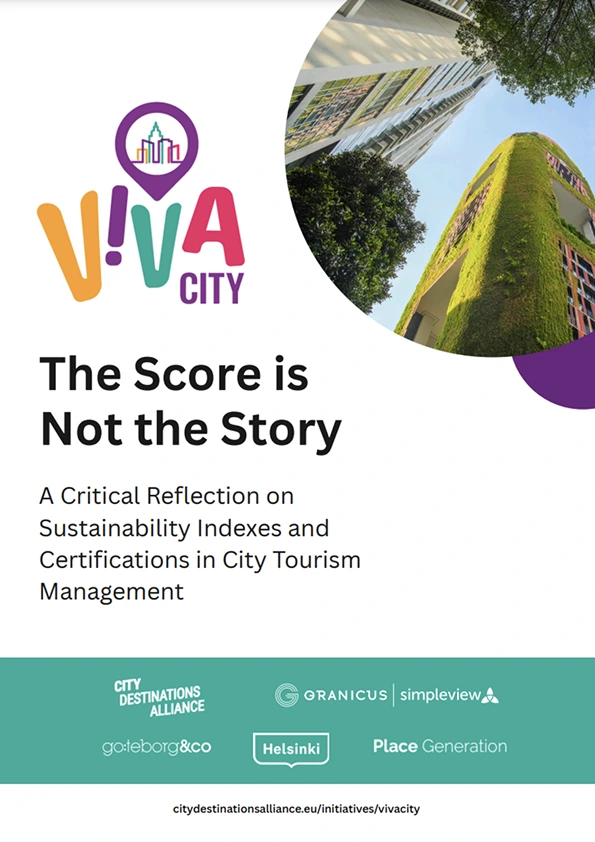
This is why The Score is Not the Story. Scores and certifications can provide structure and direction, but they represent just one part of a broader narrative. The deeper story of a sustainable city lies in the relationships it builds, the challenges it addresses, and the long-term commitments it upholds—often beyond public recognition. High scores may offer external validation, but meaningful impact is ultimately measured by the lived experiences of people and the health of local ecosystems.
In recent years, cities across Europe have increasingly turned to sustainability certifications and indexes as tools to demonstrate commitment, monitor progress, and enhance their positioning as sustainable destinations.
This whitepaper examines how such tools are being used in practice, highlighting both their contributions and the challenges they present. Based on a City Destinations Alliance (CityDNA) survey, comparative survey data, and 20 interviews with tourism professionals, academics, and sustainability strategists, the report provides an informed analysis of sustainability frameworks in urban tourism management.
The findings reflect a growing recognition that while tourism can support sustainable development, it is not inherently sustainable—nor are the methods used to assess it always comprehensive. Certifications and rankings can offer useful guidelines, foster benchmarking, and encourage collaboration among stakeholders. At the same time, they may not fully capture the diverse realities, complexities, and specific contexts of each destination.
Certifications and rankings can offer useful guidelines, foster benchmarking, and encourage collaboration among stakeholders.
Strategic Implications
This paper proposes a shift in perspective: certifications and rankings should be seen as tools to support ongoing learning and improvement, rather than as end goals in themselves. When used thoughtfully, they can encourage self-assessment, inform internal strategies, and foster constructive dialogue. Their value lies not in generating visibility or comparison, but in helping cities reflect on what matters most in their local context—and how to respond accordingly.
In addition, evolving EU regulations—such as the Green Claims Directive and the Corporate Sustainability Reporting Directive—are likely to raise expectations around verified sustainability performance. Destination Management Organisations (DMOs) may need to adapt to a growing emphasis on transparency and accountability, as sustainability practices move from voluntary efforts to more formal requirements.
This whitepaper does not suggest abandoning sustainability frameworks. Instead, it encourages cities to engage with them in a more informed, context-sensitive, and reflective way. Progress in sustainability is not solely measured by a position in a ranking, but also by tangible outcomes—such as clean air, public trust, environmental stewardship, and community well-being.
This is why The Score is Not the Story. Scores and certifications can provide structure and direction, but they represent just one part of a broader narrative. The deeper story of a sustainable city lies in the relationships it builds, the challenges it addresses, and the long-term commitments it upholds—often beyond public recognition. High scores may offer external validation, but meaningful impact is ultimately measured by the lived experiences of people and the health of local ecosystems.


