Author:
Visit Britain / Visit England
Screenshot 2025-05-07 at 17.47.20 2.webpScreenshot 2025-05-07 at 17.47.20 2.webp
Language:
English

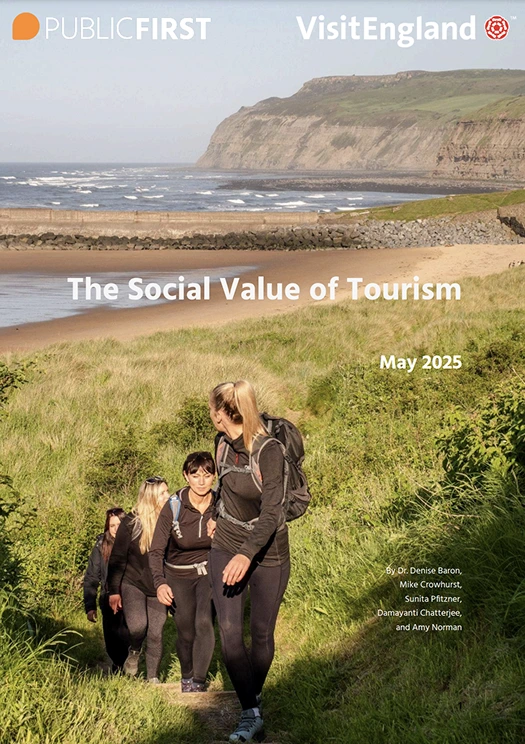
The Social Value of Tourism

May 2025
Culture

This report explores the wide-ranging social, cultural, and community impacts of tourism, particularly through the lens of local communities, whose lives it directly impacts. Drawing on polling data, case studies, and statistical analysis, it reveals how tourism contributes to community pride, well-being, and regeneration, while also highlighting the importance of sustainable and inclusive practices.

**Key Findings **

**1. Community Roots – Pride, Identity, and Empowerment **

  • Host communities, specifically the people who live and work in the communities most impacted by tourism, consistently report higher levels of local and national pride.
  • 72% of the British public are proud that visitors come to the UK from around the world, and that goes up to 79% of people living in host communities.
  • Social cohesion is notably stronger in host communities, where residents feel more connected to their community and protective of their local identity. 58% of those in host communities feel connected to their community, while only 35% in non-host communities feel that community connection.
  • The Resident Empowerment Index, an original scale we develop to measure pride, connectedness, and agency, shows statistically significant higher scores in host communities. Host communities scored 20% higher on this index than non-host communities.
  • Case Study: Eurovision 2023 in Liverpool illustrated how community spirit and cultural pride can elevate a major tourism event into a model for engagement and cultural exchange.

**2. Shared Spaces – Nature, Culture, and Everyday Benefits **

  • Tourism improves access to cultural amenities, green spaces, and local businesses—enhancing the daily quality of life for residents and visitors. Over half of host communities residents consistently report living within 5 miles of cultural institutions, heritage sites, museums, arts venues, waterways, beaches, and other aspects of nature, with non-host communities consistently reporting longer distances.
  • Case Study: Programmes like Generation Green 2 connect disadvantaged youth with nature, showcasing tourism's role in social inclusion.
  • Host communities report better infrastructure and institutions, driven by local business engagement and cultural participation. ○ Half of host communities rate their cultural institutions positively, compared to only 25% in non-host communities.
  • Case Study: Bath’s Visitor Economy shows how tourism enables local economies and culture to thrive.
  • Transport investments in Cornwall, Yorkshire Dales, and Thanet exemplify infrastructure improvements that benefit both visitors and residents.

**3. Future Pathways – Growing, Regenerative, and Inclusive Tourism **

  • Tourism can act as a catalyst for social regeneration, providing funds which can be re-invested in the community. Case Study: The National Forest demonstrated how environmental restoration and sustainable tourism can go hand in hand.
  • Host communities have strong business, cultural, and social networks, which we measured using the Social and Cultural Strength Index. This original index captures the relative strength of communities’ business districts, cultural offerings, and identities. Using regression analysis, we found that it is positively and significantly correlated with levels of tourism.
  • The visitor economy offers a range of employment opportunities and diverse entry routes, including for young people and those with varied educational backgrounds. For instance, of the 4,220 apprenticeship starts focused on subjects linked to Leisure, Travel and Tourism in 2023/24, 55% were undertaken by people under 19 and 85% by people under the age of 24. This compares to only 23% and 52% respectively for apprenticeships across the whole economy.
  • Case Study: The Visitor Economy Network Initiative (VENI) highlights tourism’s potential for workforce development and civic pride, especially for underserved populations.
  • There is a clear appetite within the British public to travel in a regenerative way that is both good for communities and the environment. Nearly 60% of the public says that when they travel, they try to leave the place better than they found it.

Contents:

  • Introduction
  • Chapter One: Community Roots
  • Chapter Two: Shared Spaces
  • Chapter Three: Future Pathways
  • Appendix 1: Case Studies
  • Appendix 2: Technical Note

Continue reading...

Get access to 100s of case studies, workshop templates, industry leading events and more.
See membership options
Already a member? Sign in

The Social Value of Tourism

May 2025
Culture

This report explores the wide-ranging social, cultural, and community impacts of tourism, particularly through the lens of local communities, whose lives it directly impacts. Drawing on polling data, case studies, and statistical analysis, it reveals how tourism contributes to community pride, well-being, and regeneration, while also highlighting the importance of sustainable and inclusive practices.

**Key Findings **

**1. Community Roots – Pride, Identity, and Empowerment **

  • Host communities, specifically the people who live and work in the communities most impacted by tourism, consistently report higher levels of local and national pride.
  • 72% of the British public are proud that visitors come to the UK from around the world, and that goes up to 79% of people living in host communities.
  • Social cohesion is notably stronger in host communities, where residents feel more connected to their community and protective of their local identity. 58% of those in host communities feel connected to their community, while only 35% in non-host communities feel that community connection.
  • The Resident Empowerment Index, an original scale we develop to measure pride, connectedness, and agency, shows statistically significant higher scores in host communities. Host communities scored 20% higher on this index than non-host communities.
  • Case Study: Eurovision 2023 in Liverpool illustrated how community spirit and cultural pride can elevate a major tourism event into a model for engagement and cultural exchange.

**2. Shared Spaces – Nature, Culture, and Everyday Benefits **

  • Tourism improves access to cultural amenities, green spaces, and local businesses—enhancing the daily quality of life for residents and visitors. Over half of host communities residents consistently report living within 5 miles of cultural institutions, heritage sites, museums, arts venues, waterways, beaches, and other aspects of nature, with non-host communities consistently reporting longer distances.
  • Case Study: Programmes like Generation Green 2 connect disadvantaged youth with nature, showcasing tourism's role in social inclusion.
  • Host communities report better infrastructure and institutions, driven by local business engagement and cultural participation. ○ Half of host communities rate their cultural institutions positively, compared to only 25% in non-host communities.
  • Case Study: Bath’s Visitor Economy shows how tourism enables local economies and culture to thrive.
  • Transport investments in Cornwall, Yorkshire Dales, and Thanet exemplify infrastructure improvements that benefit both visitors and residents.

**3. Future Pathways – Growing, Regenerative, and Inclusive Tourism **

  • Tourism can act as a catalyst for social regeneration, providing funds which can be re-invested in the community. Case Study: The National Forest demonstrated how environmental restoration and sustainable tourism can go hand in hand.
  • Host communities have strong business, cultural, and social networks, which we measured using the Social and Cultural Strength Index. This original index captures the relative strength of communities’ business districts, cultural offerings, and identities. Using regression analysis, we found that it is positively and significantly correlated with levels of tourism.
  • The visitor economy offers a range of employment opportunities and diverse entry routes, including for young people and those with varied educational backgrounds. For instance, of the 4,220 apprenticeship starts focused on subjects linked to Leisure, Travel and Tourism in 2023/24, 55% were undertaken by people under 19 and 85% by people under the age of 24. This compares to only 23% and 52% respectively for apprenticeships across the whole economy.
  • Case Study: The Visitor Economy Network Initiative (VENI) highlights tourism’s potential for workforce development and civic pride, especially for underserved populations.
  • There is a clear appetite within the British public to travel in a regenerative way that is both good for communities and the environment. Nearly 60% of the public says that when they travel, they try to leave the place better than they found it.

Contents:

  • Introduction
  • Chapter One: Community Roots
  • Chapter Two: Shared Spaces
  • Chapter Three: Future Pathways
  • Appendix 1: Case Studies
  • Appendix 2: Technical Note