BC Tourism Climate Resiliency Initiative: Building a Province-Wide Framework for Sustainable Transformation
BC’s Tourism Climate Resiliency Initiative unites government, DMOs and Indigenous partners to help tourism businesses adapt.
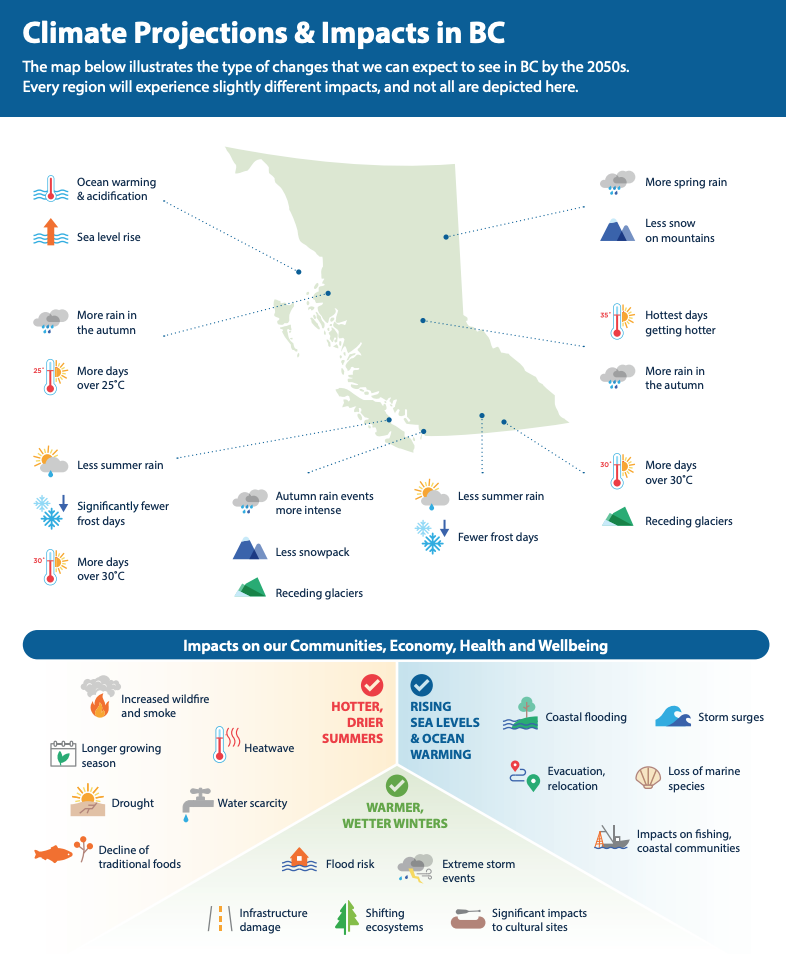
BC’s tourism sector faces a challenge in preparing thousands of businesses for climate change, whilst maintaining the natural beauty that draws visitors to the province. The British Columbia Tourism Climate Resiliency Initiative (BCTCRI), winner of the Transformation Award at the X. Awards, offers a compelling answer through a unified platform that brings together provincial leadership, regional organisations and Indigenous tourism partners under one strategic framework.
Continue reading...
Get access to 100s of case studies, workshop templates, industry leading events and more.
BC’s tourism sector faces a challenge in preparing thousands of businesses for climate change, whilst maintaining the natural beauty that draws visitors to the province. The British Columbia Tourism Climate Resiliency Initiative (BCTCRI), winner of the Transformation Award at the X. Awards, offers a compelling answer through a unified platform that brings together provincial leadership, regional organisations and Indigenous tourism partners under one strategic framework.
Continue reading...
Get access to 100s of case studies, workshop templates, industry leading events and more.
BC’s tourism sector faces a challenge in preparing thousands of businesses for climate change, whilst maintaining the natural beauty that draws visitors to the province. The British Columbia Tourism Climate Resiliency Initiative (BCTCRI), winner of the Transformation Award at the 2024 X. Awards, offers a compelling answer through a unified platform that brings together provincial leadership, regional organisations and Indigenous tourism partners under one strategic framework.
The BCTCRI was developed following recognition that individual efforts, however well-intentioned, cannot address the scale of the climate challenge facing British Columbia’s tourism industry. This strategic grounding led Destination BC, the British Columbia Ministry of Tourism, Arts, Culture and Sport, six Regional Destination Management Organisations and Indigenous Tourism BC to join forces to provide clear pathways and support for businesses.
The inclusion of Indigenous Tourism BC also ensures that climate adaptation efforts respect and incorporate traditional knowledge and priorities. Such a partnership model recognises that effective climate action in tourism cannot succeed without meaningful engagement with First Nations communities, who have been stewards of the land for generations.
With an initial investment of C$3 million through Destination BC, the initiative represents a significant commitment to long-term transformation. The vision extends beyond immediate carbon reduction to creating thriving communities and destinations safeguarded against climate change, setting a foundation that future programmes can build upon.
Four Projects, One Vision
The BCTCRI operates through four interconnected projects, each addressing different aspects of climate resilience whilst contributing to the achievement of the initiative's three main objectives:
BC’s tourism industry is better prepared to adapt to climate change.
BC’s tourism industry is using a standard set of tools to track, measure and improve sustainable practices and climate adaptation initiatives.
Setting a foundation for a long-term sustainability and climate adaptation approach for BC's tourism sector.
Recognising that SMEs in tourism often lack the expertise to navigate sustainability planning, the Facilitated Sustainable Tourism and Climate Adaptation Planning for Tourism Businesses provides free one-on-one support with expert advisors. Together, businesses develop customised roadmaps addressing their specific circumstances. By November 2024, 260 businesses participated in the programme, receiving actionable recommendations for resources, certification programmes and funding sources. Additional expert services, fully funded by the initiative, include carbon footprint analysis, waste audits, energy assessments and climate risk evaluations.
Yet, even the best plans remain unrealised without resources to implement them. The Micro-Grant Program to Support Sustainability and Climate Adaptation Plan Implementation addresses this barrier through funding of up to C$15,000, enabling businesses to act on recommendations from their sustainability assessments. Two grant rounds have distributed over C$997,000 to around 80 businesses across British Columbia, funding projects that range from renewable energy installations and solar panels to energy efficiency upgrades, Fire-Smart property assessment and electric vehicle acquisition.
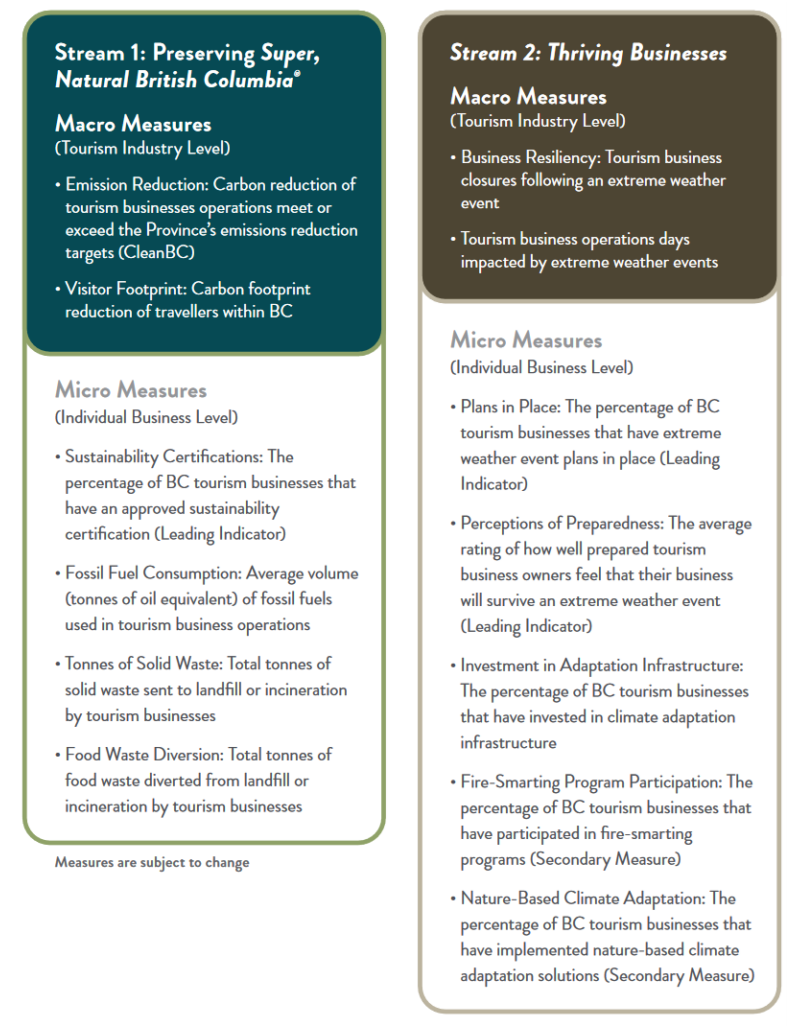
Tourism organisations also frequently struggle to track sustainability outcomes because consistent data remains scarce across the industry. The Sustainability & Climate Adaptation Data Framework addresses this gap through establishing common metrics at a provincial level, with standardised data collection methods and baseline measurements. This framework has been structured to monitor both the broader tourism industry performance and help individual businesses measure their own performance. While the framework will continue to evolve, it has already resulted in the first province-wide Tourism Climate Adaptation and Environmental Sustainability Business Survey and the creation of a guide for businesses that summarises the efforts being taken by the sector.
Connecting these efforts, the Community Destination Stewardship Initiative established a network that launched in May 2024. The network brings together DMOs, municipalities, visitor centres, First Nations and economic development corporations. Eight workshops have been delivered, covering topics including climate resiliency, regenerative tourism, decarbonisation, Indigenous knowledge and marketing. Additional resources, including a peer discussion forum and learning platform provide further support for the network.
From Individual Action to Collective Impact
What sets the BCTCRI apart is how it layers different interventions to serve varying needs whilst building toward systemic change. Individual businesses receive personalised support and funding to make immediate improvements, while communities gain access to education and peer networks that build shared understanding. Underpinning both, the data framework creates accountability and enables the industry to track collective progress against climate targets.
This multi-pronged approach positions British Columbia as a leader in driving forward action on climate change. The BCTCRI draws on successful approaches developed during the COVID-19 pandemic, when one-on-one support proved helpful for SMEs to navigate unprecedented challenges. That experience demonstrated the value of meeting businesses individually rather than relying solely on general guidance or mass communication.
This ground-up approach meets businesses where they are. The initiative works from the supply side, understanding that each tourism operator faces unique challenges depending on their location, sector and capacity: a small adventure tour operator in Northern BC has different climate risks and opportunities than a large hotel in Vancouver. The personalised roadmaps ensure that sustainability planning reflects these realities.
Key Takeaways
Coordinate across governance levels: Effective climate action requires alignment between provincial government, regional organisations, communities and businesses. Creating a unified platform reduces confusion and enables consistent support for the entire tourism sector.
Layer interventions for different needs: Individual business support, community education, grant funding and data measurement work together to create change at multiple levels. No single intervention can address the full scope of climate challenges.
Invest in measurement capabilities: Developing common metrics and data collection methods enables progress to be tracked against clearly defined targets. Without measurement, sustainability efforts lack the evidence base needed to inform decision-making and secure ongoing investment.
Provide personalised pathways: Tourism operators face diverse circumstances that require tailored responses. One-on-one support that creates customised roadmaps for each business proves more effective than generic guidance.
Connect funding to planning: Micro-grants tied to sustainability assessments ensure that funding supports strategic priorities rather than ad hoc projects. This approach maximises the impact of limited resources whilst building business capacity for ongoing improvement.
Build peer networks for sustained engagement: Destination stewardship networks create ongoing learning opportunities and mutual support among communities. This collaborative approach outlasts any single programme and builds a shared commitment to climate goals.
Published on:
February 2026
About the contributor
SUSTAINABILITY LEADERSHIP PROGRAMME
Become a certified Sustainability Advocate
Created for destinations around the world, this programme will provide the insight to help you become a sustainability leader within your organisation.
Designed to teach you how to master must-have tools and acquire essential skills to succeed in managing your destination or organisation, be ready to challenge all of your assumptions.
Designed to teach you how to master must-have tools and acquire essential skills to succeed in managing your destination or organisation, be ready to challenge all of your assumptions.