Destination marketing has long operated on established assumptions about how travellers discover, evaluate and choose places to visit. Zeynep Mutlu (Skyscanner), Nils Persson (Visit Sweden), Tanny Por (Visit Greenland) and Claire Cadogan (Fáilte Ireland) examined how these assumptions are being tested by shifting consumer expectations and the continued evolution of AI. The conversation revealed that whilst the fundamentals of meaningful travel remain constant, the pathways through which destinations reach visitors are evolving in ways that demand fresh strategic thinking.
Continue reading...
Get access to 100s of case studies, workshop templates, industry leading events and more.
Destination marketing has long operated on established assumptions about how travellers discover, evaluate and choose places to visit. Zeynep Mutlu (Skyscanner), Nils Persson (Visit Sweden), Tanny Por (Visit Greenland) and Claire Cadogan (Fáilte Ireland) examined how these assumptions are being tested by shifting consumer expectations and the continued evolution of AI. The conversation revealed that whilst the fundamentals of meaningful travel remain constant, the pathways through which destinations reach visitors are evolving in ways that demand fresh strategic thinking.
Continue reading...
Get access to 100s of case studies, workshop templates, industry leading events and more.
Destination marketing has long operated on established assumptions about how travellers discover, evaluate and choose places to visit. Zeynep Mutlu (Skyscanner), Nils Persson (Visit Sweden), Tanny Por (Visit Greenland) and Claire Cadogan (Fáilte Ireland) examined how these assumptions are being tested by shifting consumer expectations and the continued evolution of AI. The conversation revealed that whilst the fundamentals of meaningful travel remain constant, the pathways through which destinations reach visitors are evolving in ways that demand fresh strategic thinking.
Emerging Travel Trends for 2026
Zeynep presented findings from Skyscanner's annual Horizons report, drawing on responses from 22,000 travellers to map the motivations shaping travel decisions. The research suggests that whilst overall travel intent remains robust, with 84% planning to maintain or increase their trips in 2026, the nature of what travellers seek from destinations is becoming more varied and personal.
Several distinct trends emerged from the data:
Connection was revealed as a dominant motivation, illuminated by the 'Family Miles' and 'Catching Flights and Feelings' trends. This desire was showcased by 59% citing the intention to create memories with loved ones. Yet, economic considerations interweave with these emotional drivers, as 20% acknowledged that cost-sharing influences their decision to travel with extended family. At the same time, 44% express an openness to meeting others on trips.
The 'Glowmads' phenomenon captures the growing intersection of beauty and travel, particularly among younger travellers. 60% of Gen Z respondents indicated they allocate more discretionary spending to beauty than any other category, increasingly extending this priority to destination selection. Places associated with beauty culture or treatments, South Korea being a notable example, are seeing interest driven by this lifestyle alignment.
The 'Altitude Shift' trend points to evolving perceptions of mountain destinations. With 71% expressing interest in summer and autumn mountain experiences and Google searches rising by over 120%, the data suggests travellers increasingly view alpine regions through a year-round lens rather than associating them primarily with winter sports. For mountainous destinations, this opens possibilities for seasonal repositioning.
Literary influence on travel decisions has intensified through the 'Bookbound' trend, fuelled by more than 200 billion views of the BookTok hashtag on TikTok. Nearly a third of travellers (32%) expressed interest in visiting destinations featured in books, whilst 18% sought book-themed accommodation. Meanwhile, the 'Shelf Discovery' trend reveals a different form of cultural curiosity: 73% of travellers regularly visit supermarkets abroad, treating grocery stores as windows into local life rather than mere convenience stops.
Perhaps most telling for how destinations might approach visitor dispersal, the data suggests that overtourism mitigation strategies will find willing audiences. 34% indicated they would actively seek quieter destinations, whilst 31% planned shoulder season travel specifically to avoid crowds. These preferences suggest that visitors will be receptive to marketing campaigns that build confidence about lesser-known destinations, with emotional storytelling and user-friendly AI tools expected to play a strong role in shifting visitor behaviour.
Skyscanner's research provides context for why this matters: half of users (51%) arrive at the platform without fixed destination preferences. This moment of openness represents an opportunity, with travellers in this exploratory mindset being receptive to discovery.
Nature as a Wellness Antidote
Nils described how Sweden has sought to position itself at the intersection of wellness trends and authentic natural experiences. The Swedish Prescription campaign emerged from a process that began with the DMO's brand platform, centred on purposeful travel and lasting memories, before examining societal trends and assessing Sweden's capacity to deliver against these emerging interests. This culminated in the conclusion that there is potential to encourage visitors to be 'prescribed' a trip to Sweden by positioning nature as a wellness antidote, providing a connection between these elements.
Two decades of consistent research across target markets had established nature as Sweden's defining tourism characteristic. This foundation even shapes campaigns focused on culture or cuisine, where natural environments invariably feature. The Swedish lifestyle itself has become a draw, with visitors seeking immersion in ways of living that prioritise balance and outdoor connection. Sweden's moderate summer temperatures offer an additional practical dimension. Visitors can remain active without the discomfort of extreme heat, addressing both wellness aspirations and climate adaptation concerns, with Nils referring to the coolcation trend as being a key driver for travellers visiting the country.
What distinguishes the Swedish Prescription approach is its reliance on credible third-party validation. Visit Sweden partnered with Professor Yvonne Forsell from the Karolinska Institutet to ground health benefit claims in research. The campaign then extended this credibility by recruiting doctors in the UK, the Netherlands, Germany and the United States to serve as ambassadors. Their participation didn't require any remuneration and stemmed from alignment with their own advocacy for social, cultural and nature prescriptions as preventive care.
This approach has generated a ripple effect, with the campaign gaining traction within healthcare conversations. The broader preventive care movement in Western healthcare systems has created receptive conditions for messaging that positions travel as therapeutic rather than indulgent. This bold approach to sparking conversations about the destination has been a central element of Visit Sweden's approach, as Nils shared at Future. Destination. Brand in 2024.
Authentic Intelligence: Preparing Visitors for Transformation
Tanny offered a complimentary perspective shaped by the challenge of marketing a destination defined by climate change itself. The Arctic is warming four times faster than the rest of the world, with Greenland anticipating its first ice-free season by 2050. Rather than treating this environmental reality as a marketing obstacle, Visit Greenland has integrated it into the destination narrative.
The harsh natural environment shapes everything from transport logistics, where flying between communities is often necessary, to food culture, where locally sourced meat proves more sustainable than imported vegetables. These realities become part of preparing visitors for an experience that differs fundamentally from tourism elsewhere. The approach acknowledges that Greenland attracts visitors with specific personal ambitions, whether for polar circle marathons or to hike across Greenland's ice sheet, whilst suggesting they may discover something unexpected.
The notion of transformative travel proves central to branding Greenland as a destination. Visitors often arrive unaware that disconnecting from everyday life will lead them to reconnect with something they did not know they needed. Greenland becomes a place that challenges assumptions and expands perspectives, requiring marketing that prepares visitors for unpredictability whilst promising experiences grounded in what Tanny termed 'unimaginable reality'.
Taking this into account, Tanny introduced the concept of 'authentic intelligence' as a counterpoint to artificial intelligence. In Greenland, guidance comes from community elders and cultural traditions. Local travel planners create itineraries that Greenlanders would follow themselves, connecting visitors with the varied experiences offered; from Greenlandic mask dancers to sheep farmers. This emphasis on human expertise and local knowledge positions the destination around qualities that technological advances cannot replace.
Piloting AI for Meaningful Connection
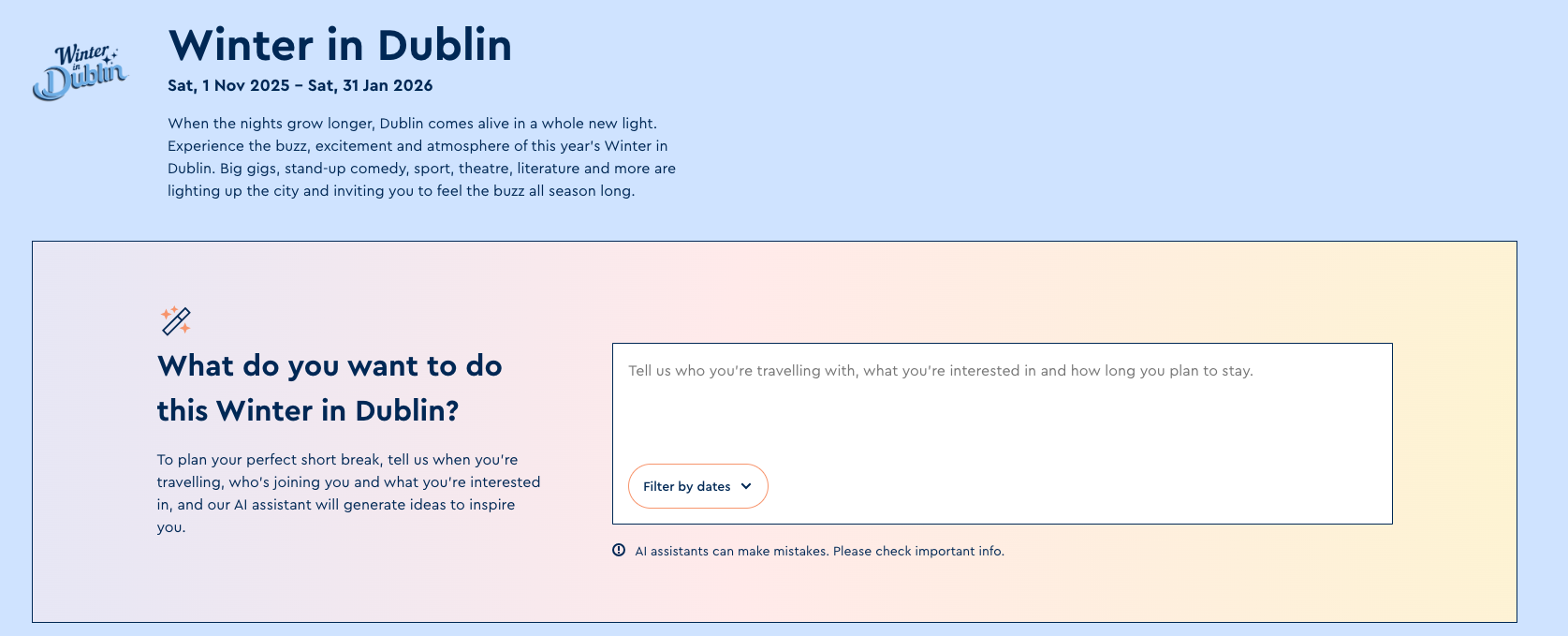
In contrast to Visit Greenland, Claire added a perspective of how technology can have substantial benefits for supporting the work of DMOs, sharing insights from a pilot AI assistant developed for Winter in Dublin — a 3-month festival in the Irish capital. The AI planning tool generated simple itineraries responding to natural language queries, helping families and groups plan around shared interests. The initiative emerged from a recognition that consumer expectations around conversational interfaces are evolving faster than traditional website development cycles. Against the backdrop of AI-driven discovery, many websites already feel dated, despite only being a few years old.
Rather than comprehensive platform redevelopment, Fáilte Ireland chose an iterative approach focused on learning. The proof of concept used Azure Documents to create a Retrieval Augmented Generation system trained exclusively on content from owned websites. This governance ensured responses are based on sources the DMO had verified, addressing concerns about accuracy and brand consistency that often accompany AI deployment.
Claire emphasised the importance of capturing first-party data about how visitors phrase queries, helping to reveal content gaps and emerging interests that remain invisible through conventional analytics. This complete data ownership dimension carries strategic significance. Unlike search engine analytics, where platforms retain the underlying query data, insights belong to the DMO. If the pilot proves scalable, Fáilte Ireland plans to integrate the approach into other campaigns, whilst also exploring potential integration with external platforms. The emphasis throughout remains on experimentation, with feedback loops informing ongoing development.
Early indicators prove encouraging. Within three weeks, the AI pilot achieved a 5-6% usage rate, compared to 3% for traditional search functionality during the equivalent period in the previous year. Based on this initial insight, even relatively simple intelligent recommendations seem to perform well at enhancing visitor experiences, quickly providing travellers with information so that they can plan trips based on their passions and travel companions.
The Enduring Appeal of Rejuvenation
Claire's closing remarks offered a fitting synthesis of the panel's broader themes. She referenced Fáilte Ireland's evolving domestic marketing strategy, noting how recent research revealed that travellers seek experiences that offer genuine renewal. These insights are shaping how the DMO’s 'Keep Discovering' campaign evolves to help Irish residents explore unfamiliar corners of their own country.
From this perspective of rejuvenation, nature's enduring appeal becomes clearer. Natural environments offer a space for decompression, a slower pace and encounters that operate on rhythms different from daily life. Sweden, Greenland and Ireland have each found distinctive ways to articulate this proposition, but what unites them is a recognition that nature serves not as a backdrop but as an active component in the rejuvenation travellers increasingly seek.
For destination marketers, understanding evolving consumer trends matters because the ways visitors express their desires are shifting. New trends will emerge and fade. Yet the core human desire for experiences that restore, connect and transform appears remarkably constant. Destinations that ground their strategies in this understanding, whilst remaining alert to the changing pathways through which travellers seek fulfilment, position themselves to thrive regardless of which specific trends define any given year.
Key Takeaways
Specificity over generality: Traveller motivations are diversifying in ways that reward targeted positioning. From beauty tourism to literary pilgrimages, visitors increasingly organise travel around personal interests. Destinations will benefit from identifying which motivations align with their offer rather than pursuing messaging that attempts to speak to everyone.
External validation as a credibility multiplier: Authenticity increasingly requires voices beyond the DMO itself to confirm what marketing promises.Visit Sweden's healthcare partnership approach and Visit Greenland's emphasis on local expertise suggest that third-party endorsement carries significant weight.
Learning-centred technology adoption: Fáilte Ireland's iterative approach to AI implementation, capturing behavioural insights whilst delivering utility, offers a model for destinations navigating technological uncertainty. Starting with small pilots that prioritise learning over immediate performance builds foundations for confident scaling.
Strategic value of first-party data: As discovery fragments across platforms, owned channels that capture visitor search data provide intelligence unavailable through platform-dependent marketing. Understanding how visitors phrase their desires provides clear input to significantly inform and influence both content development needs and targeting strategies.
Dispersal as a demand response: Research showing significant interest in quieter destinations and shoulder season travel suggests overtourism mitigation can be positioned as responding to consumer preference rather than imposing constraints. The framing of this around evolving consumer trends provides the emotional storytelling required to resonate with audiences.