We'll explore how design thinking, academia-industry collaboration and the responsible use of AI are shaping the next generation of tourism professionals and supporting the small businesses that form the backbone of destination.
When we encounter a challenge, there is a tendency to reach for technology first and to ask what tool might fix it. Yet, this instinct often gets things the wrong way around. Päivi Hanni-Vaara, Outi Kähkönen and Petra Paloniemi from Lapland University of Applied Sciences joined Nick Hall on the Leading Tourism's Transition podcast to discuss how design thinking, academia-industry collaboration and the responsible use of AI are shaping the next generation of tourism professionals and supporting the small businesses that form the backbone of destinations. What emerged was a case for putting human understanding at the centre of how destinations develop, how businesses grow and where AI fits in achieving these objectives.
Disciplined Problem Solving
Design thinking is a structured approach to problem solving that moves through stages of understanding, defining, generating ideas, prototyping and testing. A thread running throughout the process is a willingness to experiment without knowing what the end result will be. Outi is candid about how AI's current pace of change means that certainty is not an option. What matters is the disposition to keep trying, to treat each experiment as a source of learning and to remain curious. That enthusiastic and open mindset is increasingly the difference between organisations that develop real capability and those that only innovate at the surface level.
Following the methodologies of Jeanne Liedtka and Tim Ogilvie as well as Tim Brown, a systematic process enables research to proceed confidently and reframe mindsets to look at the ultimate cause of a challenge from a broader and more holistic viewpoint. This provides a way for businesses and destinations to step back from day-to-day pressures and examine a challenge properly before trying to solve it.
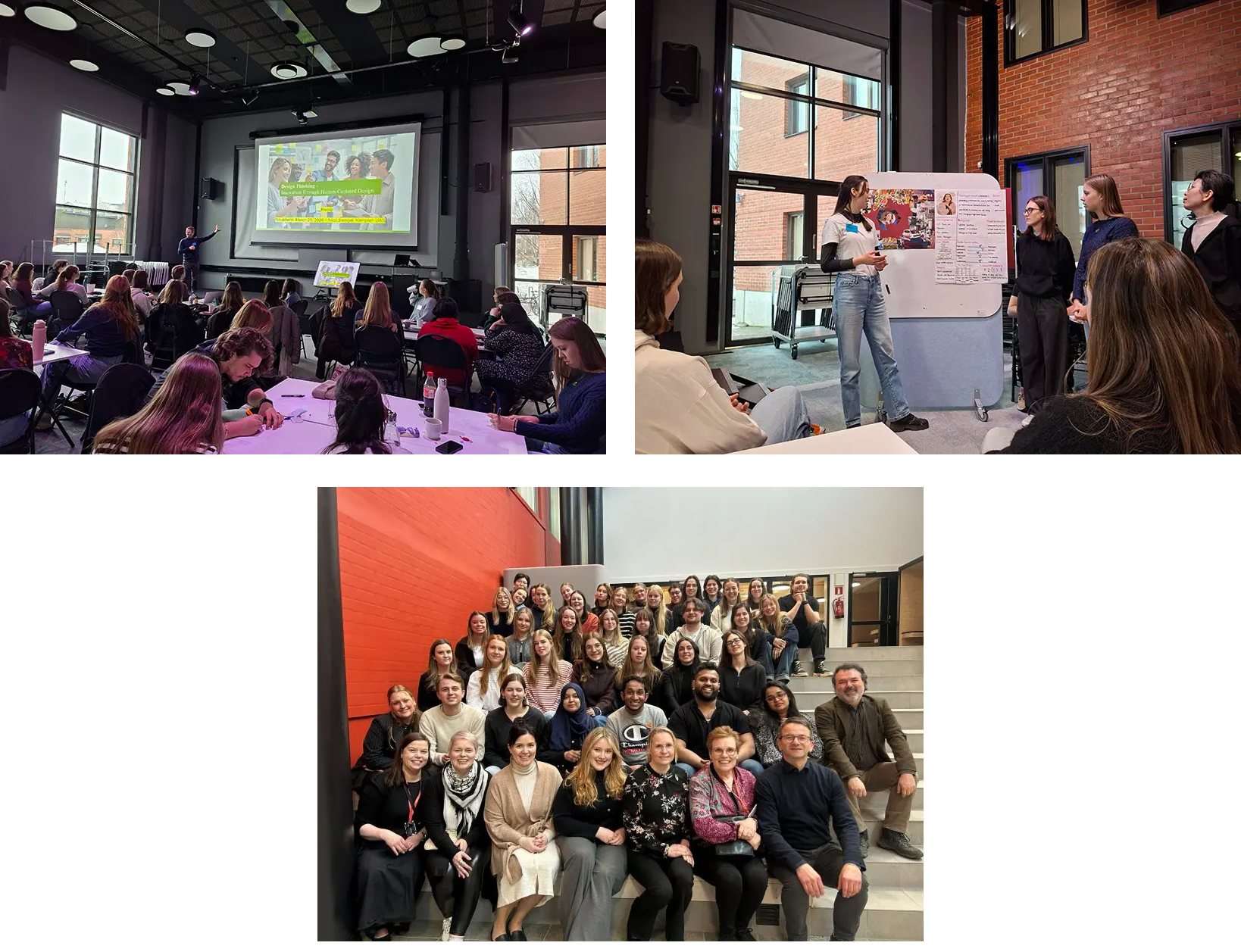
Petra has been working with design thinking for over a decade, running intensive courses in collaboration with Kempten University of Applied Sciences in Germany and Breda University of Applied Sciences in the Netherlands. Each year, students from these institutions come together in Finnish Lapland to work on tackling real issues faced by local businesses. Students begin their work before the intensive week, conducting interviews with potential customers and building their understanding of what those visitors are actually looking for. Petra explains the importance of this empathising phase, explaining that companies want to understand the real values of people who dream of a trip to Lapland. That means speaking directly to prospective visitors rather than relying on assumptions.
Nick distinguishes that the way you describe a challenge and the way you properly frame it are rarely the same thing. Design thinking forces that reframing. It asks participants to generate a very large number of ideas before evaluating any of them, a process that can feel counterintuitive but consistently produces stronger results. As Petra puts it, students are told to be "a bit of a fool" in the ideation stage, to let ideas flow without self-editing. Assessing the feasibility and inherent implications associated with proposed ideas comes later.
What also becomes clear in practice is that design thinking is not a singular activity. It requires a genuinely diverse team; people who bring different cultural backgrounds, professional instincts and ways of approaching a problem. While multicultural student groups frequently encounter friction early on, these obstacles are part of the process itself. Working through them builds the judgement and interpersonal reasoning skills that tourism careers demand. Supported by academic staff who understand when to intervene and when to let student teams find their own way through, that combination of hands-on experience, industry exposure and structured reflection is what makes the learning tangible.
While the process might seem demanding, it requires time and a willingness to sit with uncertainty before conclusions emerge. Päivi notes that both students and companies arrive wanting to know the answer quickly and both have to learn to trust the process. However, it is important to recognise that service and experience design are team disciplines. The quality of the output depends on how well the people involved know and trust one another. Before rushing into research, time must first be spent understanding each person's strengths and their motivations.
For companies, the lesson is that design thinking should not be treated as a one-off exercise with a defined endpoint. The most effective organisations treat it as an ongoing process running in the background, generating solutions continuously through collaboration, both inside the business and across wider networks.
Academia and Industry Collaboration
When universities treat businesses as genuine collaborators, Lapland University of Applied Sciences illustrates what becomes possible. In establishing the concept of 'regenerative luxury tourism' through the LUPPO project or how the e-hospitality project created real value by integrating enhanced digital touchpoints, the process compounds academic learnings that can then be applied across an industry.
The e-hospitality research, which Päivi traces back to 2010, originated from an attempt to understand how technology was changing the nature of hospitality. By 2020, it had evolved into a more pressing question. Where high-tech innovation accelerated, the human dimension of hospitality was getting lost. That observation became the foundation for a collaborative research programme that included two parallel projects, with Lapland University of Applied Sciences working alongside LAB University of Applied Sciences and Turku University of Applied Sciences to examine how digital tools could support and strengthen human connection in guest experiences.
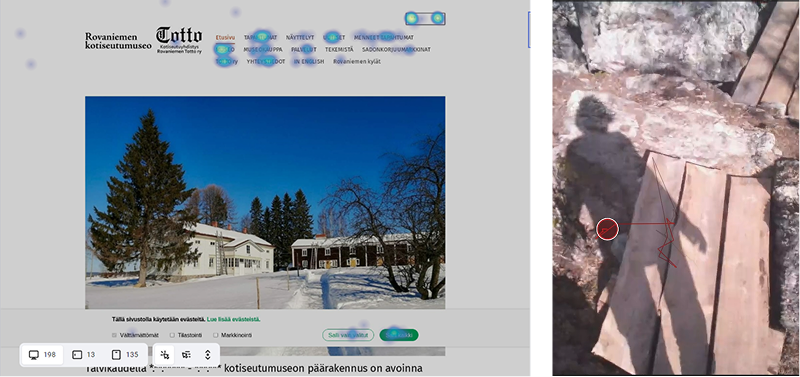
Two examples illustrate the practical value of incorporating technology to enhance the visitor journey. At a local heritage museum, eye-tracking technology and empathy mapping were used to understand how visitors were moving through and experiencing the space. The museum then used those findings to redesign its on-site service. In a second project with a tourism destination in Lapland, students used Hotjar, a web analytics tool, to analyse online visitor behaviour, identifying at which points prospective guests were dropping off the destination's website. That analysis directly informed improvements to the website's design and content.
What makes these collaborative projects successful is the combination of structured methodology, student energy and academic expertise applied to a real problem that a small business rarely finds time and resources to address alone. As Outi describes it, many tourism businesses in Lapland are micro-enterprises, where the CEO takes on many different roles. This is where the university fills that research gap, and in return, receives the applied experience that makes its teaching relevant. Päivi is adamant about the importance of this mutual dependency as a value exchange that produces better-equipped graduates, more capable businesses and a more resilient local tourism economy.
AI as a Hidden Competency
Applied industry experience becomes essential for building the necessary skills that enable students to transition from academia into industry. With AI skills becoming increasingly valued, research into how tourism businesses in Lapland currently use AI to support sales and marketing brings both familiar and revealing insights. Nearly all of them are using free ChatGPT accounts for ideation, basic editorial tasks and for translations and cultural adaptations. Most are also unaware that more powerful research features exist. This reflects a wider reality where, despite industry professionals using AI regularly, when observing how they use it, the picture is far more modest. The potential is largely untapped because the knowledge of what these AI tools can do, and the time to explore that, remains scarce.
Businesses are also already placing limits on what they accept from AI, editing the output and protecting their tone of voice. Several expressed concern that AI-generated images would undermine the authenticity of a destination where the natural landscape is the primary draw. There is also a significant note of scepticism in how businesses are approaching AI. Hallucinations, where a tool generates plausible but factually incorrect output and the biases embedded in training data remain strong concerns.
Yet this scepticism sits alongside a recognition that AI will, in the relatively near future, be woven into business processes in ways that are not always visible or optional. The task is therefore not to choose between trusting AI or distrusting it, but to build an informed, critical relationship with it that makes useful integration possible. That means knowing how to verify output, how to identify the limits of what a tool can reliably do and ensuring people make the final judgement.
Outi describes AI as "an eager and capable intern that you need to give proper instructions". That framing is essential because it positions AI as a tool that requires investment and direction rather than a system that works automatically. Good prompting, which means giving AI clear, specific and contextual instructions, takes practice and is a skill that needs to be taught. For tourism businesses, the opportunity is to free up time from the repetitive and administrative tasks that take professionals away from the face-to-face interactions that guests actually value.
Keeping Humans-in-the-Loop
Päivi raises the key dimension of the business ethics of using AI. This goes beyond standard questions of data privacy or legal compliance to consider what values guide the decisions businesses and educators make when they choose to integrate AI into their processes.
It is also worth questioning some of the assumptions the industry tends to make that younger people adopt new technology quickly. Päivi tested that assumption in early 2025 and found that around 80% of tourism and hospitality students had not yet tested AI at all. In fact, some had made a deliberate choice not to, citing concerns about the amount of energy AI consumes and the environmental cost involved. They are also a reminder that ethical reasoning about technology usage is an asset and space is needed to discuss these vital questions.
However, Petra remains resolute in her opinion that "we just have to use all the opportunities AI can offer to us for innovation". Where AI is beginning to reshape design thinking is in the parts of the process that have historically slowed it down or introduced the most friction. Synthesising large volumes of handwritten notes, transcribing and analysing recorded conversations can now be done far more quickly, with AI able to spot patterns that may previously have been missed. Prototyping, which was once one of the biggest blockers in the design thinking process because it required design skills and significant time, can now also be approached at speed. This enables us to build and to move things forward in ways that previously weren't possible.
As a result, while there are perceptions that AI is eliminating the need for design thinking and reducing creativity, the opposite is true. AI allows for an even more collaborative process, with new ideas being introduced into discussions when traditional design thinking approaches previously encountered barriers. The important corollary is that using AI well in any context still requires a design thinking approach, starting with a clear understanding of the problem, being deliberate about where AI is applied and staying critical about the response.
At Lapland University of Applied Sciences, students are allowed to use AI in their work, but must follow detailed guidance on how to use it responsibly. Assignments are designed with this in mind, while a manual of AI guidelines has been developed to make expectations clear. However, the deeper concern that Outi raises needs to be taken seriously. If students consistently outsource thinking and writing to AI, what happens to those skills over time? The same question applies across the entire industry. AI is fast and often produces plausible outputs, but plausibility is not the same as quality and speed is not the same as understanding.
Päivi's research on empathy in digital interactions adds another layer to this. She notes that current AI systems are capable of recognising and replicating certain aspects of cognitive empathy, which is the ability to understand another person's perspective and respond in kind. What they do not yet have is emotional empathy in any meaningful sense. The distinction matters because hospitality, at its best, is built on emotional connection. Guests remember how a place made them feel and no amount of accurate information or polished language substitutes for that. The time is coming when it will be harder to distinguish human from AI interaction and it is therefore more important now to be deliberate about where human input must remain.
Key Takeaways
The conversation was a reminder of what becomes possible when academia and industry commit to working together as a genuine exchange of expertise, curiosity and effort. Universities bring academic rigour, energy and structured methodologies, while businesses contribute the applied context that supports the development of lasting knowledge. This kind of collaboration deserves to be championed more often, particularly in an emerging global landscape where intuitive judgement and lived experiences are only going to become more important in moderating the increased reliance on AI outputs. The DTTT is proud to be playing a strong role in facilitating these vital connections, with our revised academia programme designed to make cross-sector collaboration a more consistent feature of how tourism develops its thinking and talent.
Here are the key takeaways:
Speed is not a measure of quality: Design thinking takes time because understanding a problem properly and moving through ideation without cutting corners requires it. Outputs shouldn't be rushed by defined end dates, with the most valuable insights emerging through an ongoing, collaborative discipline.
Hands-on learning builds judgement: The ability to analyse, synthesise, make considered recommendations and communicate findings clearly is what employers require. This is the output that structured applied learning is specifically designed to develop, where hands-on teaching develops long-term skills and knowledge.
Experimentation is the starting point:No one fully understands AI yet, including the developers building it. The organisations that develop real capability are the ones that engage with it actively, honestly test its limits and treat each experiment as a source of learning.
AI literacy requires critical thinking: Knowing how to prompt is the starting point. Understanding what AI cannot reliably do, where its biases sit, how to verify its output and when not to use it at all is the more important capability to ensure that analytical and written skills are not eroded and the workforce maintains its ability to make effective decisions.
AI integration requires ethical thinking:Decisions about where AI is used and how this usage is disclosed require active choices. Instead of measuring how capable AI is, the personal relationships inherent in tourism mean that we must first understand how well it protects and supports the human connection that the sector is built upon.
Oops! Something went wrong while submitting the form.
When we encounter a challenge, there is a tendency to reach for technology first and to ask what tool might fix it. Yet, this instinct often gets things the wrong way around. Päivi Hanni-Vaara, Outi Kähkönen and Petra Paloniemi from Lapland University of Applied Sciences joined Nick Hall on the Leading Tourism's Transition podcast to discuss how design thinking, academia-industry collaboration and the responsible use of AI are shaping the next generation of tourism professionals and supporting the small businesses that form the backbone of destinations. What emerged was a case for putting human understanding at the centre of how destinations develop, how businesses grow and where AI fits in achieving these objectives.
Disciplined Problem Solving
Design thinking is a structured approach to problem solving that moves through stages of understanding, defining, generating ideas, prototyping and testing. A thread running throughout the process is a willingness to experiment without knowing what the end result will be. Outi is candid about how AI's current pace of change means that certainty is not an option. What matters is the disposition to keep trying, to treat each experiment as a source of learning and to remain curious. That enthusiastic and open mindset is increasingly the difference between organisations that develop real capability and those that only innovate at the surface level.
Following the methodologies of Jeanne Liedtka and Tim Ogilvie as well as Tim Brown, a systematic process enables research to proceed confidently and reframe mindsets to look at the ultimate cause of a challenge from a broader and more holistic viewpoint. This provides a way for businesses and destinations to step back from day-to-day pressures and examine a challenge properly before trying to solve it.
Petra has been working with design thinking for over a decade, running intensive courses in collaboration with Kempten University of Applied Sciences in Germany and Breda University of Applied Sciences in the Netherlands. Each year, students from these institutions come together in Finnish Lapland to work on tackling real issues faced by local businesses. Students begin their work before the intensive week, conducting interviews with potential customers and building their understanding of what those visitors are actually looking for. Petra explains the importance of this empathising phase, explaining that companies want to understand the real values of people who dream of a trip to Lapland. That means speaking directly to prospective visitors rather than relying on assumptions.
Nick distinguishes that the way you describe a challenge and the way you properly frame it are rarely the same thing. Design thinking forces that reframing. It asks participants to generate a very large number of ideas before evaluating any of them, a process that can feel counterintuitive but consistently produces stronger results. As Petra puts it, students are told to be "a bit of a fool" in the ideation stage, to let ideas flow without self-editing. Assessing the feasibility and inherent implications associated with proposed ideas comes later.
What also becomes clear in practice is that design thinking is not a singular activity. It requires a genuinely diverse team; people who bring different cultural backgrounds, professional instincts and ways of approaching a problem. While multicultural student groups frequently encounter friction early on, these obstacles are part of the process itself. Working through them builds the judgement and interpersonal reasoning skills that tourism careers demand. Supported by academic staff who understand when to intervene and when to let student teams find their own way through, that combination of hands-on experience, industry exposure and structured reflection is what makes the learning tangible.
While the process might seem demanding, it requires time and a willingness to sit with uncertainty before conclusions emerge. Päivi notes that both students and companies arrive wanting to know the answer quickly and both have to learn to trust the process. However, it is important to recognise that service and experience design are team disciplines. The quality of the output depends on how well the people involved know and trust one another. Before rushing into research, time must first be spent understanding each person's strengths and their motivations.
For companies, the lesson is that design thinking should not be treated as a one-off exercise with a defined endpoint. The most effective organisations treat it as an ongoing process running in the background, generating solutions continuously through collaboration, both inside the business and across wider networks.
Academia and Industry Collaboration
When universities treat businesses as genuine collaborators, Lapland University of Applied Sciences illustrates what becomes possible. In establishing the concept of 'regenerative luxury tourism' through the LUPPO project or how the e-hospitality project created real value by integrating enhanced digital touchpoints, the process compounds academic learnings that can then be applied across an industry.
The e-hospitality research, which Päivi traces back to 2010, originated from an attempt to understand how technology was changing the nature of hospitality. By 2020, it had evolved into a more pressing question. Where high-tech innovation accelerated, the human dimension of hospitality was getting lost. That observation became the foundation for a collaborative research programme that included two parallel projects, with Lapland University of Applied Sciences working alongside LAB University of Applied Sciences and Turku University of Applied Sciences to examine how digital tools could support and strengthen human connection in guest experiences.
Two examples illustrate the practical value of incorporating technology to enhance the visitor journey. At a local heritage museum, eye-tracking technology and empathy mapping were used to understand how visitors were moving through and experiencing the space. The museum then used those findings to redesign its on-site service. In a second project with a tourism destination in Lapland, students used Hotjar, a web analytics tool, to analyse online visitor behaviour, identifying at which points prospective guests were dropping off the destination's website. That analysis directly informed improvements to the website's design and content.
What makes these collaborative projects successful is the combination of structured methodology, student energy and academic expertise applied to a real problem that a small business rarely finds time and resources to address alone. As Outi describes it, many tourism businesses in Lapland are micro-enterprises, where the CEO takes on many different roles. This is where the university fills that research gap, and in return, receives the applied experience that makes its teaching relevant. Päivi is adamant about the importance of this mutual dependency as a value exchange that produces better-equipped graduates, more capable businesses and a more resilient local tourism economy.
AI as a Hidden Competency
Applied industry experience becomes essential for building the necessary skills that enable students to transition from academia into industry. With AI skills becoming increasingly valued, research into how tourism businesses in Lapland currently use AI to support sales and marketing brings both familiar and revealing insights. Nearly all of them are using free ChatGPT accounts for ideation, basic editorial tasks and for translations and cultural adaptations. Most are also unaware that more powerful research features exist. This reflects a wider reality where, despite industry professionals using AI regularly, when observing how they use it, the picture is far more modest. The potential is largely untapped because the knowledge of what these AI tools can do, and the time to explore that, remains scarce.
Businesses are also already placing limits on what they accept from AI, editing the output and protecting their tone of voice. Several expressed concern that AI-generated images would undermine the authenticity of a destination where the natural landscape is the primary draw. There is also a significant note of scepticism in how businesses are approaching AI. Hallucinations, where a tool generates plausible but factually incorrect output and the biases embedded in training data remain strong concerns.
Yet this scepticism sits alongside a recognition that AI will, in the relatively near future, be woven into business processes in ways that are not always visible or optional. The task is therefore not to choose between trusting AI or distrusting it, but to build an informed, critical relationship with it that makes useful integration possible. That means knowing how to verify output, how to identify the limits of what a tool can reliably do and ensuring people make the final judgement.
Outi describes AI as "an eager and capable intern that you need to give proper instructions". That framing is essential because it positions AI as a tool that requires investment and direction rather than a system that works automatically. Good prompting, which means giving AI clear, specific and contextual instructions, takes practice and is a skill that needs to be taught. For tourism businesses, the opportunity is to free up time from the repetitive and administrative tasks that take professionals away from the face-to-face interactions that guests actually value.
Keeping Humans-in-the-Loop
Päivi raises the key dimension of the business ethics of using AI. This goes beyond standard questions of data privacy or legal compliance to consider what values guide the decisions businesses and educators make when they choose to integrate AI into their processes.
It is also worth questioning some of the assumptions the industry tends to make that younger people adopt new technology quickly. Päivi tested that assumption in early 2025 and found that around 80% of tourism and hospitality students had not yet tested AI at all. In fact, some had made a deliberate choice not to, citing concerns about the amount of energy AI consumes and the environmental cost involved. They are also a reminder that ethical reasoning about technology usage is an asset and space is needed to discuss these vital questions.
However, Petra remains resolute in her opinion that "we just have to use all the opportunities AI can offer to us for innovation". Where AI is beginning to reshape design thinking is in the parts of the process that have historically slowed it down or introduced the most friction. Synthesising large volumes of handwritten notes, transcribing and analysing recorded conversations can now be done far more quickly, with AI able to spot patterns that may previously have been missed. Prototyping, which was once one of the biggest blockers in the design thinking process because it required design skills and significant time, can now also be approached at speed. This enables us to build and to move things forward in ways that previously weren't possible.
As a result, while there are perceptions that AI is eliminating the need for design thinking and reducing creativity, the opposite is true. AI allows for an even more collaborative process, with new ideas being introduced into discussions when traditional design thinking approaches previously encountered barriers. The important corollary is that using AI well in any context still requires a design thinking approach, starting with a clear understanding of the problem, being deliberate about where AI is applied and staying critical about the response.
At Lapland University of Applied Sciences, students are allowed to use AI in their work, but must follow detailed guidance on how to use it responsibly. Assignments are designed with this in mind, while a manual of AI guidelines has been developed to make expectations clear. However, the deeper concern that Outi raises needs to be taken seriously. If students consistently outsource thinking and writing to AI, what happens to those skills over time? The same question applies across the entire industry. AI is fast and often produces plausible outputs, but plausibility is not the same as quality and speed is not the same as understanding.
Päivi's research on empathy in digital interactions adds another layer to this. She notes that current AI systems are capable of recognising and replicating certain aspects of cognitive empathy, which is the ability to understand another person's perspective and respond in kind. What they do not yet have is emotional empathy in any meaningful sense. The distinction matters because hospitality, at its best, is built on emotional connection. Guests remember how a place made them feel and no amount of accurate information or polished language substitutes for that. The time is coming when it will be harder to distinguish human from AI interaction and it is therefore more important now to be deliberate about where human input must remain.
Key Takeaways
The conversation was a reminder of what becomes possible when academia and industry commit to working together as a genuine exchange of expertise, curiosity and effort. Universities bring academic rigour, energy and structured methodologies, while businesses contribute the applied context that supports the development of lasting knowledge. This kind of collaboration deserves to be championed more often, particularly in an emerging global landscape where intuitive judgement and lived experiences are only going to become more important in moderating the increased reliance on AI outputs. The DTTT is proud to be playing a strong role in facilitating these vital connections, with our revised academia programme designed to make cross-sector collaboration a more consistent feature of how tourism develops its thinking and talent.
Here are the key takeaways:
Speed is not a measure of quality: Design thinking takes time because understanding a problem properly and moving through ideation without cutting corners requires it. Outputs shouldn't be rushed by defined end dates, with the most valuable insights emerging through an ongoing, collaborative discipline.
Hands-on learning builds judgement: The ability to analyse, synthesise, make considered recommendations and communicate findings clearly is what employers require. This is the output that structured applied learning is specifically designed to develop, where hands-on teaching develops long-term skills and knowledge.
Experimentation is the starting point:No one fully understands AI yet, including the developers building it. The organisations that develop real capability are the ones that engage with it actively, honestly test its limits and treat each experiment as a source of learning.
AI literacy requires critical thinking: Knowing how to prompt is the starting point. Understanding what AI cannot reliably do, where its biases sit, how to verify its output and when not to use it at all is the more important capability to ensure that analytical and written skills are not eroded and the workforce maintains its ability to make effective decisions.
AI integration requires ethical thinking:Decisions about where AI is used and how this usage is disclosed require active choices. Instead of measuring how capable AI is, the personal relationships inherent in tourism mean that we must first understand how well it protects and supports the human connection that the sector is built upon.
Continue reading...
Get access to 100s of case studies, workshop templates, industry leading events and more.




.svg)