Embedding AI in Destination Marketing: From Hype to Long-Term Utility

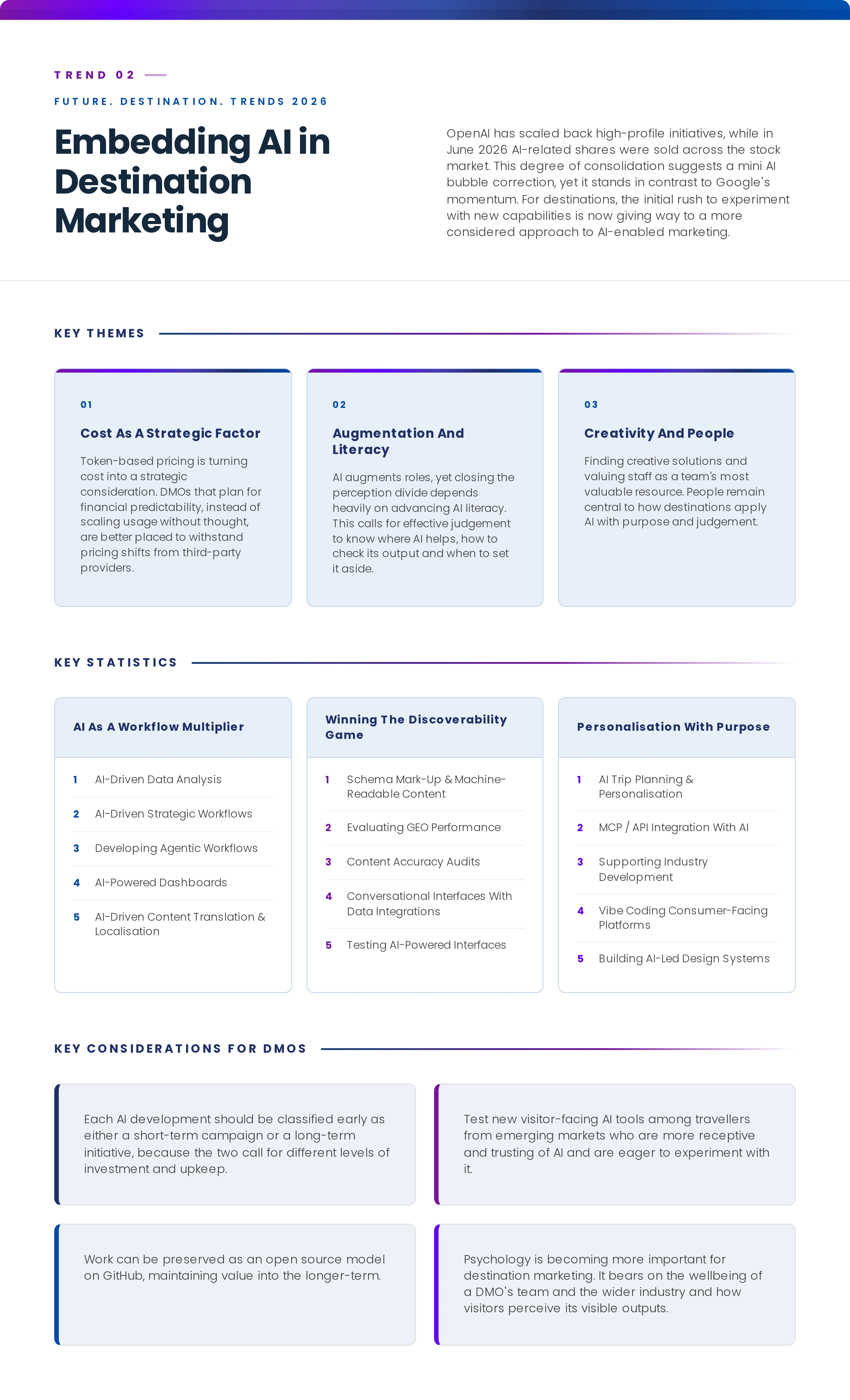
Is the narrative around generative AI shifting? For destinations, the initial rush to experiment with new capabilities is now giving way to a more considered approach to AI-enabled marketing, focused on stability and long-term utility.

Is the narrative around generative AI shifting? Some market leaders, such as OpenAI, have scaled back high-profile platforms such as Sora and paused the roll-out of AI-enabled transactions. This cautionary approach is also visible in stock market shifts, with investors selling off AI-related shares in June 2026 on doubts about whether the scale of AI spending will pay off. This degree of consolidation suggests a mini AI bubble correction, yet it stands in contrast to Google's momentum in embedding Gemini directly into the traveller's journey through Google Maps and its Universal Commerce Protocol that supports agentic shopping.

For destinations, the initial rush to experiment with new capabilities is now giving way to a more considered approach to AI-enabled marketing, focused on stability and long-term utility. Travel is too complex for quick-fix distribution and deciding where AI belongs takes considerable thought about where the strategic opportunities lie. On this point, DTTT's panel of destination experts is unanimous in the belief that the industry is currently looking at AI from a long-term perspective.

What The Mini AI Bubble Correction Signals

Cost is becoming a strategic concern, with decisions taken now having long-term consequences. AI tools are billed by the token, the small units of text that a model reads as input and produces as output. Over the past year and across industries, many teams pushed to use as much AI as possible, a habit nicknamed tokenmaxxing. Yet, as bills climbed, some businesses have since changed course. The shift towards tokenomics, by understanding token cost and using AI in a financially predictable way, is one that any destination AI strategy should recognise as an external risk. A capability that looks permanent can be repriced, restricted or withdrawn with little notice when terms of use are revised. A DMO that leans heavily on a third-party AI tool is highly exposed to these financial risks.

The speed of change is the other reason to assess each initiative carefully. One case in point is NBTC's decision to take its Cycling Lifestyle AI tool offline in January 2026, three years after launch. The tool leveraged a customised Stable Diffusion model to modify Google Street View images, reimagining streets around the world as green, cycle-friendly spaces. Over 290,000 people were inspired by the platform, with 100,000 cycle-friendly streets generated within 24 hours alone. Yet, with updated models having overtaken its capability, the initiative has been depreciated, with the work preserved as an open source model on GitHub, the shared home for much of the AI developer community. A key learning here is that each AI development should be classified early as either a short-term campaign or a long-term initiative, because the two call for different levels of investment and upkeep.

Source: NBTC

Workflow and Productivity

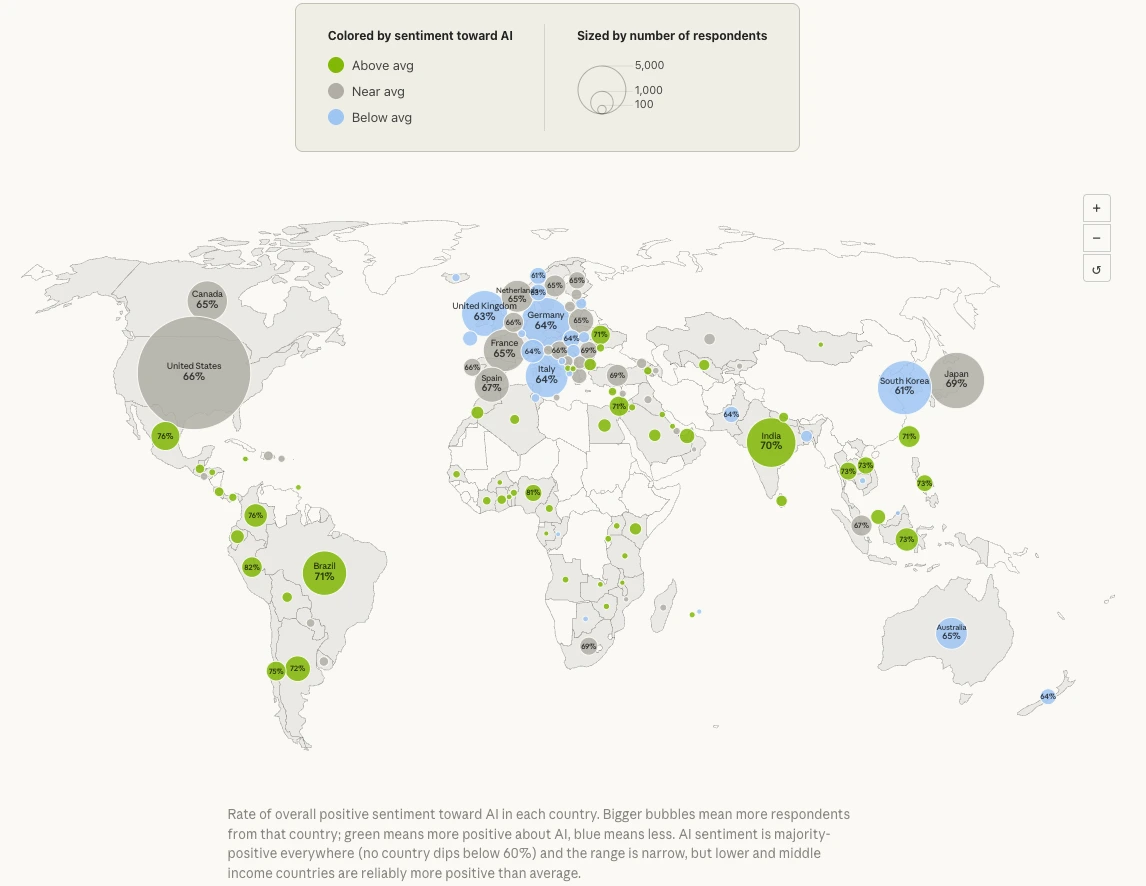
For DMOs, the most pressing need is for clear AI integration in workflows. AI is most useful when it augments people's roles, though the evidence on whether it achieves this ambition is mixed. Anthropic's study of more than 80,000 AI users found that 32% reported that AI had increased their productivity, while 19% said it had not yet delivered what they hoped for. Unreliability was the single most common worry of all, raised by 27%. The same tensions recur to a lesser extent when contrasting time saving (50%) and concerns of illusory productivity (18%), the sense of working faster only to absorb more work. On decision-making, however, the split was sharper, with 22% valuing AI as providing beneficial support while 37% named its unreliability as a clear harm. Closing this perception divide depends heavily on literacy, requiring effective judgement to know where AI helps, how to check its output and when to set it aside.

Source: Anthropic

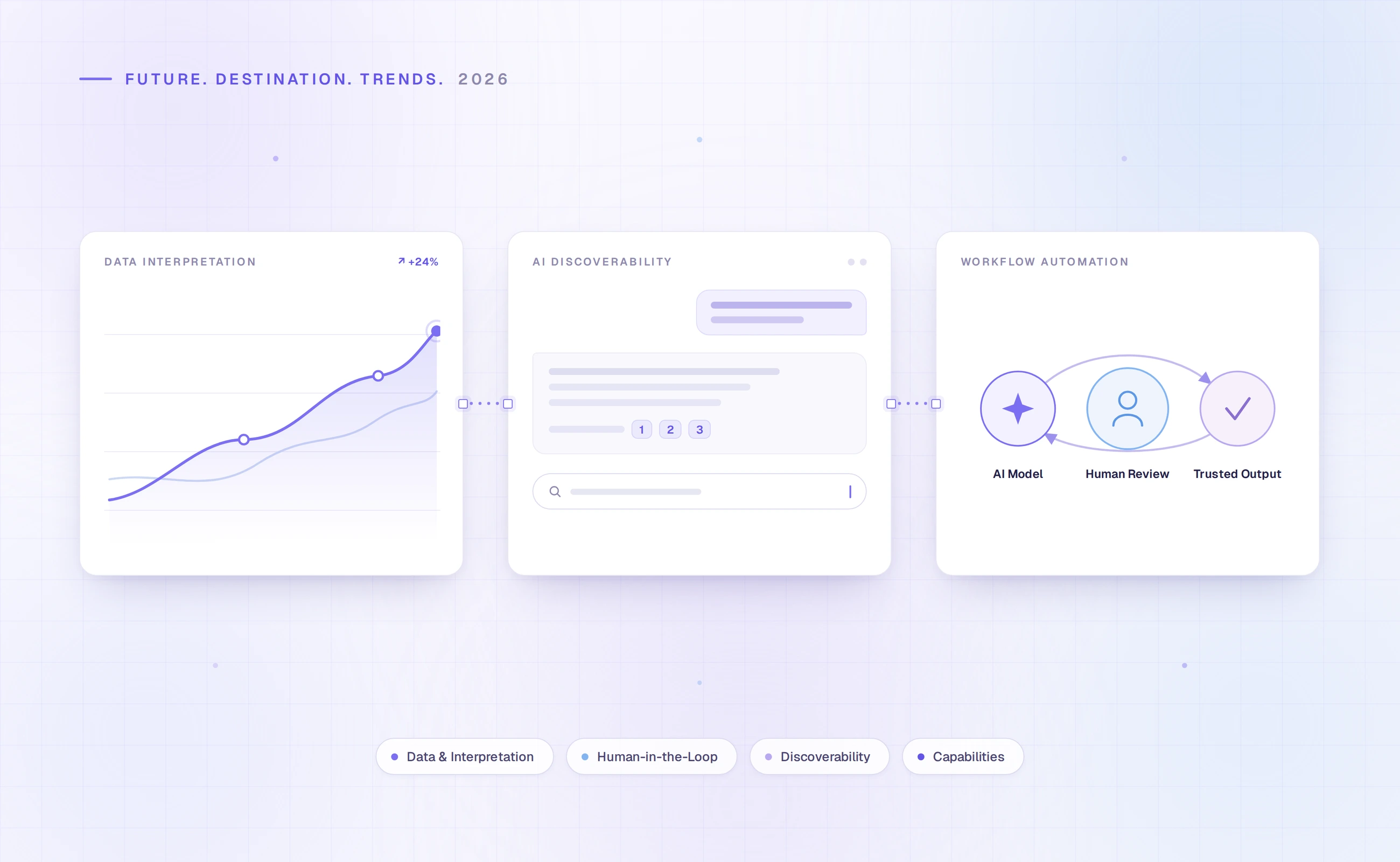
For our panel, the strongest near-term gain is in data analysis. AI can read large datasets and return plain-language answers, which lets teams make data-based decisions more quickly and with more confidence. This enhanced efficiency implies that teams no longer need to ask specialists for complex analytics, with AI able to handle the work of sorting, summarising and spotting patterns. As a result, analysts and marketers can both be more efficient with their time. Yet, a core concern remains around data security and accuracy, which are key determinants of whether AI actually brings its long-promised advantages.

AI also strengthens the workflows that sit around a decision. Anthropic's Economic Index found that augmented, human-in-the-loop use now makes up the majority of activity (52%), with shared capabilities such as customised skills and persistent memory pushing usage towards more collaborative work. For destinations, this is where AI helps teams work more closely together, with shared files and systems informing what each team does next. Integrating AI into the platforms teams already work in means shared context is maintained, eliminating the silos that once kept work separated and creating the conditions that enable enhanced collaboration.

Agentic AI takes the streamlining of workflows further. An AI agent can carry out a multi-step task on its own, which suits repetitive work, such as monitoring listings, tagging content or compiling routine reports. Automating that kind of task frees people to focus on what matters, though agents need oversight and clear limits, both structural and financial. This is particularly important since research shows a current lack of diversity in agentic AI models. As agentic workflows become more commonplace, job roles will likewise adapt. IKEA provides a notable example of how automating repetitive tasks and retraining staff to do the remaining tasks even better can generate significant productivity gains. By introducing a chatbot and upskilling their call centre team to become interior designers, a cost saving of €13 million was vastly surpassed by the €1.3 billion additional revenue stream generated. This shows how finding creative solutions can boost performance when leveraging staff as a team's most valuable resource.

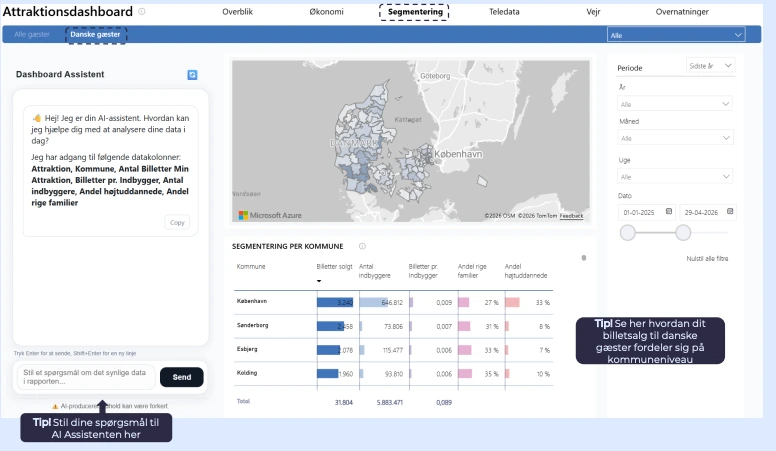
At the same time, AI-powered dashboards make information far easier to find, significantly improving the usability of these tools. Destination Canada has built conversational AI into its Canadian Tourism Data Collective through Aurora AI, letting users hold a natural-language conversation and ask how different visitor segments think and plan. VisitDenmark also recently introduced similar functionalities to its national data platform, VisitData, where an AI assistant explains charts and answers questions. Both examples highlight the benefits of moving away from simply giving access to data towards helping teams understand it, with AI as an enabler in the process.

Source: VisitData

Of least priority to our panel was content translation and localisation. While 75% of consumers will look elsewhere when they can't find information in their preferred language, Google Translate's website widget enables visitors to translate content into their native language automatically. This external solution means that translation is often a limited consideration, except where more complex languages are involved. However, localisation goes beyond translation, adapting tone, references and imagery to each market. AI lowers the cost of doing this well and reaching target markets more effectively.

Discoverability in AI

Building upon this internal transformation, AI is also changing how people find destination content. While AI remains a secondary tool for most travellers, it is gradually emerging as an influential platform for recommending destinations. This means DMOs are increasingly researching how they are being understood, trusted and recommended by AI systems. In many cases, ongoing projects are exploring these trends directly, identifying where best to show up and intervene, with testing and learning planned when search volumes to a destination's content ecosystem are at their highest.

Ensuring content is machine-readable is the foundation of DMO activities in this field, with schema, the shared vocabulary that lets machines understand what a piece of content describes, being among the most important priorities. When a destination marks its information this way, AI assistants and search tools can read and reuse it. When the data is poorly structured, a destination's offer can fall out of AI-generated search and planning journeys altogether. This means that the underlying structure of a destination's website needs extensive review and remedial plans drawn up to respond to this emerging trend. However, Framer's State of Sites 2026 highlights that for many teams, 53% of website edits are spent on maintenance as opposed to improvements. With technical blockers hard to overcome quickly, strong leadership is required to keep teams motivated as the underlying data gets transferred into a format that can be read by AI.

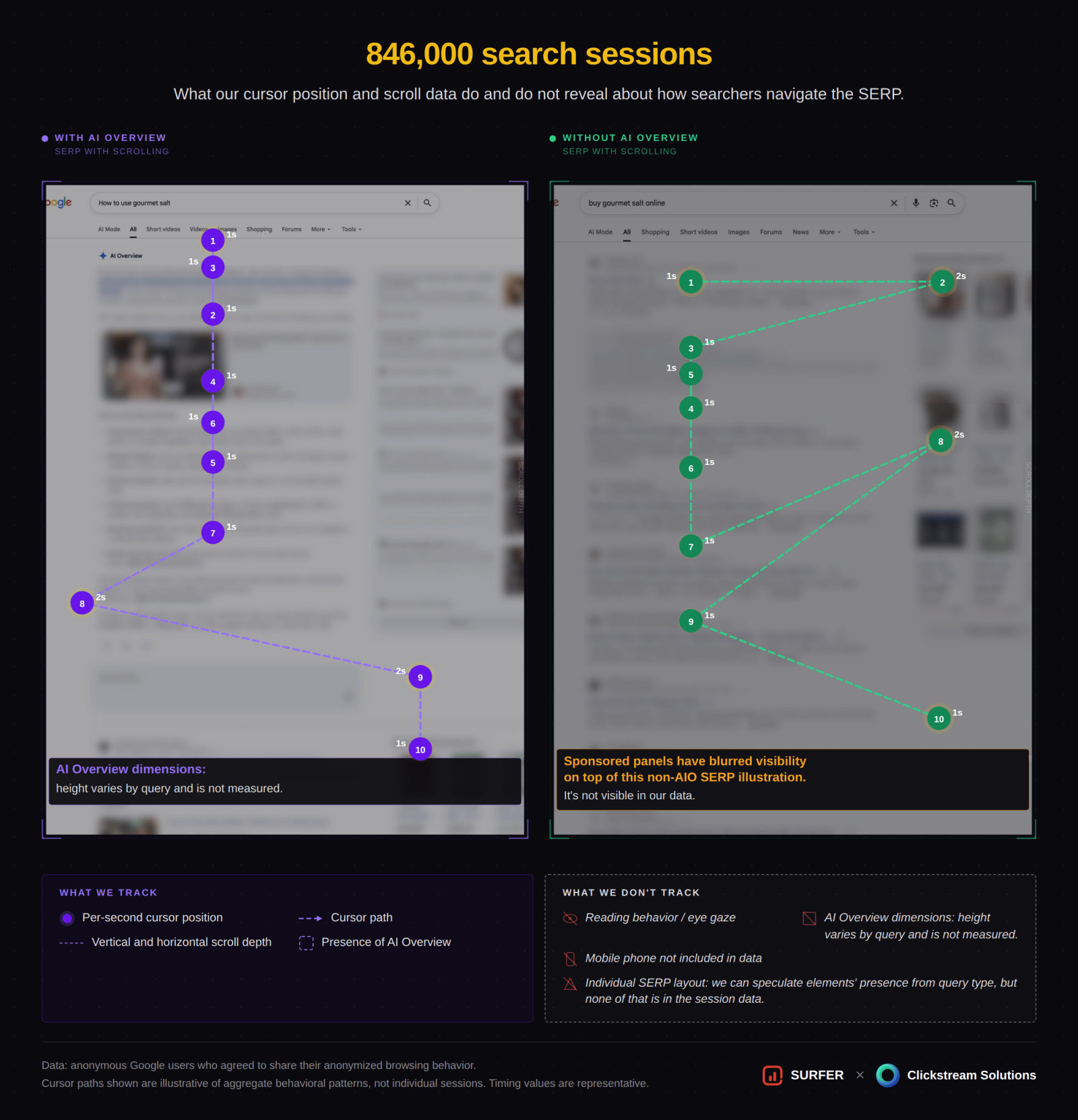
For many, measuring Generative Engine Optimisation (GEO), the practice of getting cited inside AI-generated answers, has become a core strategic priority. With ChatGPT now having a billion monthly users and Google's AI Overviews changing how users search the internet, destinations need a way to measure whether they are being surfaced and cited, because traditional rankings no longer tell the full story. AI trust and authority scores and AI-driven demand lift will soon become established metrics that DMOs rely upon, recognising that AI-driven traffic often arrives on a DMO's website with stronger intent.

Source: Search Engine Journal

Content checks matter just as much since AI systems can repeat information that is out of date. Research found that one in ten AI overviews is incorrect, with the consequences borne by destinations that have been misrepresented. Regular audits of what AI says about a place and the sources behind it help DMOs to better understand the perceptions of their destination and take action to ensure information is correct and current.

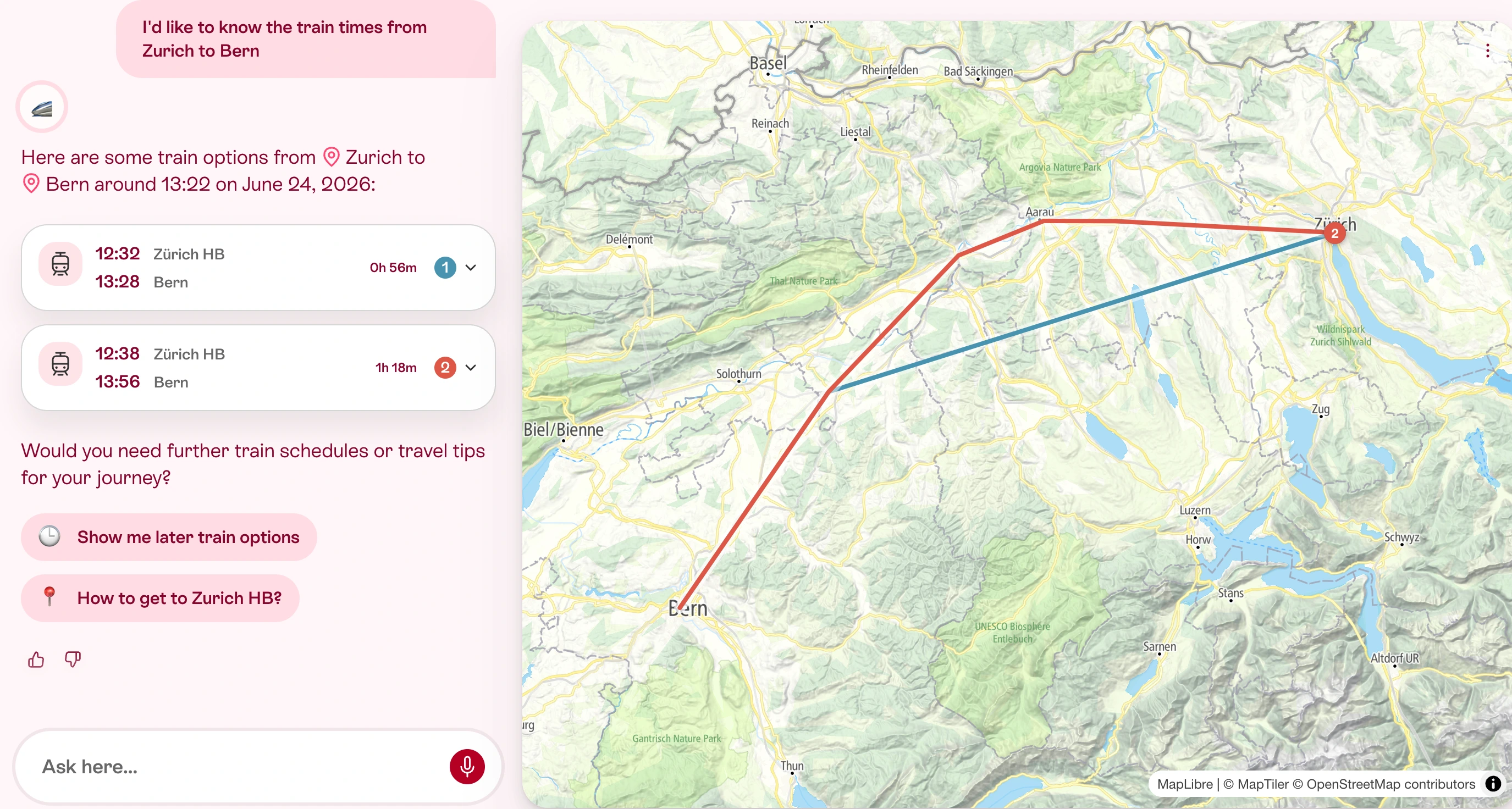
Conversational interfaces backed by data integrations are the next layer, where a smaller number of DMOs have prioritised. Switzerland Tourism's chatbot lets a visitor ask for the train times between two cities and returns a timetable, showing departure and arrival times, journey length and the number of changes. This streamlining of information sources through API connections improves the visitor experience by minimising the number of different platforms they have to visit in the planning process.

Source: Switzerland Tourism

However, a conversational front-end is only as good as the structured data feeding it, meaning that such functionalities should only be released after extensive testing to ensure accuracy and reliability are maintained. This regular testing is not a one-time job and should become an embedded practice in destination marketing to ensure that the destination offer is being communicated effectively. This feedback is vital for making ongoing improvements as well as for recognising when an AI-enabled interface needs to be temporarily or permanently taken offline.

Taking AI Further Through Internal Capabilities

What stands out from our panel's responses is the overwhelming importance of AI trip planning and personalisation. In providing functional tools, visitors can navigate a destination's offers more effectively; however, design and usability considerations must always be placed at the forefront. This includes critical choices, such as whether trip planning tools should assist with managing visitor flows. For example, Discover Flagstaff's AI trip planner uses detailed questions to narrow down potential options based on each visitor's specific interests and is designed to deprioritise locations once they pass a weekly recommendation threshold. However, prioritising visitor dispersal as a strategic objective of trip planners also risks underselling the hero attractions that draw visitors in the first place.

Source: LighthousePE

A key note of caution is that interest in such tools is strongest in emerging markets. 81% of travellers in China use AI to design itineraries and seek inspiration, alongside 71% in India, with adoption lower in Europe at 35% in Spain and 24% in France. While concerns around hallucinations affect the degree of trust, localisation of content may be the ideal route into experimenting with trip planning, with these emerging markets best placed to test new tools before rolling them out globally.

The technical backbone that drives how efficiently AI accesses a destination's data are Application Programming Interface (API) integration and Model Context Protocol (MCP). An API lets developers build services on top of a destination's data, as Visit Sweden's open national API does, with around 14,000 tourism listings structured to a shared standard and made freely available. This is essential because there are many competing listings for the same business, so having a structured way to update information in one place streamlines efficiency. MCP goes a step further by giving AI systems and agents a standard way to directly reach structured data. The German National Tourist Board has recently launched an MCP server so developers can plug German tourism data straight into automated AI tools. WebMCP is the next evolution of this protocol, which will directly integrate websites so that users are able to interact with them through an LLM or agent.

Creating a structured approach for businesses to update their information and for this to be fed directly into AI constitutes just one way that DMOs are supporting industry development. This matters enormously because a destination's strength depends on the businesses also adjusting to the new technological landscape. Helping smaller operators get AI-ready and enabling them to develop and grow their business is part of a destination's role. This is particularly relevant given a recent YouGov survey highlighted a strong reluctance from these businesses to adapt to AI, with 54% of UK SMEs unlikely to replace their traditional platforms.

To a lesser extent, DMOs are experimenting with vibe coding, the practice of building software by describing what you want to an AI in plain language. Done without care, this can create a messy spread of websites about one destination that confuses visitors and dilutes the brand. However, when planned with precision, it has clear potential, because a site built for a single, well-defined audience can speak to that group far more directly than a broad destination website packed with content. Ultimately, the deciding factor is whether each new site has a clear purpose and audience. Nevertheless, where most DMOs are taking advantage of this capability is by building detailed mock-ups as a proof-of-concept.

In a similar vein, the recent emergence of AI-led design systems is what keeps the consistency of vibe coded outputs. A design system, a shared set of colours, fonts, components and templates, gives both humans and AI a fixed reference, so that content generated at speed still sounds and looks like the place it represents. As AI-supported content gradually becomes more accepted and produces more material across more channels, a strong design system protects branding and positioning and turns scale into an advantage.

With so many potential applications, AI is a strategic trend that destination marketing will be working with for years. The current opportunity is to use it to sharpen data analysis, understand visitor behaviour, personalise content and make a destination's information easier to find across the new AI-powered search and planning tools travellers turn to. That work sits alongside the human side of destination marketing. A destination's identity, local knowledge and creativity remain essential and AI earns its place by supporting teams to go further. The priority is responsible and practical use focused on better decisions, improved visitor experiences and stronger support for the local tourism ecosystem.

Bringing AI into both internal workflows and visitor-facing tools also makes psychology a larger part of destination marketing. It bears on the wellbeing of a DMO's team and the wider industry and how visitors perceive its visible outputs. The destinations that get this balance right will treat AI as a long-term capability, prioritising AI literacy and confidence first before rushing beyond the most pressing trends and foundational layer. As the direction of travel in AI development has begun to settle, teams can now plan with more confidence. Since AI adoption tends to involve reworking existing processes, finding new ways to create value and guarding against steep costs associated with an AI-first approach, a step-by-step approach and weighing decisions carefully helps keep potential risks in check before experimenting with more advanced capabilities.

Subscribe to our Newsletter

Thank you! Your submission has been received!
Oops! Something went wrong while submitting the form.

Is the narrative around generative AI shifting? Some market leaders, such as OpenAI, have scaled back high-profile platforms such as Sora and paused the roll-out of AI-enabled transactions. This cautionary approach is also visible in stock market shifts, with investors selling off AI-related shares in June 2026 on doubts about whether the scale of AI spending will pay off. This degree of consolidation suggests a mini AI bubble correction, yet it stands in contrast to Google's momentum in embedding Gemini directly into the traveller's journey through Google Maps and its Universal Commerce Protocol that supports agentic shopping.

For destinations, the initial rush to experiment with new capabilities is now giving way to a more considered approach to AI-enabled marketing, focused on stability and long-term utility. Travel is too complex for quick-fix distribution and deciding where AI belongs takes considerable thought about where the strategic opportunities lie. On this point, DTTT's panel of destination experts is unanimous in the belief that the industry is currently looking at AI from a long-term perspective.

What The Mini AI Bubble Correction Signals

Cost is becoming a strategic concern, with decisions taken now having long-term consequences. AI tools are billed by the token, the small units of text that a model reads as input and produces as output. Over the past year and across industries, many teams pushed to use as much AI as possible, a habit nicknamed tokenmaxxing. Yet, as bills climbed, some businesses have since changed course. The shift towards tokenomics, by understanding token cost and using AI in a financially predictable way, is one that any destination AI strategy should recognise as an external risk. A capability that looks permanent can be repriced, restricted or withdrawn with little notice when terms of use are revised. A DMO that leans heavily on a third-party AI tool is highly exposed to these financial risks.

The speed of change is the other reason to assess each initiative carefully. One case in point is NBTC's decision to take its Cycling Lifestyle AI tool offline in January 2026, three years after launch. The tool leveraged a customised Stable Diffusion model to modify Google Street View images, reimagining streets around the world as green, cycle-friendly spaces. Over 290,000 people were inspired by the platform, with 100,000 cycle-friendly streets generated within 24 hours alone. Yet, with updated models having overtaken its capability, the initiative has been depreciated, with the work preserved as an open source model on GitHub, the shared home for much of the AI developer community. A key learning here is that each AI development should be classified early as either a short-term campaign or a long-term initiative, because the two call for different levels of investment and upkeep.

Source: NBTC

Workflow and Productivity

For DMOs, the most pressing need is for clear AI integration in workflows. AI is most useful when it augments people's roles, though the evidence on whether it achieves this ambition is mixed. Anthropic's study of more than 80,000 AI users found that 32% reported that AI had increased their productivity, while 19% said it had not yet delivered what they hoped for. Unreliability was the single most common worry of all, raised by 27%. The same tensions recur to a lesser extent when contrasting time saving (50%) and concerns of illusory productivity (18%), the sense of working faster only to absorb more work. On decision-making, however, the split was sharper, with 22% valuing AI as providing beneficial support while 37% named its unreliability as a clear harm. Closing this perception divide depends heavily on literacy, requiring effective judgement to know where AI helps, how to check its output and when to set it aside.

Source: Anthropic

For our panel, the strongest near-term gain is in data analysis. AI can read large datasets and return plain-language answers, which lets teams make data-based decisions more quickly and with more confidence. This enhanced efficiency implies that teams no longer need to ask specialists for complex analytics, with AI able to handle the work of sorting, summarising and spotting patterns. As a result, analysts and marketers can both be more efficient with their time. Yet, a core concern remains around data security and accuracy, which are key determinants of whether AI actually brings its long-promised advantages.

AI also strengthens the workflows that sit around a decision. Anthropic's Economic Index found that augmented, human-in-the-loop use now makes up the majority of activity (52%), with shared capabilities such as customised skills and persistent memory pushing usage towards more collaborative work. For destinations, this is where AI helps teams work more closely together, with shared files and systems informing what each team does next. Integrating AI into the platforms teams already work in means shared context is maintained, eliminating the silos that once kept work separated and creating the conditions that enable enhanced collaboration.

Agentic AI takes the streamlining of workflows further. An AI agent can carry out a multi-step task on its own, which suits repetitive work, such as monitoring listings, tagging content or compiling routine reports. Automating that kind of task frees people to focus on what matters, though agents need oversight and clear limits, both structural and financial. This is particularly important since research shows a current lack of diversity in agentic AI models. As agentic workflows become more commonplace, job roles will likewise adapt. IKEA provides a notable example of how automating repetitive tasks and retraining staff to do the remaining tasks even better can generate significant productivity gains. By introducing a chatbot and upskilling their call centre team to become interior designers, a cost saving of €13 million was vastly surpassed by the €1.3 billion additional revenue stream generated. This shows how finding creative solutions can boost performance when leveraging staff as a team's most valuable resource.

At the same time, AI-powered dashboards make information far easier to find, significantly improving the usability of these tools. Destination Canada has built conversational AI into its Canadian Tourism Data Collective through Aurora AI, letting users hold a natural-language conversation and ask how different visitor segments think and plan. VisitDenmark also recently introduced similar functionalities to its national data platform, VisitData, where an AI assistant explains charts and answers questions. Both examples highlight the benefits of moving away from simply giving access to data towards helping teams understand it, with AI as an enabler in the process.

Source: VisitData

Of least priority to our panel was content translation and localisation. While 75% of consumers will look elsewhere when they can't find information in their preferred language, Google Translate's website widget enables visitors to translate content into their native language automatically. This external solution means that translation is often a limited consideration, except where more complex languages are involved. However, localisation goes beyond translation, adapting tone, references and imagery to each market. AI lowers the cost of doing this well and reaching target markets more effectively.

Discoverability in AI

Building upon this internal transformation, AI is also changing how people find destination content. While AI remains a secondary tool for most travellers, it is gradually emerging as an influential platform for recommending destinations. This means DMOs are increasingly researching how they are being understood, trusted and recommended by AI systems. In many cases, ongoing projects are exploring these trends directly, identifying where best to show up and intervene, with testing and learning planned when search volumes to a destination's content ecosystem are at their highest.

Ensuring content is machine-readable is the foundation of DMO activities in this field, with schema, the shared vocabulary that lets machines understand what a piece of content describes, being among the most important priorities. When a destination marks its information this way, AI assistants and search tools can read and reuse it. When the data is poorly structured, a destination's offer can fall out of AI-generated search and planning journeys altogether. This means that the underlying structure of a destination's website needs extensive review and remedial plans drawn up to respond to this emerging trend. However, Framer's State of Sites 2026 highlights that for many teams, 53% of website edits are spent on maintenance as opposed to improvements. With technical blockers hard to overcome quickly, strong leadership is required to keep teams motivated as the underlying data gets transferred into a format that can be read by AI.

For many, measuring Generative Engine Optimisation (GEO), the practice of getting cited inside AI-generated answers, has become a core strategic priority. With ChatGPT now having a billion monthly users and Google's AI Overviews changing how users search the internet, destinations need a way to measure whether they are being surfaced and cited, because traditional rankings no longer tell the full story. AI trust and authority scores and AI-driven demand lift will soon become established metrics that DMOs rely upon, recognising that AI-driven traffic often arrives on a DMO's website with stronger intent.

Source: Search Engine Journal

Content checks matter just as much since AI systems can repeat information that is out of date. Research found that one in ten AI overviews is incorrect, with the consequences borne by destinations that have been misrepresented. Regular audits of what AI says about a place and the sources behind it help DMOs to better understand the perceptions of their destination and take action to ensure information is correct and current.

Conversational interfaces backed by data integrations are the next layer, where a smaller number of DMOs have prioritised. Switzerland Tourism's chatbot lets a visitor ask for the train times between two cities and returns a timetable, showing departure and arrival times, journey length and the number of changes. This streamlining of information sources through API connections improves the visitor experience by minimising the number of different platforms they have to visit in the planning process.

Source: Switzerland Tourism

However, a conversational front-end is only as good as the structured data feeding it, meaning that such functionalities should only be released after extensive testing to ensure accuracy and reliability are maintained. This regular testing is not a one-time job and should become an embedded practice in destination marketing to ensure that the destination offer is being communicated effectively. This feedback is vital for making ongoing improvements as well as for recognising when an AI-enabled interface needs to be temporarily or permanently taken offline.

Taking AI Further Through Internal Capabilities

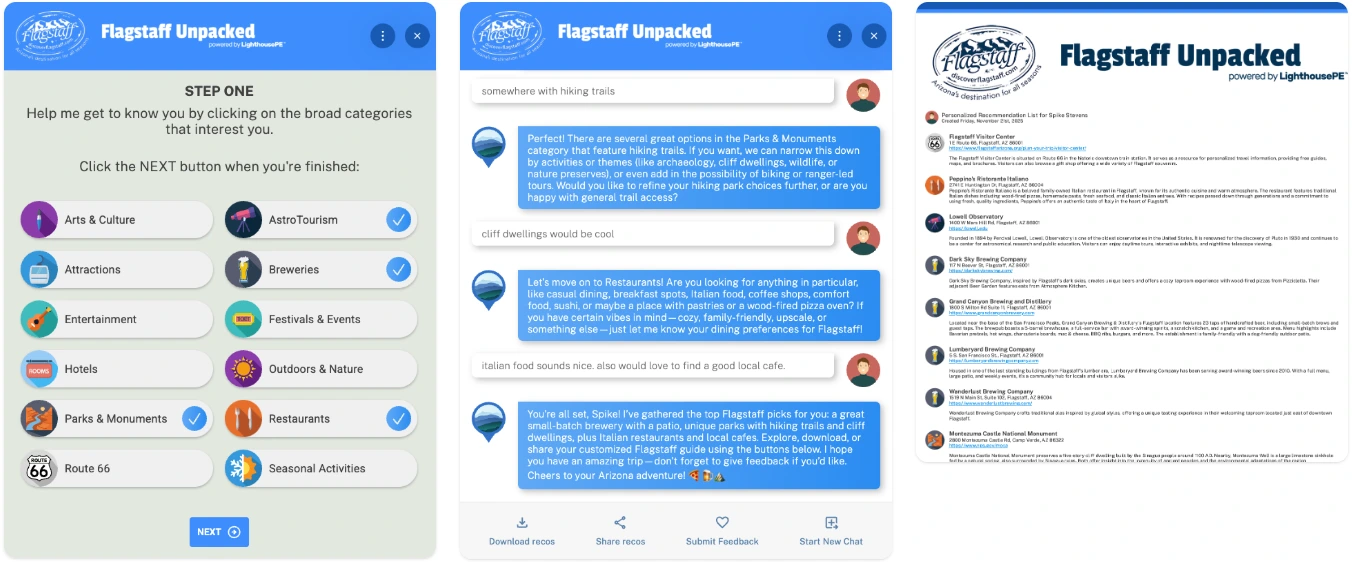
What stands out from our panel's responses is the overwhelming importance of AI trip planning and personalisation. In providing functional tools, visitors can navigate a destination's offers more effectively; however, design and usability considerations must always be placed at the forefront. This includes critical choices, such as whether trip planning tools should assist with managing visitor flows. For example, Discover Flagstaff's AI trip planner uses detailed questions to narrow down potential options based on each visitor's specific interests and is designed to deprioritise locations once they pass a weekly recommendation threshold. However, prioritising visitor dispersal as a strategic objective of trip planners also risks underselling the hero attractions that draw visitors in the first place.

Source: LighthousePE

A key note of caution is that interest in such tools is strongest in emerging markets. 81% of travellers in China use AI to design itineraries and seek inspiration, alongside 71% in India, with adoption lower in Europe at 35% in Spain and 24% in France. While concerns around hallucinations affect the degree of trust, localisation of content may be the ideal route into experimenting with trip planning, with these emerging markets best placed to test new tools before rolling them out globally.

The technical backbone that drives how efficiently AI accesses a destination's data are Application Programming Interface (API) integration and Model Context Protocol (MCP). An API lets developers build services on top of a destination's data, as Visit Sweden's open national API does, with around 14,000 tourism listings structured to a shared standard and made freely available. This is essential because there are many competing listings for the same business, so having a structured way to update information in one place streamlines efficiency. MCP goes a step further by giving AI systems and agents a standard way to directly reach structured data. The German National Tourist Board has recently launched an MCP server so developers can plug German tourism data straight into automated AI tools. WebMCP is the next evolution of this protocol, which will directly integrate websites so that users are able to interact with them through an LLM or agent.

Creating a structured approach for businesses to update their information and for this to be fed directly into AI constitutes just one way that DMOs are supporting industry development. This matters enormously because a destination's strength depends on the businesses also adjusting to the new technological landscape. Helping smaller operators get AI-ready and enabling them to develop and grow their business is part of a destination's role. This is particularly relevant given a recent YouGov survey highlighted a strong reluctance from these businesses to adapt to AI, with 54% of UK SMEs unlikely to replace their traditional platforms.

To a lesser extent, DMOs are experimenting with vibe coding, the practice of building software by describing what you want to an AI in plain language. Done without care, this can create a messy spread of websites about one destination that confuses visitors and dilutes the brand. However, when planned with precision, it has clear potential, because a site built for a single, well-defined audience can speak to that group far more directly than a broad destination website packed with content. Ultimately, the deciding factor is whether each new site has a clear purpose and audience. Nevertheless, where most DMOs are taking advantage of this capability is by building detailed mock-ups as a proof-of-concept.

In a similar vein, the recent emergence of AI-led design systems is what keeps the consistency of vibe coded outputs. A design system, a shared set of colours, fonts, components and templates, gives both humans and AI a fixed reference, so that content generated at speed still sounds and looks like the place it represents. As AI-supported content gradually becomes more accepted and produces more material across more channels, a strong design system protects branding and positioning and turns scale into an advantage.

With so many potential applications, AI is a strategic trend that destination marketing will be working with for years. The current opportunity is to use it to sharpen data analysis, understand visitor behaviour, personalise content and make a destination's information easier to find across the new AI-powered search and planning tools travellers turn to. That work sits alongside the human side of destination marketing. A destination's identity, local knowledge and creativity remain essential and AI earns its place by supporting teams to go further. The priority is responsible and practical use focused on better decisions, improved visitor experiences and stronger support for the local tourism ecosystem.

Bringing AI into both internal workflows and visitor-facing tools also makes psychology a larger part of destination marketing. It bears on the wellbeing of a DMO's team and the wider industry and how visitors perceive its visible outputs. The destinations that get this balance right will treat AI as a long-term capability, prioritising AI literacy and confidence first before rushing beyond the most pressing trends and foundational layer. As the direction of travel in AI development has begun to settle, teams can now plan with more confidence. Since AI adoption tends to involve reworking existing processes, finding new ways to create value and guarding against steep costs associated with an AI-first approach, a step-by-step approach and weighing decisions carefully helps keep potential risks in check before experimenting with more advanced capabilities.

Subscribe to our Newsletter

Thank you! Your submission has been received!
Oops! Something went wrong while submitting the form.