How Literature Influences Destination Branding

Literature has shaped how people imagine places for centuries. Long before destinations had marketing budgets, books drew travellers to specific landscapes, streets and cafés on the strength of a character's footsteps alone.

Literature has shaped how people imagine places for centuries. Long before destinations had marketing budgets, books drew travellers to specific landscapes, streets and cafés on the strength of a character's footsteps alone. That instinct has not weakened. If anything, the rise of book clubs, BookTok, screen adaptations and reading retreats has given literary tourism a fresh commercial relevance.

The numbers reflect it. Future Market Insights values the global literary tourism market at $2.4 billion in 2024, projected to reach $3.3 billion by 2034. A recent Explore Worldwide survey, reported by Business Traveller, found that 72% of its travellers had visited a destination based on a book they had read. For DMOs, that is a meaningful and often underused lever. Literary travellers tend to skew educated, intellectually curious and willing to spend on cultural experiences, exactly the kind of high-value visitor most destinations are now trying to attract.

The opportunities for DMOs span heritage sites, contemporary fiction, screen adaptations, festivals and book towns. Several destinations are already using literature to extend dwell time, disperse visitors and build lasting brand associations.

Following the author's footsteps

The most established model for literary tourism is the author trail. Spain offers one of the clearest examples. The official Hemingway Route, promoted through partnerships between Turespaña and the regional tourist boards of Navarre, La Rioja and the Basque Country, invites visitors to retrace the corners of northern Spain that shaped The Sun Also Rises, Death in the Afternoon and For Whom the Bell Tolls. Pamplona's Café Iruña, the Hotel La Perla (where his old room still bears the number 201 in his honour), the village of Burguete, the Irati river and San Sebastián all anchor a route that links cities, rural areas and gastronomy under a single recognisable narrative.

Source: Discover Spain

What makes the Hemingway Route effective is the way it connects established attractions, like the San Fermín festival, to lesser-known towns and landscapes that benefit from the association. Tourism Euskadi has built a parallel "Hemingway Basque Route", weaving in Bilbao, Eibar, Deba and Donostia. The result is a multi-region story that uses one author to legitimise a wider geography.

Reinterpreting national heritage through contemporary writers

Where Spain has leaned on a foreign author's love affair, Portugal has taken the opposite approach, building a flagship literary tourism platform around its own Nobel laureate. Journey to Portugal Revisited, promoted by Visit Portugal, reimagines José Saramago's 1981 travelogue Journey to Portugal forty years on. Across fourteen itineraries spanning Guimarães, Coimbra, Tomar, Mafra, Évora, Beja, Alcoutim and Lagos, contemporary writer José Luís Peixoto hosts eight international authors from Brazil, Angola, the United States, Spain, France and Argentina, who each produce original texts about the places they visit.

Source: Visit Portugal

Saramago's original book gives the project literary credibility, Peixoto provides continuity and the international authors expand the campaign's reach into their own readerships and language markets. Each itinerary works as both a promotional asset and a genuine travel route, with regional information embedded directly into the Visit Portugal site. It turns a single literary work into a national content engine that supports regional dispersal.

Visit Portugal has extended this positioning into international book festivals. In April 2026, Turismo de Portugal took a 70-square-metre institutional stand at the 50th Buenos Aires International Book Fair, presenting the exhibition concept "Una mesa para leer Portugal" (A table for reading Portugal) and 50 suggestions for literary experiences across the country, from writers' homes and literary routes to libraries, bookshops and festivals. The Portuguese delegation included authors Afonso Cruz and Valter Hugo Mãe, and the activation formed part of a wider strategy to position literary tourism as a structured product. Closer to home, Visit Portugal returned as a sponsor of Ireland's Dalkey Book Festival in June 2026 for the second consecutive year, hosting tastings, music and workshops at The Corner Note café in the heart of the village. Both activations show how a DMO can use international literary events to reach engaged, culturally curious audiences in priority source markets.

Using literature to take a brand position

Literary tourism does not have to be about the past. Visit Seattle's Bookmarked Banned Edition uses the city's UNESCO City of Literature status, and its identity as one of only three US cities to make banned books available nationwide, to take a clear cultural position. The series features short films in which notable Seattleites read excerpts from books by local authors that have been banned elsewhere in the country. Dan Savage reads Shaun David Hutchinson's Brave Face, actor Jeremy Rudd reads Jewell Parker Rhodes's Ghost Boys and artist Angelina Villalobos reads Jonathan Evison's Lawn Boy.

The campaign targets a traveller segment identified as 200% more likely to be in book clubs and 40% more likely to read at least twice a week. The tagline, "In Seattle, your story matters", links freedom of expression to the city's wider proposition as a welcoming, progressive place to visit. It is one of the strongest recent examples of a DMO using literature to make a values-led brand statement rather than simply promote a list of attractions.

Capitalising on screen tourism

The crossover between books and screen adaptations is one of the most commercially significant developments for literary tourism. VisitScotland's response to the Outlander franchise has become the benchmark. Since the television adaptation of Diana Gabaldon's novels first aired in 2014, VisitScotland has built dedicated content hubs, themed itineraries, ancestry tie-ins and trade campaigns around the show, recognising that fans engage with both the books and the locations.

The impact on heritage sites has been substantial. VisitScotland's own analysis shows that the 23 most prominent Outlander attractions saw visitor numbers rise from 1.47 million in 2014 to 3.20 million by 2020 and visitscotland.com Outlander pages have averaged around half a million views a year since launch. Diana Gabaldon was awarded a special "International Contribution to Scottish Tourism" recognition at the Scottish Thistle Awards in 2019. When a book or its adaptation is generating organic destination demand, the DMO's role is to channel and shape that demand, not simply observe it.

Building festivals around a single book

Few literary tourism propositions are as concentrated as Bloomsday in Dublin. Held every 16 June, the day on which James Joyce's Ulysses is set, the Bloomsday Festival has run in its current weeklong form since 1994 and now features more than 100 separate events across the city. It is delivered by the James Joyce Centre with support from Fáilte Ireland and the Department of Tourism, Culture, Arts, Gaeltacht, Sport and Media, and is promoted by Tourism Ireland through ireland.com.

Bloomsday is more than a single anniversary. It generates literary breakfasts, walking tours, dramatised readings, costumed parades and pub crawls that activate Dublin's hospitality, retail and cultural sectors simultaneously. It also gives Tourism Ireland a recurring annual content moment with global recognition, with parallel celebrations now staged in cities including New York, Sydney and Trieste. For destinations with a strong literary anchor, building around a fixed date is one of the most effective ways to convert heritage into a repeatable economic event.

Building a destination brand around a literary figure

Some destinations have gone further still and made a single author the organising principle of their entire identity. Shakespeare's England, the Local Visitor Economy Partnership (LVEP) for Warwickshire, is one of the clearest examples in the UK. The organisation covers Stratford-upon-Avon, Warwick, Kenilworth, Royal Leamington Spa and the surrounding county and uses Shakespeare as a unifying brand for a region that combines literary heritage, castles, countryside and a strong food and drink offer. The brand sits across the official tourism website, itineraries, the Shakespeare Pass and the LVEP's wider destination management function, and explicitly invites visitors to "write your story in Shakespeare's England".

The model is instructive because it shows how a literary figure can act as a brand anchor for a multi-town region rather than a single attraction. It also gives a coherent positioning to towns that might otherwise compete for the same visitor.

Developing literary tourism as a cross-border product

The growing perception of literary tourism as a serious travel motivator is reflected in deliberate product development at the European level. The DANTE project, funded through the Interreg Italy-Slovenia 2021–2027 programme with a budget of around €1.37 million, is developing a cross-border literary trail based on Dante Alighieri's documented presence in what is now Friuli Venezia Giulia and Posočje. The project, led by the Municipality of Izola with five partners across Italy and Slovenia, will deliver five interactive one-day routes, visitor centres in Izola, Tolmin and Ceggia and joint events tied to the PordenoneLegge and Vilenica literary festivals. It runs until October 2026, with a published report on literary tourism already available through the project pages.

Source: Interreg VI-A Italy-Slovenia Programme

The Friuli Venezia Giulia region also hosts a wider resource library on literary tourism through its regional portal, which collects research, project outputs and good practice from across Europe. For DMOs looking to develop their own literary tourism product, these resources offer a useful reference point.

DTTT Take

The examples above show that literary tourism is no longer a niche cultural product. It is being used by DMOs to disperse visitors, position destinations on values, capitalise on screen adaptations, build recurring annual moments and anchor entire regional brands. The opportunities are wide, but they reward destinations that treat their literary heritage as a strategic asset rather than a heritage footnote. Some points to remember:

  1. Use literary heritage to disperse visitors. Authors rarely sit in a single city. Routes, like the Hemingway trail or Journey to Portugal Revisited, are an effective way to connect well-known anchors with less-visited regions and turn one literary association into many.
  2. Refresh historical material with contemporary voices. Visit Portugal's decision to invite international writers to reinterpret Saramago is a useful template. A heritage figure provides credibility, but contemporary authors give the campaign new audiences, fresh language and renewed media value.
  3. Use literature to take a brand position. Seattle's Bookmarked work shows how literary content can carry values-led messaging that resonates with specific traveller segments. Done well, this avoids generic destination messaging and gives the DMO a clear point of view.
  4. Treat screen adaptations as literary tourism opportunities. As Visit Britain's data has long indicated, book-led travel and screen-led travel overlap heavily. The DMOs that succeed are the ones that build planning resources and trade content around the original source material as well as the show.
  5. Anchor recurring annual moments. Bloomsday demonstrates the value of a fixed literary event in the calendar. A single date, supported by authentic local programming, creates predictable demand and a recognisable platform for international PR.
  6. Use authors as regional brand anchors and invest in product development. Shakespeare's England shows how a literary figure can unify a multi-town region under a single identity, while the cross-border DANTE project illustrates how destinations are now investing in dedicated literary product, routes and infrastructure rather than relying on existing heritage alone.

Literature is one of the most durable forms of destination storytelling available to a DMO and it travels well across generations, languages and formats. The destinations treating their literary heritage as a strategic asset, rather than a legacy thread, are the ones turning readers into long-term visitors.

Literature has shaped how people imagine places for centuries. Long before destinations had marketing budgets, books drew travellers to specific landscapes, streets and cafés on the strength of a character's footsteps alone. That instinct has not weakened. If anything, the rise of book clubs, BookTok, screen adaptations and reading retreats has given literary tourism a fresh commercial relevance.

The numbers reflect it. Future Market Insights values the global literary tourism market at $2.4 billion in 2024, projected to reach $3.3 billion by 2034. A recent Explore Worldwide survey, reported by Business Traveller, found that 72% of its travellers had visited a destination based on a book they had read. For DMOs, that is a meaningful and often underused lever. Literary travellers tend to skew educated, intellectually curious and willing to spend on cultural experiences, exactly the kind of high-value visitor most destinations are now trying to attract.

The opportunities for DMOs span heritage sites, contemporary fiction, screen adaptations, festivals and book towns. Several destinations are already using literature to extend dwell time, disperse visitors and build lasting brand associations.

Following the author's footsteps

The most established model for literary tourism is the author trail. Spain offers one of the clearest examples. The official Hemingway Route, promoted through partnerships between Turespaña and the regional tourist boards of Navarre, La Rioja and the Basque Country, invites visitors to retrace the corners of northern Spain that shaped The Sun Also Rises, Death in the Afternoon and For Whom the Bell Tolls. Pamplona's Café Iruña, the Hotel La Perla (where his old room still bears the number 201 in his honour), the village of Burguete, the Irati river and San Sebastián all anchor a route that links cities, rural areas and gastronomy under a single recognisable narrative.

Source: Discover Spain

What makes the Hemingway Route effective is the way it connects established attractions, like the San Fermín festival, to lesser-known towns and landscapes that benefit from the association. Tourism Euskadi has built a parallel "Hemingway Basque Route", weaving in Bilbao, Eibar, Deba and Donostia. The result is a multi-region story that uses one author to legitimise a wider geography.

Reinterpreting national heritage through contemporary writers

Where Spain has leaned on a foreign author's love affair, Portugal has taken the opposite approach, building a flagship literary tourism platform around its own Nobel laureate. Journey to Portugal Revisited, promoted by Visit Portugal, reimagines José Saramago's 1981 travelogue Journey to Portugal forty years on. Across fourteen itineraries spanning Guimarães, Coimbra, Tomar, Mafra, Évora, Beja, Alcoutim and Lagos, contemporary writer José Luís Peixoto hosts eight international authors from Brazil, Angola, the United States, Spain, France and Argentina, who each produce original texts about the places they visit.

Source: Visit Portugal

Saramago's original book gives the project literary credibility, Peixoto provides continuity and the international authors expand the campaign's reach into their own readerships and language markets. Each itinerary works as both a promotional asset and a genuine travel route, with regional information embedded directly into the Visit Portugal site. It turns a single literary work into a national content engine that supports regional dispersal.

Visit Portugal has extended this positioning into international book festivals. In April 2026, Turismo de Portugal took a 70-square-metre institutional stand at the 50th Buenos Aires International Book Fair, presenting the exhibition concept "Una mesa para leer Portugal" (A table for reading Portugal) and 50 suggestions for literary experiences across the country, from writers' homes and literary routes to libraries, bookshops and festivals. The Portuguese delegation included authors Afonso Cruz and Valter Hugo Mãe, and the activation formed part of a wider strategy to position literary tourism as a structured product. Closer to home, Visit Portugal returned as a sponsor of Ireland's Dalkey Book Festival in June 2026 for the second consecutive year, hosting tastings, music and workshops at The Corner Note café in the heart of the village. Both activations show how a DMO can use international literary events to reach engaged, culturally curious audiences in priority source markets.

Using literature to take a brand position

Literary tourism does not have to be about the past. Visit Seattle's Bookmarked Banned Edition uses the city's UNESCO City of Literature status, and its identity as one of only three US cities to make banned books available nationwide, to take a clear cultural position. The series features short films in which notable Seattleites read excerpts from books by local authors that have been banned elsewhere in the country. Dan Savage reads Shaun David Hutchinson's Brave Face, actor Jeremy Rudd reads Jewell Parker Rhodes's Ghost Boys and artist Angelina Villalobos reads Jonathan Evison's Lawn Boy.

The campaign targets a traveller segment identified as 200% more likely to be in book clubs and 40% more likely to read at least twice a week. The tagline, "In Seattle, your story matters", links freedom of expression to the city's wider proposition as a welcoming, progressive place to visit. It is one of the strongest recent examples of a DMO using literature to make a values-led brand statement rather than simply promote a list of attractions.

Capitalising on screen tourism

The crossover between books and screen adaptations is one of the most commercially significant developments for literary tourism. VisitScotland's response to the Outlander franchise has become the benchmark. Since the television adaptation of Diana Gabaldon's novels first aired in 2014, VisitScotland has built dedicated content hubs, themed itineraries, ancestry tie-ins and trade campaigns around the show, recognising that fans engage with both the books and the locations.

The impact on heritage sites has been substantial. VisitScotland's own analysis shows that the 23 most prominent Outlander attractions saw visitor numbers rise from 1.47 million in 2014 to 3.20 million by 2020 and visitscotland.com Outlander pages have averaged around half a million views a year since launch. Diana Gabaldon was awarded a special "International Contribution to Scottish Tourism" recognition at the Scottish Thistle Awards in 2019. When a book or its adaptation is generating organic destination demand, the DMO's role is to channel and shape that demand, not simply observe it.

Building festivals around a single book

Few literary tourism propositions are as concentrated as Bloomsday in Dublin. Held every 16 June, the day on which James Joyce's Ulysses is set, the Bloomsday Festival has run in its current weeklong form since 1994 and now features more than 100 separate events across the city. It is delivered by the James Joyce Centre with support from Fáilte Ireland and the Department of Tourism, Culture, Arts, Gaeltacht, Sport and Media, and is promoted by Tourism Ireland through ireland.com.

Bloomsday is more than a single anniversary. It generates literary breakfasts, walking tours, dramatised readings, costumed parades and pub crawls that activate Dublin's hospitality, retail and cultural sectors simultaneously. It also gives Tourism Ireland a recurring annual content moment with global recognition, with parallel celebrations now staged in cities including New York, Sydney and Trieste. For destinations with a strong literary anchor, building around a fixed date is one of the most effective ways to convert heritage into a repeatable economic event.

Building a destination brand around a literary figure

Some destinations have gone further still and made a single author the organising principle of their entire identity. Shakespeare's England, the Local Visitor Economy Partnership (LVEP) for Warwickshire, is one of the clearest examples in the UK. The organisation covers Stratford-upon-Avon, Warwick, Kenilworth, Royal Leamington Spa and the surrounding county and uses Shakespeare as a unifying brand for a region that combines literary heritage, castles, countryside and a strong food and drink offer. The brand sits across the official tourism website, itineraries, the Shakespeare Pass and the LVEP's wider destination management function, and explicitly invites visitors to "write your story in Shakespeare's England".

The model is instructive because it shows how a literary figure can act as a brand anchor for a multi-town region rather than a single attraction. It also gives a coherent positioning to towns that might otherwise compete for the same visitor.

Developing literary tourism as a cross-border product

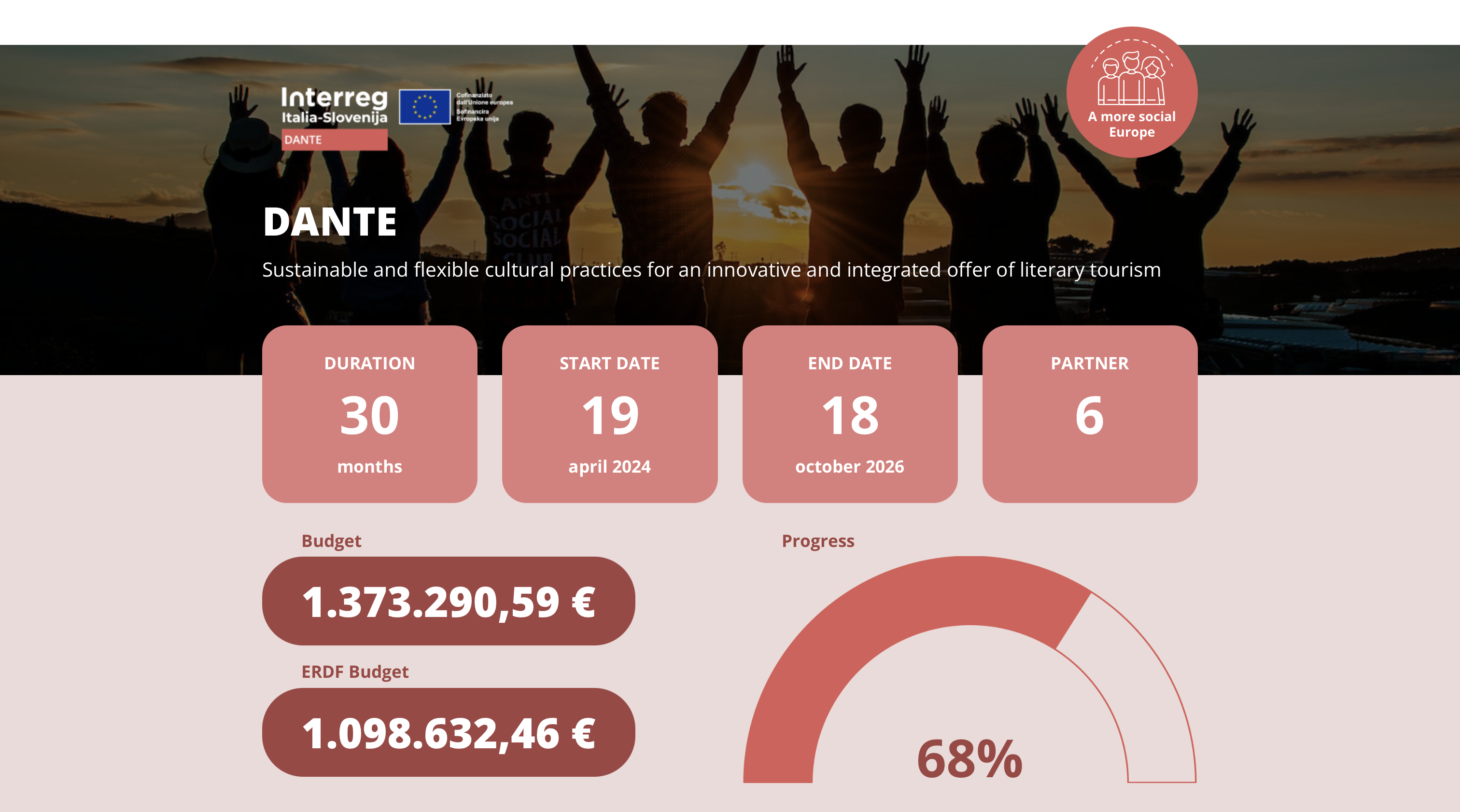
The growing perception of literary tourism as a serious travel motivator is reflected in deliberate product development at the European level. The DANTE project, funded through the Interreg Italy-Slovenia 2021–2027 programme with a budget of around €1.37 million, is developing a cross-border literary trail based on Dante Alighieri's documented presence in what is now Friuli Venezia Giulia and Posočje. The project, led by the Municipality of Izola with five partners across Italy and Slovenia, will deliver five interactive one-day routes, visitor centres in Izola, Tolmin and Ceggia and joint events tied to the PordenoneLegge and Vilenica literary festivals. It runs until October 2026, with a published report on literary tourism already available through the project pages.

Source: Interreg VI-A Italy-Slovenia Programme

The Friuli Venezia Giulia region also hosts a wider resource library on literary tourism through its regional portal, which collects research, project outputs and good practice from across Europe. For DMOs looking to develop their own literary tourism product, these resources offer a useful reference point.

DTTT Take

The examples above show that literary tourism is no longer a niche cultural product. It is being used by DMOs to disperse visitors, position destinations on values, capitalise on screen adaptations, build recurring annual moments and anchor entire regional brands. The opportunities are wide, but they reward destinations that treat their literary heritage as a strategic asset rather than a heritage footnote. Some points to remember:

  1. Use literary heritage to disperse visitors. Authors rarely sit in a single city. Routes, like the Hemingway trail or Journey to Portugal Revisited, are an effective way to connect well-known anchors with less-visited regions and turn one literary association into many.
  2. Refresh historical material with contemporary voices. Visit Portugal's decision to invite international writers to reinterpret Saramago is a useful template. A heritage figure provides credibility, but contemporary authors give the campaign new audiences, fresh language and renewed media value.
  3. Use literature to take a brand position. Seattle's Bookmarked work shows how literary content can carry values-led messaging that resonates with specific traveller segments. Done well, this avoids generic destination messaging and gives the DMO a clear point of view.
  4. Treat screen adaptations as literary tourism opportunities. As Visit Britain's data has long indicated, book-led travel and screen-led travel overlap heavily. The DMOs that succeed are the ones that build planning resources and trade content around the original source material as well as the show.
  5. Anchor recurring annual moments. Bloomsday demonstrates the value of a fixed literary event in the calendar. A single date, supported by authentic local programming, creates predictable demand and a recognisable platform for international PR.
  6. Use authors as regional brand anchors and invest in product development. Shakespeare's England shows how a literary figure can unify a multi-town region under a single identity, while the cross-border DANTE project illustrates how destinations are now investing in dedicated literary product, routes and infrastructure rather than relying on existing heritage alone.

Literature is one of the most durable forms of destination storytelling available to a DMO and it travels well across generations, languages and formats. The destinations treating their literary heritage as a strategic asset, rather than a legacy thread, are the ones turning readers into long-term visitors.