Showing Up Earlier With Relevance: Destination Glasgow and Tiki
Discover how Destination Glasgow used AI and Tiki’s Envoy to boost U.S. tourism. This article reveals how dynamic, contextual ads achieved a 7.98% CTR by reaching travellers exactly when they were planning their trips to Scotland.
DTTT Knowledge Team
15 Apr 2026
In this piece
This is a featured article as part of a paid partnership with Tiki.
Destination Glasgow leads the city's visitor economy and positions Scotland's largest city as a key international gateway. With priority inbound markets including the USA, Canada, Germany and France, the organisation carries a significant responsibility in making sure Glasgow competes credibly in international trip planning conversations.
The conditions heading into this campaign were demanding. Attention was fragmented across platforms, competition from other European gateway cities was intense and demand for authentic, local experiences was rising. Destination Glasgow had recently defined a new brand identity around the values of Gallus, which is Scottish term for bold or daring, Warm and Creative, and needed marketing that could carry that personality directly into the moments when travellers were actively choosing their destination.
Destination Glasgow set out to run a high-performing display campaign in the U.S. market that increased awareness efficiently and proved return on investment. The deeper challenge, once examined, centred on timing and relevance. Gateway cities often get flattened by national narratives, and reaching travellers after their decisions have already formed offers limited value. Glasgow needed to enter the consideration journey earlier, with messaging informed by what travellers were actually looking for rather than what the destination assumed they wanted.
Compounding this was a gap in decision-making intelligence. The DMO lacked certainty on why people were choosing Glasgow, whether for its culture, music, food, authenticity or its convenience as a gateway city. Without that clarity, sequencing the right story at the right time was difficult to do credibly or consistently. The campaign also needed to demonstrate value to a wide range of internal stakeholders while advancing the organisation's growing interest in AI adoption within its marketing approach.
The approach
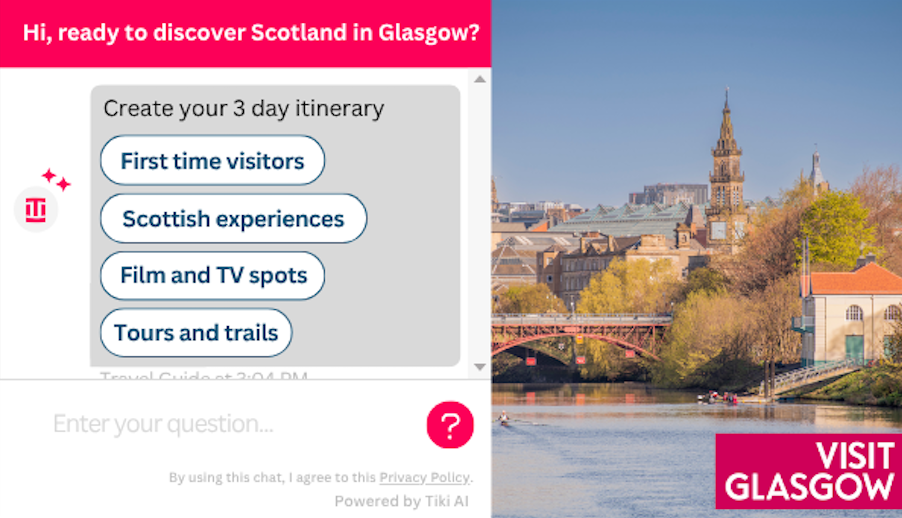
Tiki reframed the display channel from a broadcasting tool into a decision-stage touchpoint. Using travel-endemic publisher context in real time, Tiki's Envoy product engaged U.S. travel planners while they were actively researching Scotland and competitor destinations inside brand-safe environments. The campaign targeted intent-rich moments: the specific points in the planning journey where a traveller's interest in Scotland was already active and where Glasgow could step into that conversation with genuine relevance.
The strategic shift this represented was substantial. The campaign moved away from sending messages outwards and towards initiating genuine conversations with people already in a planning mindset. Generic impressions gave way to contextual relevance, with each engagement shaped by what the traveller was researching at that moment. Static display gave way to dynamic, conversational engagement that matched the brand DNA of Gallus, Warm and Creative, so the experience carried real personality throughout.
The campaign used cost-per-click pricing, meaning Destination Glasgow paid for confirmed arrivals to its site rather than for impressions. This model was a deliberate choice to build stakeholder confidence through transparency, tying expenditure directly to measurable outcomes. The campaign was also scoped specifically to first-time U.S. visitors, protecting message clarity and maximising the learning value of the data returned.
The results
The campaign delivered both performance and decision-making clarity. Destination Glasgow gained a deeper understanding of when and how international travellers consider the city within their Scotland trip planning journey. By analysing the query data generated by users engaging with the Envoy unit, the team could see how U.S. visitors were thinking about Glasgow as a destination and which experiences were pulling most strongly in that market. That intelligence gave the organisation a clearer basis for sequencing its storytelling going forward.
Source: Tiki x Visit Glasgow
On performance, the figures were strong. The click-through rate reached 7.98%, a result that indicates genuinely relevant targeting in a channel where rates above one or two per cent are considered healthy. The campaign brought 9,444 new visitors to the Destination Glasgow website, each arriving mid-consideration journey and continuing to explore the destination from there.
The cost per click came in at $1.50, meeting the key performance indicator set at the outset and well within the conversion benchmark agreed at the start of the campaign. That combination of efficiency and volume gave the team a clear and credible case to make to stakeholders across the organisation.
The campaign also provided tangible proof that AI-enhanced contextual engagement could support Glasgow's long-term marketing evolution. Destination Glasgow moved from exploratory curiosity about intelligent paid media to a position of practical adoption readiness, an important step for any organisation building more sophisticated, data-informed approaches over time.
What this means for destinations
The campaign moved Destination Glasgow from exploratory curiosity about AI-enhanced marketing to a position of practical readiness, an important step for any organisation planning to develop more intelligent, data-informed approaches over time. The results provided tangible proof that contextual engagement at the right moment can outperform broader reach strategies, not by spending more but by placing relevance at the centre of the approach.
For destination marketers working in competitive international markets, the lesson is a practical one. Reaching travellers while they are actively planning, with content shaped by what they are already thinking about, produces more useful outcomes than waiting for awareness campaigns to filter through. The Glasgow and Tiki partnership demonstrates what that looks like in practice and what it takes to make it work.



%20Turned%20an%20AI%20Shift%20into%20a%209%25%20Organic%20Traffic%20Increase.webp)
.webp)