Branding
Authentic Placemaking: The Unique Narrative of Little Tokyo
Visit Düsseldorf shows how destination brands grow stronger by amplifying authentic community stories, not creating them from scratch.
Featuring
Visit Düsseldorf
Visit Düsseldorf shows how destination brands grow stronger by amplifying authentic community stories, not creating them from scratch.
Every destination has hidden stories waiting to be discovered. For Düsseldorf, that story was already thriving in plain sight. Thorsten Schaar, Head of Content & Communications, and Franziska Sunderland, Deputy Head of Content & Communications, from Visit Düsseldorf shared what happens when DMOs stop trying to create narratives and start listening to the stories already being told, focusing on the city's Little Tokyo district, a vibrant Japanese quarter that has become one of Europe's most compelling examples of community-driven destination branding.
Every destination has hidden stories waiting to be discovered. For Düsseldorf, that story was already thriving in plain sight. Thorsten Schaar, Head of Content & Communications, and Franziska Sunderland, Deputy Head of Content & Communications, from Visit Düsseldorf shared what happens when DMOs stop trying to create narratives and start listening to the stories already being told, focusing on the city's Little Tokyo district, a vibrant Japanese quarter that has become one of Europe's most compelling examples of community-driven destination branding.
Every destination has hidden stories waiting to be discovered. For Düsseldorf, that story was already thriving in plain sight. Thorsten Schaar, Head of Content & Communications, and Franziska Sunderland, Deputy Head of Content & Communications, from Visit Düsseldorf shared what happens when DMOs stop trying to create narratives and start listening to the stories already being told, focusing on the city's Little Tokyo district, a vibrant Japanese quarter that has become one of Europe's most compelling examples of community-driven destination branding.
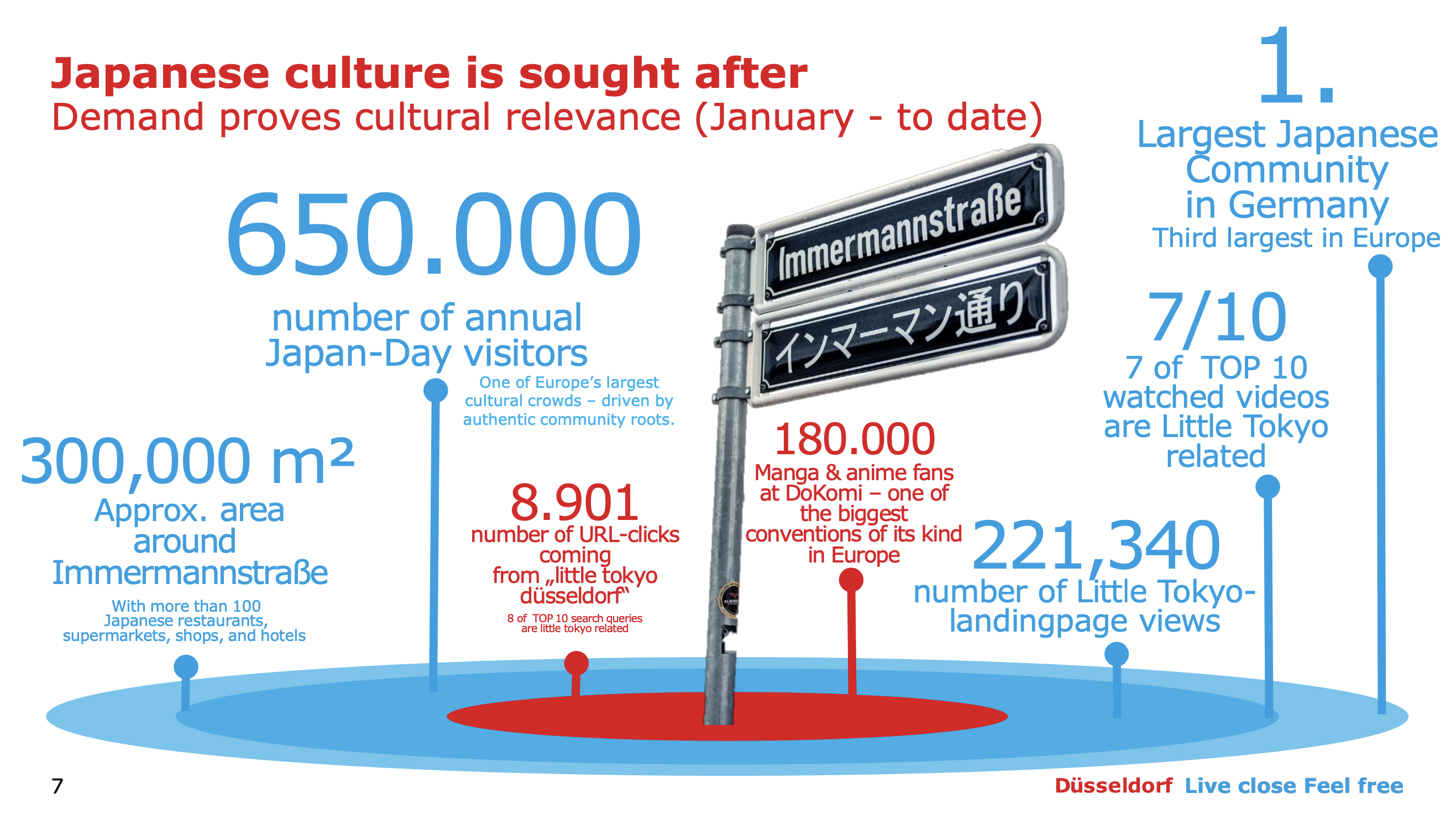
Little Tokyo emerged organically after World War Two, when trade relations brought Japanese businesses to Düsseldorf. Today, Düsseldorf hosts the largest Japanese community in Germany and the third largest in Europe, with over 100 Japanese restaurants, supermarkets, shops and hotels occupying approximately 300,000 square metres in the city centre.
Acknowledging that there were already many stories that would support the destination's positioning, this insight shaped Visit Düsseldorf's approach. This observation challenges a fundamental assumption in destination marketing, where organisations frequently invest significant resources in creating narratives rather than uncovering and amplifying those that already exist. The real heroes of Little Tokyo, as Thorsten put it, are the people who established it long before anyone thought to tell its story.
The example of Haruhiko Saeki illustrates this principle perfectly. A Tokyo native who arrived in Düsseldorf and discovered the city lacked authentic ramen, Haruhiko opened Takumi in the heart of Little Tokyo in 2007. He came from outside the restaurant industry entirely. However, despite this, by 2023, his chain operated over 60 restaurants across Europe. When Thorsten spotted a Takumi restaurant in Rotterdam named "Takumi Düsseldorf", he recognised that the city's story was being told organically. In other words, the brand was building itself.
The strategic opportunity to amplify the Little Tokyo story as a core differentiator for Düsseldorf is clearly reinforced by demand data. Eight of the top ten search queries in 2025 driving traffic to Visit Düsseldorf's website were related to Little Tokyo, with Little Tokyo's landing page accumulating over 221,000 views. Seven of their top ten watched videos focused on Japanese culture. This was a case of recognising overwhelming demand and developing relevant content accordingly.
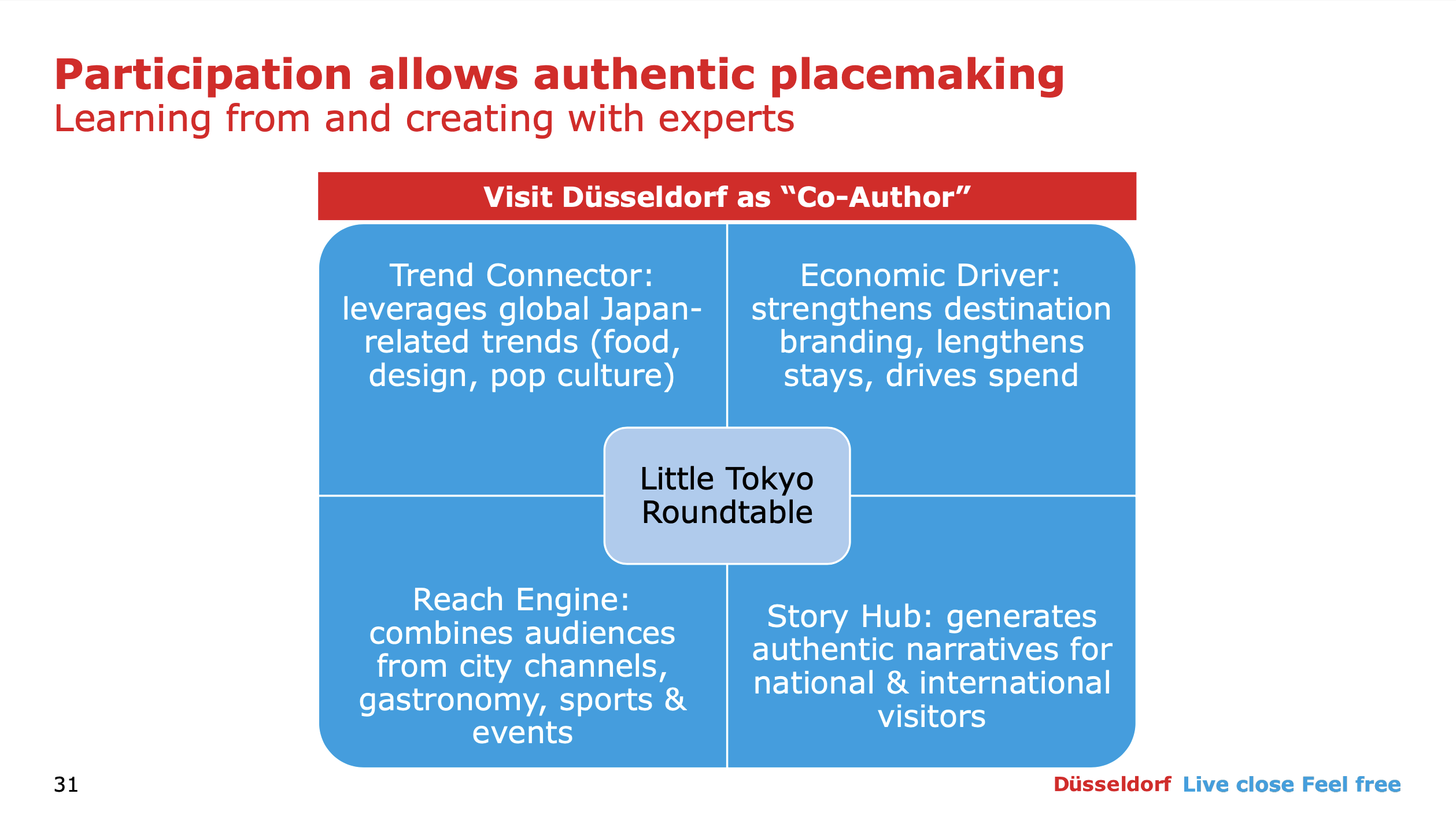
The recognition that DMOs often lack the community credibility to authentically represent a neighbourhood became the catalyst for genuine partnership. Visit Düsseldorf understood they could not tell the Little Tokyo story alone. This demanded fundamental changes in how the DMO operated, from storytelling about the community to shaping the narrative with the community. This philosophical shift represents a move towards building cultural partnerships and encouraging active participation in destination branding.
The commitment to co-creation extends to even the smallest details. When Visit Düsseldorf drafted website copy suggesting visitors could come to Düsseldorf and "feel like [being] in Tokyo", they paused before publication. The claim was obviously untrue, and the community would know it. Instead of proceeding with messaging that only served marketing convenience, they consulted community partners to find language that felt appropriate for both parties. This granular attention to accuracy might seem excessive, but it builds the trust that makes genuine partnership possible. This showcases the underlying premise that Visit Düsseldorf relied upon: respect leads to relevance.
The practical mechanism for community engagement emerged from Visit Düsseldorf's Brand Spaces format, bringing together stakeholders around specific themes. In 2024, a workshop focused on the Japanese community, inviting restaurant owners, creative professionals, cultural figures and tourism stakeholders to share their ideas for promoting Little Tokyo. Following the success of this meeting, participants asked Visit Düsseldorf to create a permanent format, recognising value in the cross-sector connections being formed. This comes from the belief that trust requires sustained, visible commitment and genuine value exchange.
The Little Tokyo Roundtable now meets quarterly and has become the heart of content marketing concerning the quarter. The format serves multiple functions: trend identification, content generation, partnership development and trust building. The stakeholder mapping underpinning the Roundtable also reflects careful strategic thinking. Visit Düsseldorf identified key partners, strategic enablers and creative drivers across five categories: municipal structures, gastronomy and retail, events and professional sport, the creative scene and Japanese institutions. This systematic approach ensures that community engagement is neither random nor superficial, but strategically aligned with organisational objectives while genuinely serving community interests.
The most striking aspect of Visit Düsseldorf's approach is what they explicitly choose not to do. They position themselves as facilitators, not narrators. This positioning represents a fundamental departure from traditional DMO practice, where ownership of narrative and control of messaging typically define organisational value.
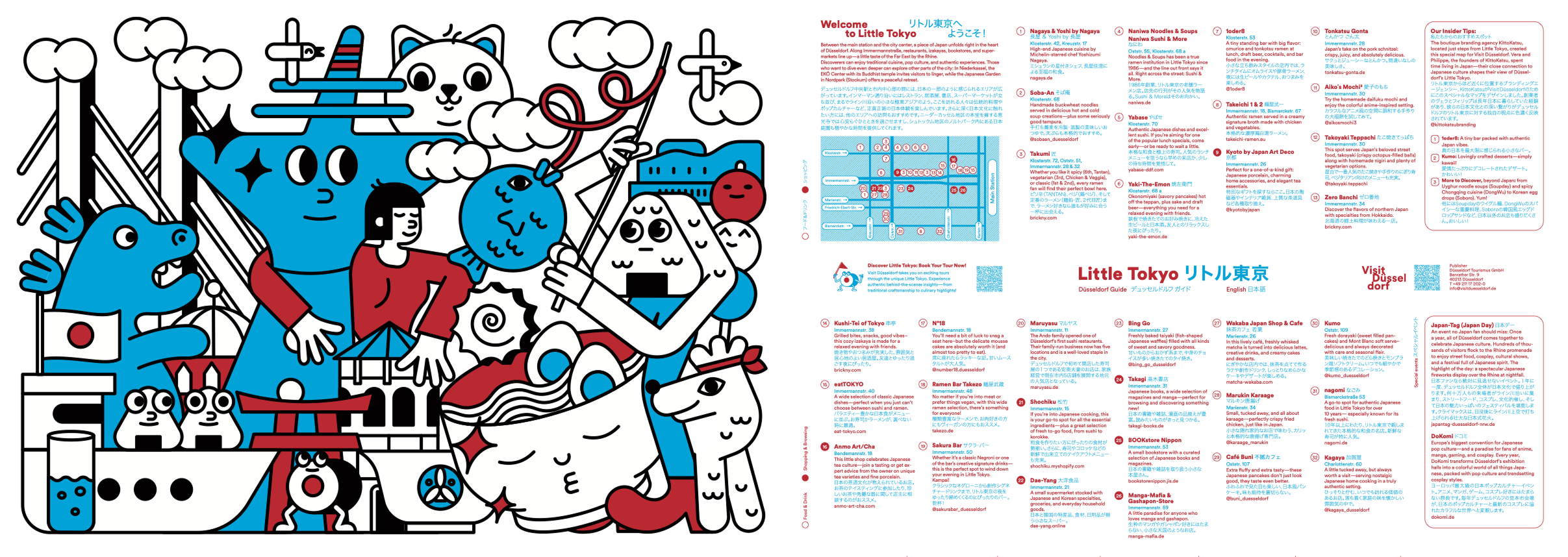
As part of the DMO's facilitation of the brand narrative, when journalists request interviews about Little Tokyo, Visit Düsseldorf invites Roundtable members to speak rather than positioning their own staff as experts. The Little Tokyo map was also developed through extensive community consultation about which establishments to include, how to describe them and whether the design felt appropriate. Guided tours were developed in partnership with businesses, ensuring that tourism products deliver authentic experiences while generating economic value for local operators.
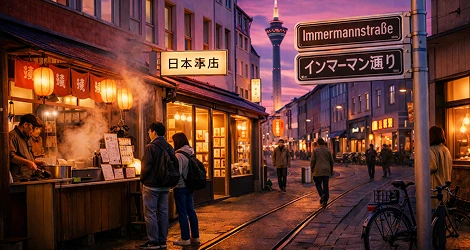
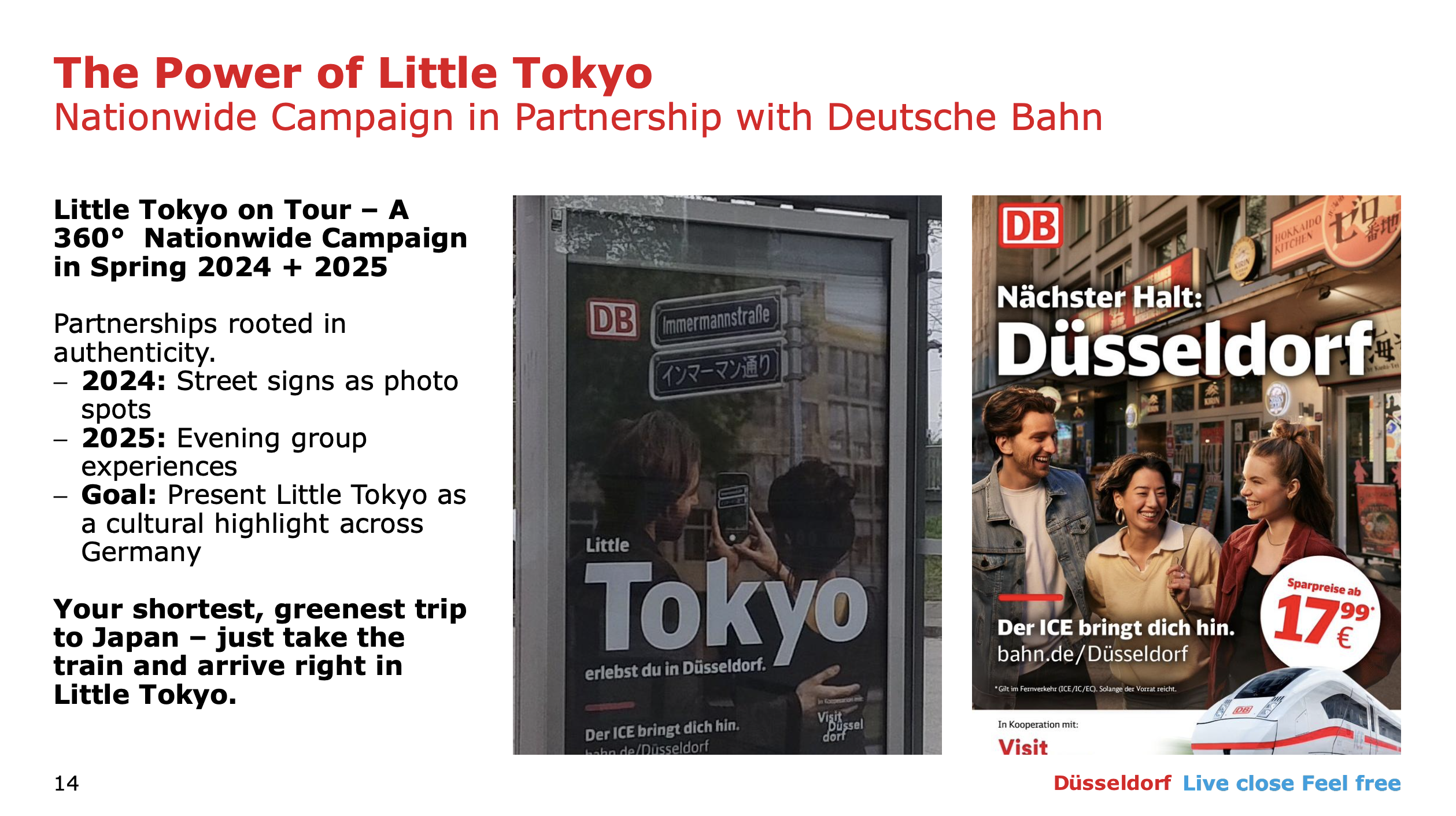
Recognising the decades-long connection with the Japanese community, a Düsseldorf resident proposed installing bilingual street signs in German and Japanese throughout the quarter. Politicians supported the initiative, and in 2021, the signs were unveiled. This grassroots development gave Visit Düsseldorf a powerful visual symbol that perfectly captured the community-led character of Little Tokyo.
The street signs became the centrepiece of a nationwide campaign with Deutsche Bahn, Germany's national railway. With Little Tokyo being located adjacent to the main station, making it accessible within moments of arrival by train, this partnership was strategically perfect. The campaign promised travellers their shortest, greenest trip to Japan. While many believe that tourism marketing must show people to succeed, Visit Düsseldorf challenged this perception. In doing so, they proved that being distinctive is far more powerful than following the standard marketing rules. As the street signs were so specific to Düsseldorf, they created a standout brand that was far more memorable than generic shots of tourists.
The Dezain Crush initiative demonstrates another dimension of making culture visible. In 2024, Visit Düsseldorf hosted a weekend-long graphic designer exchange between Japan and Germany. The event proved so successful that it has since expanded to a three-week programme at a larger venue. By providing platforms for genuine cultural exchange, Visit Düsseldorf reinforced its role as a facilitator that supports community initiatives.
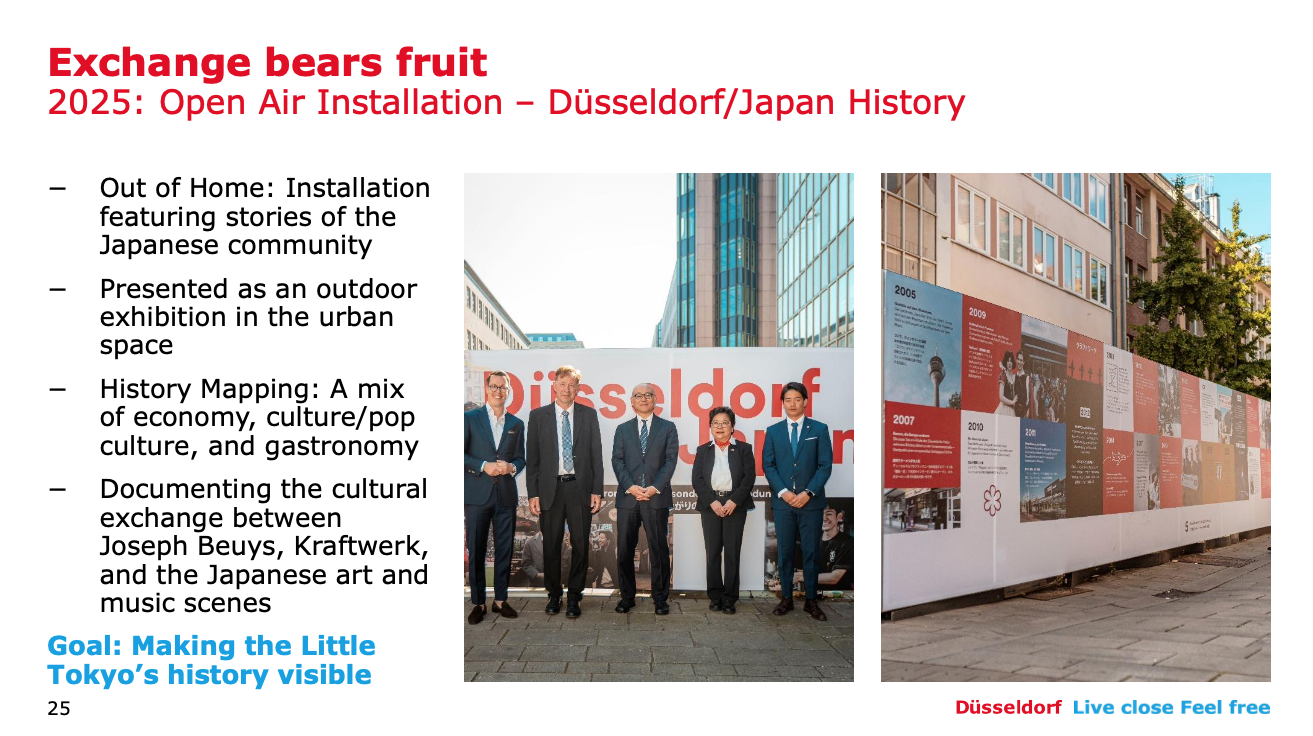
An open-air installation documenting the history of Japanese-German cultural exchange further illustrates this approach. Positioned in central Düsseldorf, the exhibition explores connections between the city and Japan, such as Kraftwerk, a band from Düsseldorf that regularly performed in Japan, the Japanese art and music scenes and the broader cultural dialogue that has shaped both communities. The installation reached an enormous audience simply by virtue of its prominent public location, an effective strategy for educating visitors about the depth and history underlying Little Tokyo's vibrancy.
Visit Düsseldorf's strategic positioning benefits from fortunate timing. Global fascination with Japan has intensified in recent years, creating unprecedented demand for authentic Japanese cultural experiences. Food trends have followed a clear progression: ramen established the foundation, matcha built momentum, mochi broadened appeal, Japanese bakeries attracted new audiences and now the izakaya concept is driving fresh interest. Each wave brings new visitors seeking experiences that Little Tokyo can authentically deliver.
The Konnichiwa Düsseldorf video series exemplifies how Visit Düsseldorf connects these trends to community stories. The series features Koki Takahashi, a manager of an izakaya restaurant in Little Tokyo, who had an established international career in Japan and New York before moving to Düsseldorf. His story illustrates the internationally connected character of the Japanese community while providing content that rides the izakaya trend wave.
The distinction between following trends and amplifying them through authenticity matters enormously. Düsseldorf's claim is genuinely credible because Little Tokyo existed long before Japanese culture became globally fashionable, and will continue thriving regardless of whether Western interest rises or declines.
The economic implications of the Little Tokyo story are substantial. Japan Day, an annual festival celebrating Japanese culture, attracts 650,000 visitors to Düsseldorf in a single day. The event has now expanded into Japan Week, responding to demonstrated demand for extended programming. Similarly, DoKomi, a manga and anime convention that began in 2002 with three tables in a school, now draws 180,000 visitors over three days.
The connections created through the Roundtable also generate unexpected opportunities. Nintendo approached Visit Düsseldorf directly to establish a cooperation at DoKomi in 2025, a partnership that emerged through networks cultivated with stakeholders from Little Tokyo's Japanese community. Such interest demonstrates how authentic community engagement creates additional opportunities for strengthening destination brands that traditional marketing approaches would struggle to achieve.


Head of Content & Communications
Visit Düsseldorf

Deputy Head of Content & Communications
Visit Düsseldorf


