Marketing
Form, Function and Engagement: Visit Norway's Fairytale Finder
"Are we there yet?" The universal refrain of children on road trips worldwide takes on particular significance for Norway's tourism sector.
Featuring
Visit Norway

"Are we there yet?" The universal refrain of children on road trips worldwide takes on particular significance for Norway's tourism sector.
"Are we there yet?" The universal refrain of children on road trips worldwide takes on particular significance for Norway's tourism sector. Nina Mariann Øvergård, Project Manager, and Jon Erik Skaret, Creative Lead, at Visit Norway, used this familiar question as both inspiration and a strategic framework for one of the most innovative digital products to emerge from a national tourism organisation. They revealed not just the creation of an app, but a fundamental rethinking of how DMOs can support families while addressing the perennial challenge of dispersing visitors beyond iconic attractions.
"Are we there yet?" The universal refrain of children on road trips worldwide takes on particular significance for Norway's tourism sector. Nina Mariann Øvergård, Project Manager, and Jon Erik Skaret, Creative Lead, at Visit Norway, used this familiar question as both inspiration and a strategic framework for one of the most innovative digital products to emerge from a national tourism organisation. They revealed not just the creation of an app, but a fundamental rethinking of how DMOs can support families while addressing the perennial challenge of dispersing visitors beyond iconic attractions.
"Are we there yet?" The universal refrain of children on road trips worldwide takes on particular significance for Norway's tourism sector. Nina Mariann Øvergård, Project Manager, and Jon Erik Skaret, Creative Lead, at Visit Norway, used this familiar question as both inspiration and a strategic framework for one of the most innovative digital products to emerge from a national tourism organisation. They revealed not just the creation of an app, but a fundamental rethinking of how DMOs can support families while addressing the perennial challenge of dispersing visitors beyond iconic attractions.
Half of all foreign tourists visiting Norway arrive by car, with 30% of these travellers being families. These families seek outdoor experiences, cultural encounters and family-friendly activities. Yet their behaviour follows a predictable pattern. They aim for Norway's iconic destinations, the famous fjords and dramatic landscapes that dominate tourism marketing. In doing so, they miss the countless experiences that are located between these well-known attractions.
This represents a dual challenge familiar to destination marketers worldwide. The concentration of visitors at iconic sites creates pressure on popular locations while leaving substantial tourism infrastructure underutilised elsewhere. Small farms, quirky museums and outdoor experiences scatter across Norway's landscapes, often invisible to families who see a roadside sign too late or simply haven't planned for spontaneous stops.
The strategic insight that shaped Fairytale Finder emerged from understanding these distinct dynamics of family travel. Children fundamentally shape itineraries through their need for entertainment. Yet, existing digital tourism content, including Visit Norway's own website, speaks primarily to parents. Engaging children in travel planning presents a genuine gap in the market, one that Visit Norway recognised could be addressed through thoughtful product design rather than simply more marketing content.
Fairytale Finder's core innovation lies in its dual functionality, designed explicitly for families. The app serves parents planning practical itineraries while simultaneously entertaining children during journeys. This approach transforms what the team calls "backseat heroes" from passive passengers into active participants in the travel experience.
The practical planning component allows families to define their route from any starting point to any destination across Norway. The system surfaces relevant attractions, accommodation and experiences along the chosen route, filtered by interest categories. Parents can build itineraries that incorporate 2,500 curated listings from Visit Norway's database, each selected specifically for family appeal. Completed routes transfer seamlessly to Google Maps, bridging the gap between discovery and navigation.
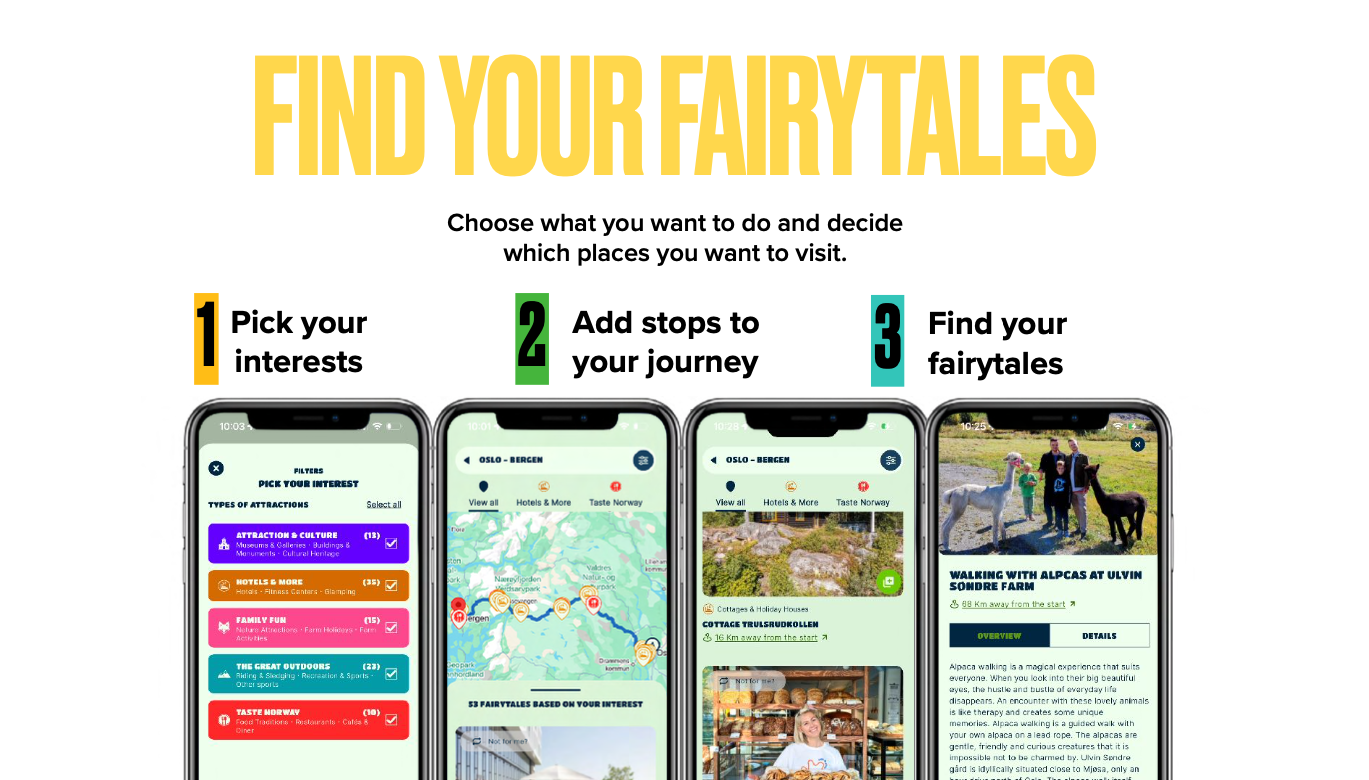
The visual design intentionally incorporates Norwegian cultural elements. Trolls, forests, mountains and native animals feature throughout the interface, creating an experience that feels authentically Norwegian. This attention to cultural specificity reflects Visit Norway's in-house Stories team approach, where creative development remains closely tied to brand identity and destination authenticity.
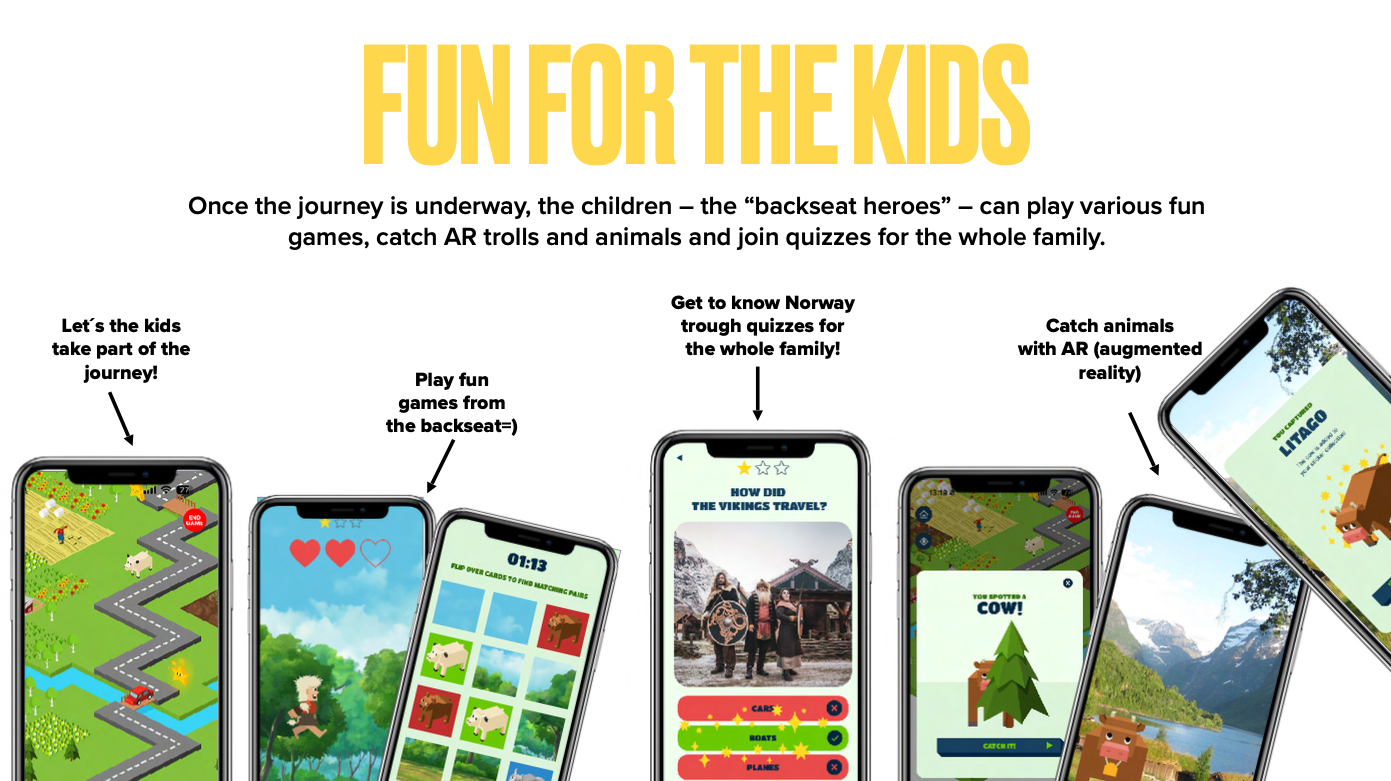
For children, the app provides a range of interactive elements designed to transform journey time into engagement opportunities. A jumping game, memory challenges and family quizzes provide entertainment during car journeys. The quiz questions incorporate Norwegian facts and cultural elements, ensuring that entertainment also carries educational value. Perhaps most distinctively, augmented reality features allow children to "catch" trolls and Norwegian animals through their phone cameras, creating moments that connect digital play with the landscape passing outside.
Development began in October 2023 with an ambitious target of launching by March 2024. The timeline proved optimistic. Nina and Jon's candid account of their development journey offers valuable lessons for any DMO considering similar digital product investments.
Initial assumptions proved both helpful and limiting. The team focused heavily on children's entertainment elements, believing the travel planner functionality would be straightforward since Visit Norway already maintained 15,000 listings on their website. The plan seemed simple: curate these existing listings for family relevance and integrate them into the app. However, in reality this proved considerably more complex.
Testing with real families revealed fundamental questions the team hadn't fully considered. Do parents actually want more screen time for their children during holidays? Do children have their own devices, and if so, do those devices have data connectivity? Is Fairytale Finder primarily a game or a planning tool? How should routes synchronise across different family members' devices? Legal considerations around children's data and device usage added further complexity that hadn't been fully anticipated at project inception.
This testing also revealed issues that internal reviews had missed. The onboarding process needed substantial improvement. The troll character, central to the app's Norwegian identity, looked too much like a regular person rather than a mythological creature. The planning functionality was too advanced, requiring simplification for practical family use. Category names that made sense to the development team confused actual users.
While the user experience was improved, continued testing uncovered a major structural issue in the underlying data architecture. When Visit Norway's team clarified categories based on user feedback, they discovered that identical products were tagged inconsistently across the database. A family-friendly attraction might surface under "Family Fun" in one instance but "The Great Outdoors" in another. The inconsistency undermined the app's core value proposition of helping families discover relevant experiences along their routes. Initial assumptions pointed toward destination partners applying tags inconsistently when uploading content. Investigation, however, revealed a more complex reality: the API that imported content from Visit Norway's main database performed translations optimised for the website's architecture. These transformations, while appropriate for web display, produced categorisation results unsuitable for the app's filtering requirements.
These additional questions and the user experience issues meant the planned launch for March 2024 was delayed. After asking the question that would become central to Visit Norway's approach — "Are we there yet?" — the honest answer was no. Quality hadn't reached the standard considered acceptable, and releasing a substandard product risked negative reviews that would undermine future adoption. While stakeholders were waiting, creating pressure to proceed, Visit Norway chose to delay the launch to fix these issues. Visit Norway's willingness to undertake substantial manual remediation rather than launching with compromised functionality reflects a commitment to product quality that ultimately improved long-term success.
The discovery of systematic tagging inconsistencies represented a pivotal moment in Fairytale Finder's development. What initially appeared to be a content curation task revealed itself as a fundamental data architecture challenge requiring substantial manual intervention before the app could function as intended. This required manually reviewing and retagging 2,500 listings. This process, entirely absent from original project planning, consumed significant time and resources.
Further complexity emerged when it was discovered that each language version of a listing carried a unique identifier, potentially requiring the same manual process across multiple languages. While a technical workaround prevented complete duplication of effort, the work remained far more labour-intensive than anticipated. This experience has shaped thinking about future development, with AI identified as a potential solution for automating such categorisation tasks.
The broader lesson extends beyond technical implementation. Digital products built on existing content databases require careful examination of how that content has been structured, tagged and processed for its original purpose. Assumptions that existing data can simply be repurposed often prove costly when the new application imposes different requirements. For DMOs considering similar product development, early investment in understanding data architecture may prevent costly mid-project discoveries that derail timelines and budgets.
With the app finally ready, Visit Norway approached the launch with what they described as wanting to "have your cake and eat it too". This was because two potentially conflicting objectives shaped the strategy, reflecting a desire to both inspire families to choose Norway as a destination while simultaneously driving app downloads. Nina and Jon acknowledged this represented a tension between awareness and conversion goals.
The creative execution reflected this dual focus. Inspirational content showcased Norwegian landscapes and family experiences to build destination desire. Direct response creative pushed download calls-to-action. The campaign was promoted across Meta platforms, YouTube, display advertising and TikTok with a total budget of €127,000 across the four target markets (Denmark, Germany, Sweden and the Netherlands), with the majority of the promotion weighted toward Germany and Denmark.
Top-of-funnel metrics painted an encouraging picture: over 20 million views, 6 million people reached and 140,000 clicks. YouTube delivered 90% completion rates. Digital audio achieved 97% completion. TikTok performed exceptionally with a 395% view rate and 13.2% engagement. However, conversion metrics told a different story. Against a target of 21,000 downloads, the campaign delivered approximately 2,500, achieving just 12% of the goal.
Notably, the exception to the lower conversion rate was Denmark, achieving 57% of its download target. This dramatically outperformed other markets. Such an outcome was an important finding given that the Danish market received distinctive treatment through a broader channel approach. Four family influencers created content alongside traditional digital advertising, while radio spots reached audiences during the planning phase for summer travel. This integrated approach tested whether deeper engagement in a single market would outperform broader but shallower activity elsewhere, proving that a broader channel mix delivers meaningfully better conversion outcomes. When direct download messaging pushed hard, the app climbed to ninth position in family app store rankings, demonstrating that clear calls-to-action could drive immediate action.
While attributing overnight stays directly to Fairytale Finder presents measurement challenges, Visit Norway observed 8% to 15% increases in overnight stays from campaign markets. While acknowledging that this likely reflects multiple campaigns operating simultaneously rather than Fairytale Finder alone, the directional indicator suggests a positive contribution to broader tourism objectives.
Beyond direct campaign metrics, Fairytale Finder generated significant industry engagement. Tourism businesses actively sought inclusion in the app, asking how they could become featured listings. This reversal of the typical dynamic, where DMOs struggle to engage industry partners in marketing initiatives, suggests the app created genuine perceived value for tourism operators. As Nina and Jon noted with characteristic understatement, DMOs aren't always celebrated by their stakeholders, making this positive reception particularly meaningful.
Fairytale Finder remains a work in progress. While budget constraints create uncertainty about continued investment, AI-assisted content categorisation and user experience refinement position future iterations for more efficient development. Over the coming years, Nina and Jon expressed an intention to continue simplifying the planning interface to reduce manual maintenance requirements and also to expand gaming elements.

Project Manager
Visit Norway

Creative Lead
Visit Norway


