Branding
Helsinki Partners' Brand: Evolving Beyond Tourism
The traditional destination marketing organisation, with its singular focus on attracting visitors, positions destinations through narrow lenses.
Featuring
Helsinki Partners

The traditional destination marketing organisation, with its singular focus on attracting visitors, positions destinations through narrow lenses.
The traditional destination marketing organisation, with its singular focus on attracting visitors, positions destinations through narrow lenses. As cities compete not just for tourists, but for talent, investment and business events, the fragmented approach of having separate agencies sharing different messages to reach these diverse audiences is proving increasingly inefficient. Helsinki Partners' transformation offers a compelling blueprint for destinations questioning whether the DMO model remains fit for purpose. Leena Lassila, Director of Visitor and Talent Attraction, articulated a vision where a unified brand identity serves multiple audiences simultaneously, challenging long-held assumptions about how DMOs should be structured.
The traditional destination marketing organisation, with its singular focus on attracting visitors, positions destinations through narrow lenses. As cities compete not just for tourists, but for talent, investment and business events, the fragmented approach of having separate agencies sharing different messages to reach these diverse audiences is proving increasingly inefficient. Helsinki Partners' transformation offers a compelling blueprint for destinations questioning whether the DMO model remains fit for purpose. Leena Lassila, Director of Visitor and Talent Attraction, articulated a vision where a unified brand identity serves multiple audiences simultaneously, challenging long-held assumptions about how DMOs should be structured.
The traditional destination marketing organisation, with its singular focus on attracting visitors, positions destinations through narrow lenses. As cities compete not just for tourists, but for talent, investment and business events, the fragmented approach of having separate agencies sharing different messages to reach these diverse audiences is proving increasingly inefficient. Helsinki Partners' transformation offers a compelling blueprint for destinations questioning whether the DMO model remains fit for purpose. Leena Lassila, Director of Visitor and Talent Attraction, articulated a vision where a unified brand identity serves multiple audiences simultaneously, challenging long-held assumptions about how DMOs should be structured.
Helsinki's brand development journey began in 2015, but understanding where it started requires confronting an uncomfortable truth. Before the transformation commenced, various departments, agencies and city-owned companies each maintained their own visual identities, creating what Leena described as a chaotic landscape of competing messages. The result was a diluted brand presence that undermined the collective impact of significant marketing investments.
This fragmentation reflects a broader challenge facing DMOs worldwide. When tourism and economic development operate in isolation, developing their own brand expressions, the cumulative effect is confusion. Resources are duplicated, messages compete and the destination's distinctiveness becomes lost in a cacophony of well-intentioned but uncoordinated communications.
The decision to pursue a unified visual identity, launched in 2017, represented a fundamental shift in how Helsinki would present itself to the world. With a clear and unified visual identity, the city would achieve greater media coverage and improved return on investment. Every touchpoint, from tourism marketing to business development, would reinforce the Helsinki story.
Helsinki Partners emerged as a city-owned company with a mandate that transcended traditional DMO boundaries. Rather than focusing solely on visitor attraction, the organisation serves four distinct target groups: visitors, talent, investors and congress organisers. This multi-audience approach reflects an intricate understanding of how cities compete for attention globally.
The organisational structure itself embodies this integrated philosophy. Three units serve the strategy:
This configuration challenges the conventional wisdom that these functions should operate independently. The rationale for combining visitor and talent attraction within a single unit reveals strategic insight that many destinations have yet to embrace. As Leena articulated, a visitor in a holiday mood and a talented individual seeking new challenges are fundamentally the same person navigating a multi-channel world. Someone who visits Helsinki for a weekend break may return considering career opportunities. By combining marketing expertise and channels within the same unit, Helsinki Partners creates substantial synergies.
This integration extends beyond organisational charts to operational reality. MyHelsinki.fi serves as the digital embodiment of Helsinki Partners' integrated approach. Rather than maintaining separate platforms for visitors, talent and business audiences, a single digital interface efficiently serves all target groups. This decision reflects the broader organisational philosophy that these audiences overlap more than they diverge. This consolidation reduces maintenance costs and technical complexity while ensuring consistent brand expression across all digital touchpoints.
The Helsinki brand concept centres on a deceptively simple proposition: in Helsinki, everyone can lead a good life. This positions the city not through architectural landmarks or cultural attractions, but through quality of life outcomes that resonate across all target audiences. For visitors, it promises experiences that enhance wellbeing. For talent, it offers a destination where careers grow while life stays balanced. For investors and congress organisers, it suggests a functioning city where business operates smoothly.
The supporting brand narrative adds to this core proposition. In Helsinki, the untamed nature meets urban buzz, and enthusiastic people with freedom to express themselves can live life to the fullest. This captures Helsinki's distinctive character without resorting to generic superlatives.
The brand's value proposition similarly demonstrates sophisticated restraint. Helsinki Partners acknowledges it cannot know what makes each of the city's residents happy, but they can create the settings for happiness to happen. This humility distinguishes the approach from destinations that make ambitious promises about transformative experiences. Instead, Helsinki positions itself as a city that provides the infrastructure, environment and opportunities for people to find their own version of the good life.
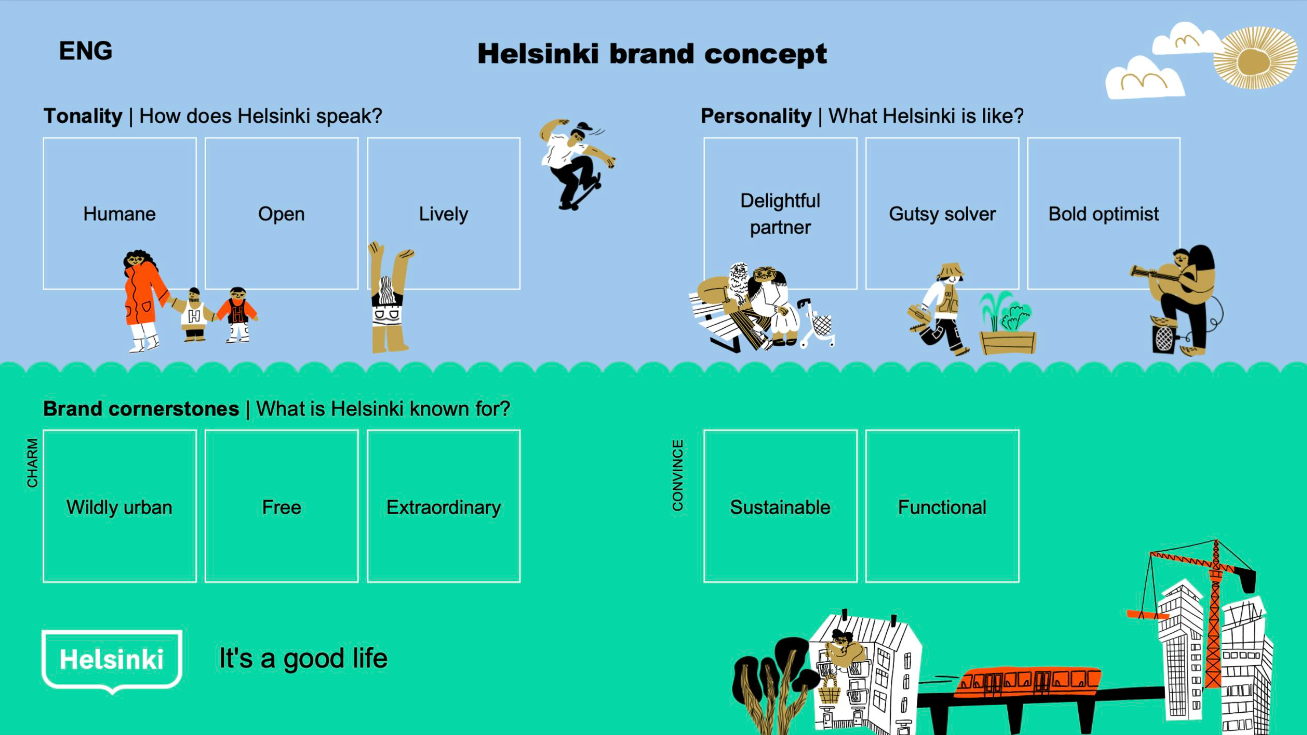
Finland's eight consecutive years as the world's happiest country, according to the UN Global Happiness Index, provides external validation. This ranking provides a credible foundation for communications that might otherwise seem aspirational. When 90% of Helsinkians express satisfaction with their quality of life, the brand promise gains substance.
The "Welcome to your Happy Place" positioning for visitor-facing communications illustrates how a unified brand concept can flex across different audiences while maintaining coherence. The recognition that happiness is personal drives an approach that avoids prescribing what visitors should experience. Instead, it invites each traveller to find their own version of happiness in Helsinki. For stakeholders to help amplify the 'Happy Helsinki' narrative, the DMO has even created a toolkit to help simplify and align how the message is integrated across all communications.
Six pillars support this storytelling framework: Here All Belong, Culture Amplified by Nature, Curiosity by Design, Wellbeing that Works, Tomorrow's Innovation Today and Planet-friendly Growth. These pillars provide structure for content development without constraining creative expression. They ensure consistency without demanding uniformity, establishing guardrails that shape how the brand comes to life across touchpoints.

The "Real, Not Perfect" philosophy deserves particular attention. This principle directly challenges conventional destination marketing wisdom that has long favoured aspirational imagery. Helsinki Partners explicitly rejects the picture-perfect brochure aesthetic in favour of honesty. Photography features real people, natural light and candid moments. Diversity appears naturally rather than being staged. This means that the tone remains direct, witty and human.
This approach reflects a broader shift in consumer expectations. Audiences increasingly recognise and reject overly polished marketing content. In an era of algorithmic content distribution, authenticity cuts through in ways that perfection cannot. The commitment to avoiding AI-generated imagery and excessive filtering represents a conscious choice to prioritise connection over aspiration.
Helsinki Partners' marketing approach balances brand building activities with tactical conversion campaigns, recognising that both serve essential but distinct purposes. The Doggy Route to Happiness campaign exemplifies the brand act philosophy. When Helsinki hosted the World Dog Show, the city created the world's first sightseeing route designed specifically for dogs.
This campaign transformed Helsinki into a living PR platform. Locals and dog influencers spread happiness across social feeds and earned media. The results demonstrated the power of distinctive brand acts. Over 1,000 dogs participated, generating more than 300 media mentions worldwide and 100+ social mentions. The reach extended to over 350 million people through earned media alone.
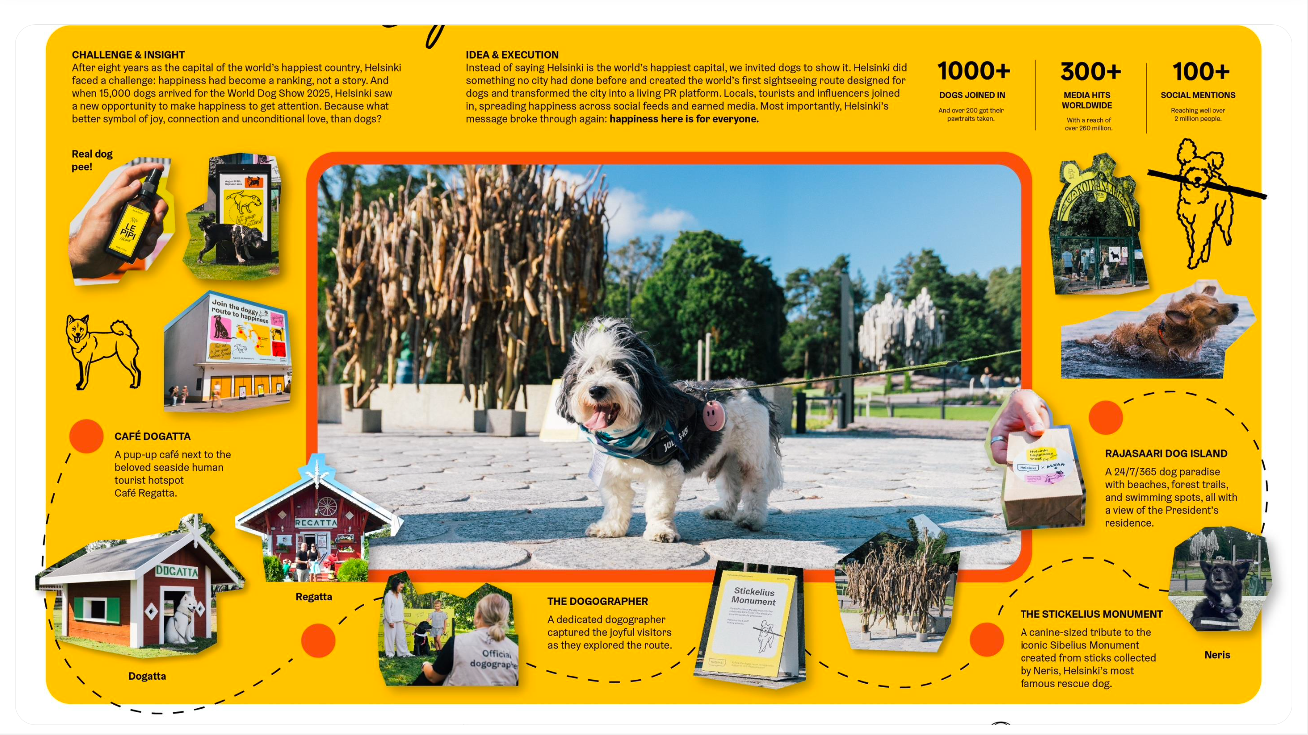
Critically, this initiative created lasting value beyond the campaign period. The dog-friendly infrastructure and experiences remain, including Café Dogatta near the beloved Café Regatta. What began as a brand act became a permanent product for dog-friendly travel, demonstrating how creative marketing can generate enduring assets.
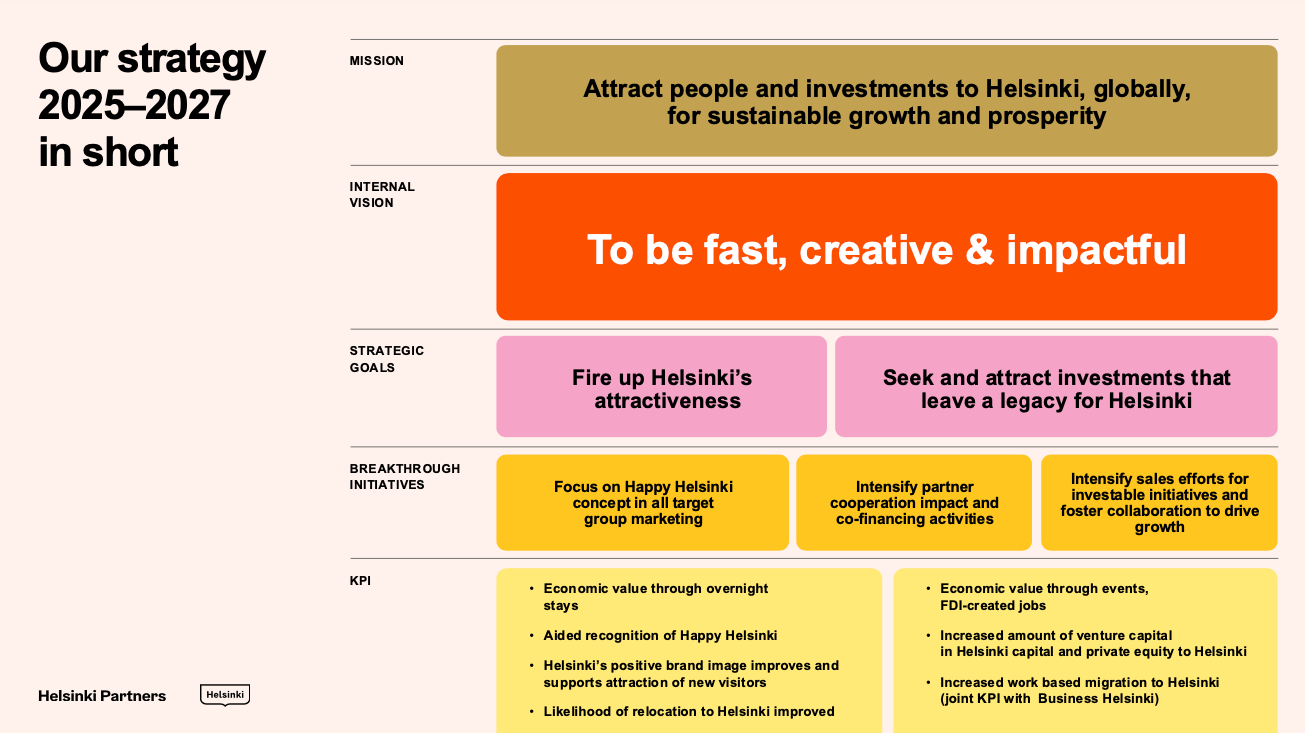
The target market focus reflects strategic prioritisation. Germany, the UK, the US and Japan represent primary markets, with the US generating the most overnight stays. This market selection informs both brand acts and tactical campaigns, ensuring resources concentrate where they can achieve the greatest impact. The impact of each campaign is carefully evaluated against a set of detailed Key Performance Indicators to ensure that all initiatives achieve the DMO's strategic goals and drive the achievement of the organisation's vision and mission.
Solidifying the connection between visitor and talent attraction, the 90 Day Finn Programme reveals sophisticated thinking about how destinations can bridge the gap between short-term visits and long-term commitment. Each year since 2021, Helsinki Partners invites 15 global business leaders, serial entrepreneurs and executives to live and work in Helsinki for up to 90 days.
The programme recognises the fundamental truth that people rarely relocate to places they have never visited. Asking someone to uproot their life and career based on marketing materials and second-hand impressions demands extraordinary confidence. The 90 Day Finn Programme removes this barrier by enabling extended immersion before commitment. Participants can bring their families, and children can attend English-speaking schools during the stay. This family-inclusive approach acknowledges that relocation decisions involve more than the primary applicant. When partners and children experience Helsinki's quality of life firsthand, the decision-making dynamic shifts fundamentally.
The recent launch of a 90 Hour Finn Programme further demonstrates a willingness to iterate based on market feedback. This shorter format offers a more efficient introduction for those unable to commit to extended stays while maintaining the core principle of experiential evaluation.
Alongside these brand building activities, Helsinki Partners' dual approach ensures that top-of-funnel activation translates into bottom-of-funnel commercial results. Partnerships with online travel agencies target overnight bookings with specific conversion metrics. Talent attraction campaigns measure success through clicks on job advertisements. This unified identity delivers bigger reach and better results. The recognition that today's tourist might become tomorrow's resident, that the same person navigates multiple decision journeys across their lifetime, demands organisational structures that acknowledge these overlapping interests rather than treating them separately.

Director of Visitor and Talent Attraction
Helsinki Partners