When Search Splits in Two: Being Found in the Age of AI Discovery

Digital discovery is shifting at an extraordinary pace, fundamentally changing how people find information online. Nearly four in ten US travellers used generative AI for trip research in 2025, an eleven-point jump in twelve months.

Digital discovery is shifting at an extraordinary pace, fundamentally changing how people find information online. Nearly four in ten US travellers used generative AI for trip research in 2025, an eleven-point jump in twelve months. Traditional search still leads as the dominant tool, but its lead is narrowing. Google continues to carry most of the volume, while the smaller share of traffic coming through AI tools tends to arrive with clearer intent.

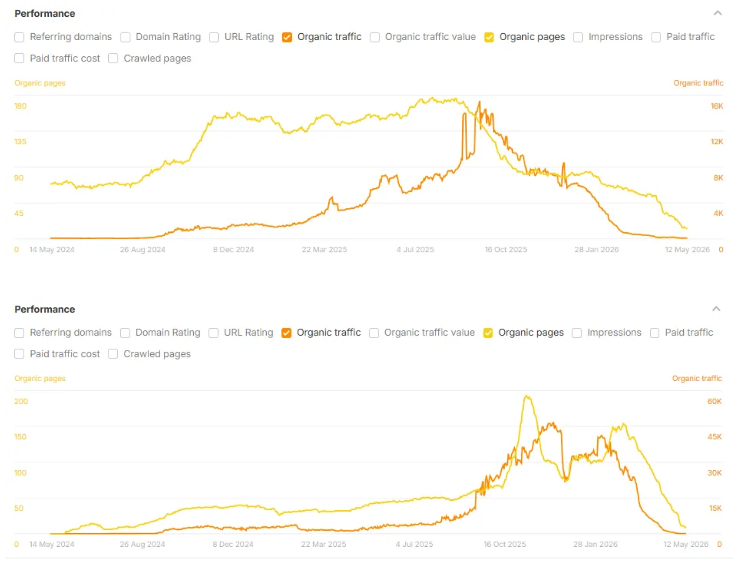
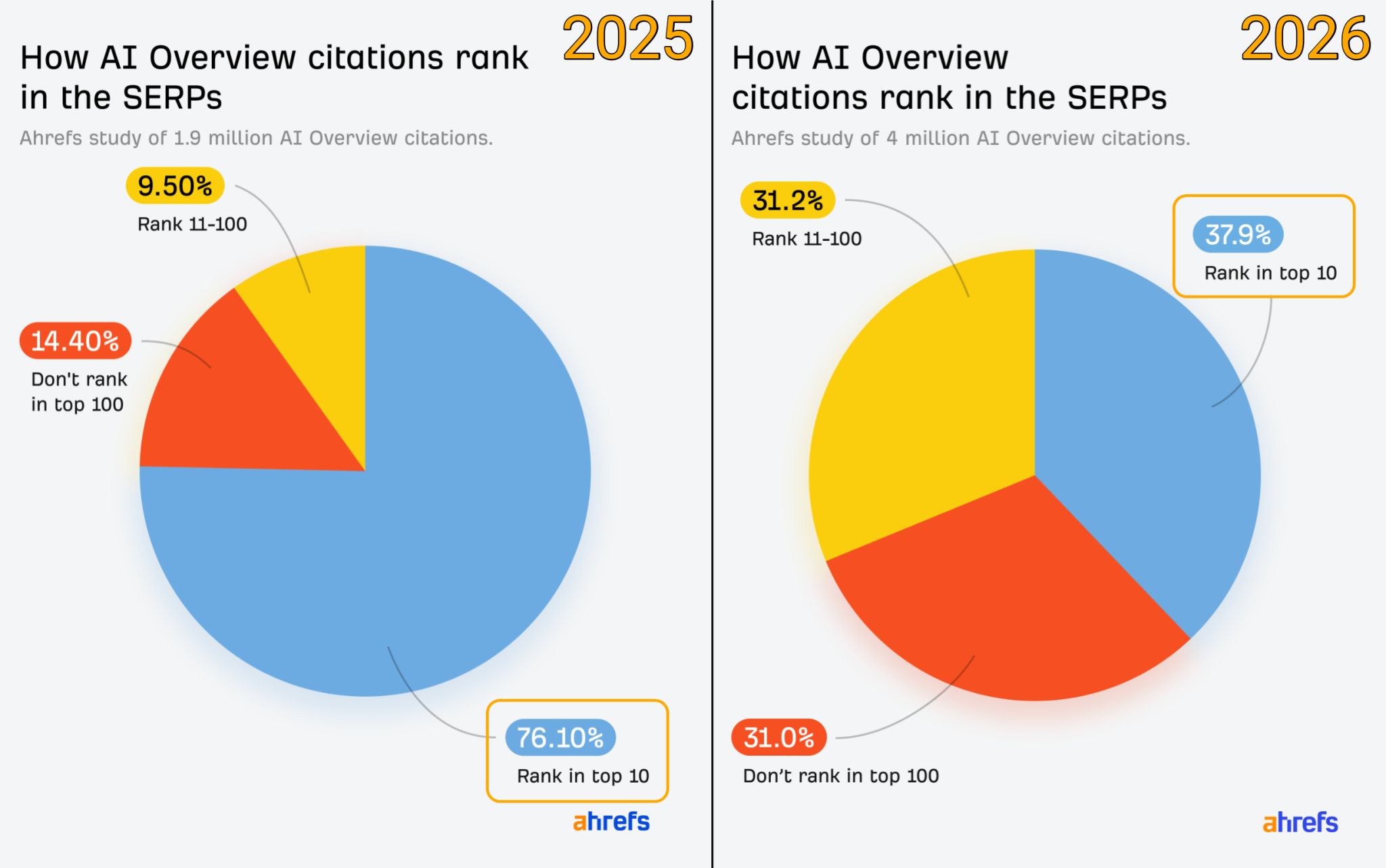
However, while traditional search is still the most important method for visitors to plan trips, data from Future Partners shows that AI tools are the only channel actively gaining momentum for trip planning (16.8% in 2025 vs. 23.1% in 2026). Crucially, growing adoption of AI-enabled trip planning is reported across all markets. Another key statistic worth considering is how AI Overviews now cite fewer pages from search engine results pages (SERPs). In July 2025, roughly 76% of citations came from the top 10 SERPs, yet this reduced to 38% by March 2026.

Source: ahrefs

The AI Discovery Shift

The changing discovery landscape has significant implications for DMOs and their content strategies. Yet, while there is a consensus that answer engine optimisation (AEO) and generative engine optimisation (GEO) strategies are essential for DMOs to improve their AI search visibility, Google's guidance for generative AI search explicitly highlights that search engine optimisation (SEO) practices remain foundational elements of AEO and GEO.

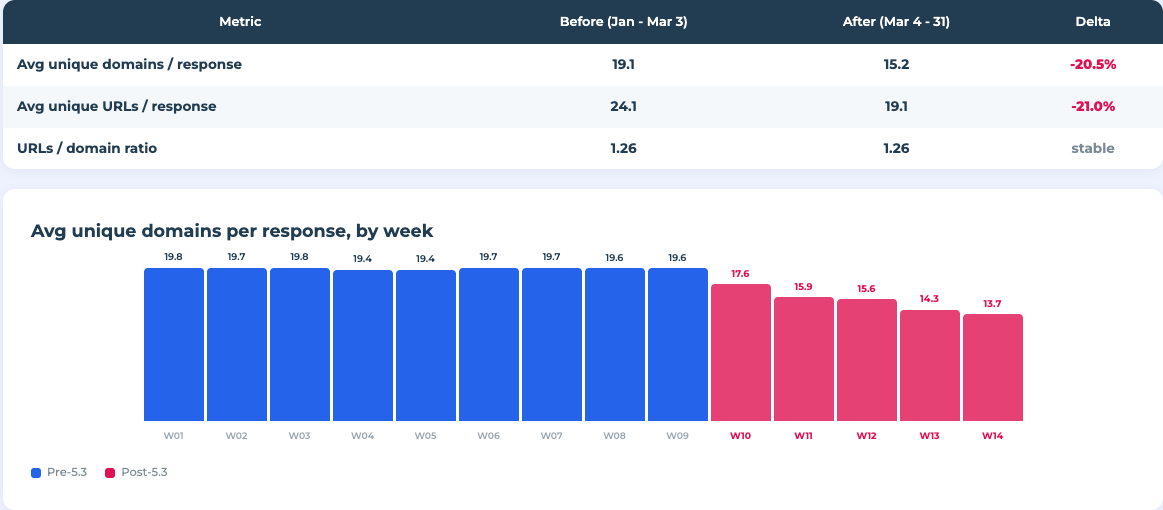
AI search itself is also more selective than the volume of AI activity suggests. According to data from Semrush, ChatGPT only searches the internet for 34.5% of queries, down from 46% at the end of 2024. Most of its answers still come from training data alone. Another notable consideration is that as default models evolve, web visibility adjusts in tandem overnight. In March 2026, following the transition from GPT-4o/5.2 to GPT-5.3 Instant, the average number of domains cited per response dropped from 19 to 15. It's also important to remember that not being cited does not mean that your page isn't being found. Research shows that 85% of the pages retrieved by ChatGPT never appear in the final response.

Source: Resoneo

Making Content Legible to Machines

Even when AI tools do reach a destination’s own website, what they find there determines whether they can use it. Schema markup is one of the most vital elements in becoming legible to AI, with this code acting as structured data to help easily categorise a piece of content, so that it can be used for the right kind of query. Alongside this technical component, clear headings give AI systems a strong signal to decide whether to read further. Direct answers placed early in a section reflect the fact that AI tools tend to extract from the first paragraphs of a page. It’s also important to recognise that AI systems often pull from FAQ pages directly, mirroring the question-and-answer shape of an AI conversation. 

An area of active debate is the extent llms.txt files influence AI visibility. Across the 300,000 domains analysed by SE Ranking, only 10% of sites have implemented it. Removing the variable from the predictive model slightly improved its accuracy, suggesting that the file format adds additional complexity to the machine readability of content. Yet, it is likely that llms.txt files will become a ranking signal for AI indexing in the coming years, meaning that it often remains as a recommended best practice.

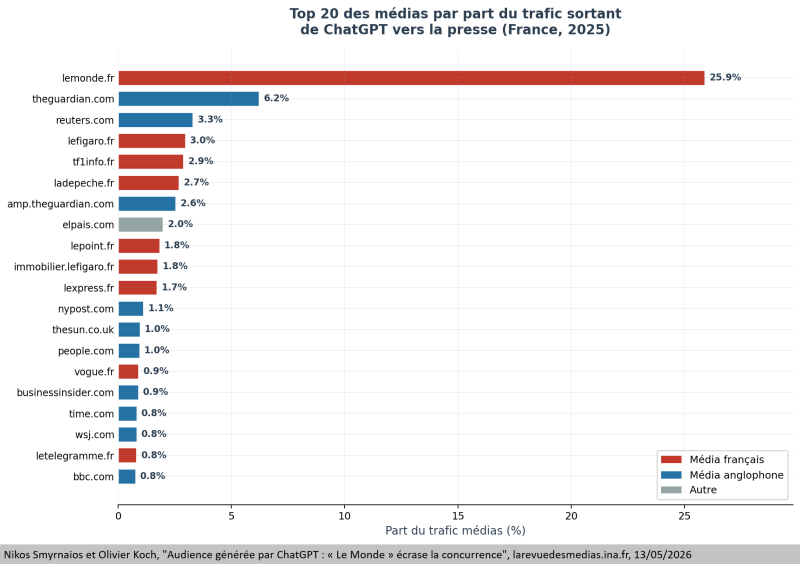
What is cited by AI can also be influenced by other means. Visibility from many popular media outlets has been influenced by the formation of partnerships. Research shows that following Le Monde’s multi-year partnership with OpenAI in March 2024, the publisher obtained 25.9% of all ChatGPT-driven visits to French news sites, more than ten times the share of its closest competitors. With The Guardian, ranked in 2nd place, having concluded a similar agreement in February 2025, it is clear that direct agreements with AI companies are shaping who gets surfaced.

Source: Nikos Smyrnaios & Olivier Koch

At the same time, the space available for organic citations is about to get smaller. Google’s AI Overviews are already placing ads inside the AI summary. The implication for destinations is that the same compressed slots already documented across AI search will now be sharing space with paid placements, narrowing the room for organic visibility further. This is worth further reflection, given that the presence of AI Overviews also reduces organic search clicks. Ahrefs data shows that in April 2025, AI Overviews reduced clicks on top SERPs by 34.5%. By December 2025, this depressed clickthrough rate had declined further to 58%.

What Citations and Mentions are Telling You

A useful distinction is emerging among teams tracking AI search, with two distinctly different KPIs gaining traction. A citation is when an AI system uses content from a destination as a source for an answer it builds in real time. On the other hand, a brand mention is when an AI system names the destination in a response drawn from its training data, often without linking out at all. The two metrics behave independently and they tell destinations very different things.

A destination can show up across the citation list without ever being one of the brands the AI is actually putting forward. While citations are still useful as a leading indicator, they tell a destination that AI knows it exists. The work that turns a citation into a mention sits in a different place. Alongside the act of retrieval, AI builds a summary view of a destination from everything it has read, and that view shapes the framing it carries into future responses. If the AI has built a picture of a destination as crowded, expensive or limited in its offer, that framing is what travellers will receive, and it stays in place until the model is retrained. Shaping that framing is largely the work of fresh and engaging content with brand authority.

However, treating AI search as a content-volume problem rather than a content-quality problem will have detrimental results. A pattern worth noting is that the methods many people implement to improve AI visibility often produce short-term citation gains. Research tracking more than 220 websites that scaled content using AI tools, found that 54% lost 30% or more of their peak organic traffic. This shows how search visibility can be earned and then lost again.

Source: Lily Ray

This short-term citation challenge is perhaps unsurprising given that the templates being marketed as fast routes to AI visibility, single-question FAQs and self-promotional listicles, all appear in the list of content formats that Google is currently demoting.

What Progress Looks Like

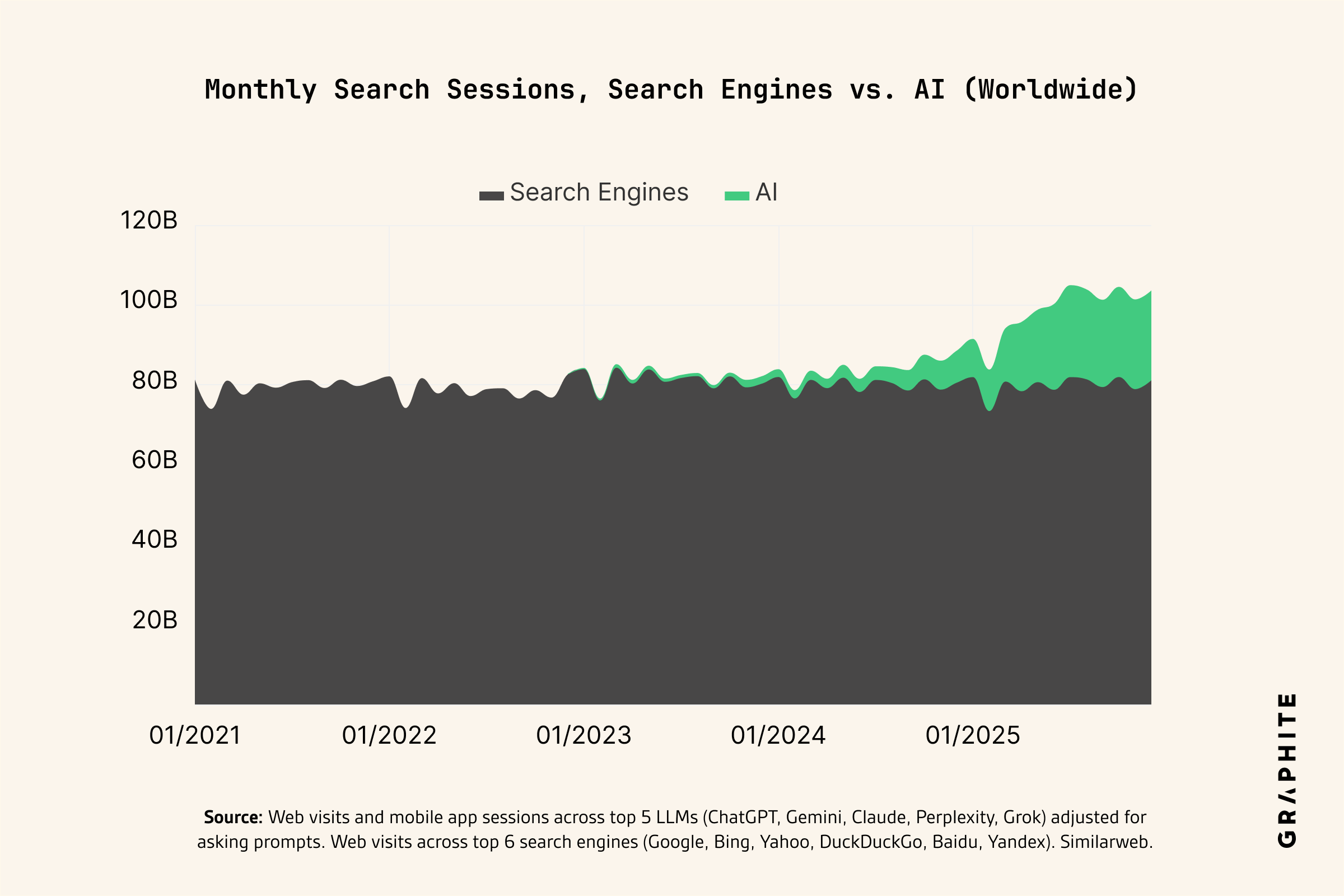
How well is the content on a destination's website organised so AI tools can pick it up and use it? Where is the destination present on the platforms AI reads from? Neither question carries more weight than the other and the DMOs making real progress on AI discoverability are running both questions in parallel. On the other side, SEO remains significant. Across 40,000 of the largest websites, SEO traffic only fell 2.5% year-on-year. Taking traditional search and AI tools together, searches have grown 26% worldwide between Q1 2023 and Q4 2025. Rather than prioritising one search mechanism over the other, the two paths now need to be jointly managed.

Source: Graphite

X. Design Week 2026, taking place in Brussels on 2-4 June, dedicates its second day to discoverability and presence in this new search environment. The programme works through how AI systems source information, how destinations are organising their content and platform presence for both traditional and AI search and where the most meaningful gaps tend to be. The format is built around peer exchange, with destinations talking honestly about what worked and what did not.

Subscribe to our Newsletter

Thank you! Your submission has been received!
Oops! Something went wrong while submitting the form.

Digital discovery is shifting at an extraordinary pace, fundamentally changing how people find information online. Nearly four in ten US travellers used generative AI for trip research in 2025, an eleven-point jump in twelve months. Traditional search still leads as the dominant tool, but its lead is narrowing. Google continues to carry most of the volume, while the smaller share of traffic coming through AI tools tends to arrive with clearer intent.

However, while traditional search is still the most important method for visitors to plan trips, data from Future Partners shows that AI tools are the only channel actively gaining momentum for trip planning (16.8% in 2025 vs. 23.1% in 2026). Crucially, growing adoption of AI-enabled trip planning is reported across all markets. Another key statistic worth considering is how AI Overviews now cite fewer pages from search engine results pages (SERPs). In July 2025, roughly 76% of citations came from the top 10 SERPs, yet this reduced to 38% by March 2026.

Source: ahrefs

The AI Discovery Shift

The changing discovery landscape has significant implications for DMOs and their content strategies. Yet, while there is a consensus that answer engine optimisation (AEO) and generative engine optimisation (GEO) strategies are essential for DMOs to improve their AI search visibility, Google's guidance for generative AI search explicitly highlights that search engine optimisation (SEO) practices remain foundational elements of AEO and GEO.

AI search itself is also more selective than the volume of AI activity suggests. According to data from Semrush, ChatGPT only searches the internet for 34.5% of queries, down from 46% at the end of 2024. Most of its answers still come from training data alone. Another notable consideration is that as default models evolve, web visibility adjusts in tandem overnight. In March 2026, following the transition from GPT-4o/5.2 to GPT-5.3 Instant, the average number of domains cited per response dropped from 19 to 15. It's also important to remember that not being cited does not mean that your page isn't being found. Research shows that 85% of the pages retrieved by ChatGPT never appear in the final response.

Source: Resoneo

Making Content Legible to Machines

Even when AI tools do reach a destination’s own website, what they find there determines whether they can use it. Schema markup is one of the most vital elements in becoming legible to AI, with this code acting as structured data to help easily categorise a piece of content, so that it can be used for the right kind of query. Alongside this technical component, clear headings give AI systems a strong signal to decide whether to read further. Direct answers placed early in a section reflect the fact that AI tools tend to extract from the first paragraphs of a page. It’s also important to recognise that AI systems often pull from FAQ pages directly, mirroring the question-and-answer shape of an AI conversation. 

An area of active debate is the extent llms.txt files influence AI visibility. Across the 300,000 domains analysed by SE Ranking, only 10% of sites have implemented it. Removing the variable from the predictive model slightly improved its accuracy, suggesting that the file format adds additional complexity to the machine readability of content. Yet, it is likely that llms.txt files will become a ranking signal for AI indexing in the coming years, meaning that it often remains as a recommended best practice.

What is cited by AI can also be influenced by other means. Visibility from many popular media outlets has been influenced by the formation of partnerships. Research shows that following Le Monde’s multi-year partnership with OpenAI in March 2024, the publisher obtained 25.9% of all ChatGPT-driven visits to French news sites, more than ten times the share of its closest competitors. With The Guardian, ranked in 2nd place, having concluded a similar agreement in February 2025, it is clear that direct agreements with AI companies are shaping who gets surfaced.

Source: Nikos Smyrnaios & Olivier Koch

At the same time, the space available for organic citations is about to get smaller. Google’s AI Overviews are already placing ads inside the AI summary. The implication for destinations is that the same compressed slots already documented across AI search will now be sharing space with paid placements, narrowing the room for organic visibility further. This is worth further reflection, given that the presence of AI Overviews also reduces organic search clicks. Ahrefs data shows that in April 2025, AI Overviews reduced clicks on top SERPs by 34.5%. By December 2025, this depressed clickthrough rate had declined further to 58%.

What Citations and Mentions are Telling You

A useful distinction is emerging among teams tracking AI search, with two distinctly different KPIs gaining traction. A citation is when an AI system uses content from a destination as a source for an answer it builds in real time. On the other hand, a brand mention is when an AI system names the destination in a response drawn from its training data, often without linking out at all. The two metrics behave independently and they tell destinations very different things.

A destination can show up across the citation list without ever being one of the brands the AI is actually putting forward. While citations are still useful as a leading indicator, they tell a destination that AI knows it exists. The work that turns a citation into a mention sits in a different place. Alongside the act of retrieval, AI builds a summary view of a destination from everything it has read, and that view shapes the framing it carries into future responses. If the AI has built a picture of a destination as crowded, expensive or limited in its offer, that framing is what travellers will receive, and it stays in place until the model is retrained. Shaping that framing is largely the work of fresh and engaging content with brand authority.

However, treating AI search as a content-volume problem rather than a content-quality problem will have detrimental results. A pattern worth noting is that the methods many people implement to improve AI visibility often produce short-term citation gains. Research tracking more than 220 websites that scaled content using AI tools, found that 54% lost 30% or more of their peak organic traffic. This shows how search visibility can be earned and then lost again.

Source: Lily Ray

This short-term citation challenge is perhaps unsurprising given that the templates being marketed as fast routes to AI visibility, single-question FAQs and self-promotional listicles, all appear in the list of content formats that Google is currently demoting.

What Progress Looks Like

How well is the content on a destination's website organised so AI tools can pick it up and use it? Where is the destination present on the platforms AI reads from? Neither question carries more weight than the other and the DMOs making real progress on AI discoverability are running both questions in parallel. On the other side, SEO remains significant. Across 40,000 of the largest websites, SEO traffic only fell 2.5% year-on-year. Taking traditional search and AI tools together, searches have grown 26% worldwide between Q1 2023 and Q4 2025. Rather than prioritising one search mechanism over the other, the two paths now need to be jointly managed.

Source: Graphite

X. Design Week 2026, taking place in Brussels on 2-4 June, dedicates its second day to discoverability and presence in this new search environment. The programme works through how AI systems source information, how destinations are organising their content and platform presence for both traditional and AI search and where the most meaningful gaps tend to be. The format is built around peer exchange, with destinations talking honestly about what worked and what did not.
Subscribe to our Newsletter

Thank you! Your submission has been received!
Oops! Something went wrong while submitting the form.