DMOs are actively adapting to AI-driven search by reshaping content, optimising for AI citation, investing in GEO, diversifying traffic channels and building proprietary tools to stay visible, trusted and competitive as discovery becomes AI-mediated.
The scale of AI search adoption is now undeniable, with click-through rates dropping when AI summaries appear and a growing number of travellers turning to AI tools for trip planning. For DMOs, this raises an obvious question: what can actually be done about it?
Here at the DTTT, we surveyed CMOs from leading DMOs worldwide, revealing that forward-thinking destinations are not waiting for the dust to settle. They’re already adapting, experimenting with new content approaches, technical infrastructure and channel strategies.
Strategic Adaptations: How DMOs Are Responding
Our research reveals a range of strategies: from reactive optimisation, which involves ensuring the accurate citation of destination content by AI systems, to proactive innovation, which entails developing proprietary AI tools to rival mainstream platforms.
Effective strategies consistently involve redefining the purpose of destination websites. Where websites once existed primarily for human visitors, leading DMOs now treat them equally as data sources for AI systems that increasingly mediate how travellers discover and plan trips.
Content Strategy Evolution: Beyond Simple Answers
Destinations are rethinking their content approach, moving beyond simply providing factual information towards creating content that AI finds difficult to summarise. This strategic shift signifies an acknowledgement that direct competition with AI-generated summaries for simple information requests is becoming unproductive.
The focus for many DMOs has shifted to producing extremely detailed content, such as showcasing local experiences, curated thematic itineraries and insider perspectives, offering clear additional emotional and editorial value. This represents a shift from informational content towards experiential and contextual content, providing unique value that AI summaries cannot easily replicate. Rather than explaining what exists, destinations are focusing on conveying why it matters, how it feels and what makes experiences distinctive in ways that resist compression into AI-generated bullet points.
Reverse Prompt Engineering: Understanding AI Visibility
A growing number of destinations now monitor how AI systems respond to queries about their location, using tools like AnswerThePublic to track what travellers are asking ChatGPT, Perplexity and Gemini. This intelligence then shapes content strategy, addressing gaps, correcting misrepresentations and ensuring the destination appears in relevant AI-generated recommendations.
Reverse prompt engineering is becoming essential for destinations serious about AI visibility. By systematically querying AI systems and analysing the responses, DMOs can identify where AI provides incomplete information, cites competitors instead or misrepresents the destination entirely. Successful destinations view this process not as a single audit but as continuous intelligence gathering, integrating it into their regular content planning cycles. This approach, which we implement with DMOs in DTTT's AI programmes and workshops, frequently reveals content gaps that necessitate a complete re-evaluation of content priorities.
Structuring Content for AI and Humans
Leading destinations are also restructuring existing content to serve both AI systems and human readers effectively. This includes ensuring content is clearly structured and directly addresses key questions while remaining easy for AI systems to interpret, combined with a focus on long-tail keywords that AI tools seem to favour and comprehensive content that answers questions thoroughly to encourage citation by AI systems rather than being paraphrased.
Some destinations have embraced principles from Google's E-E-A-T framework, focusing explicitly on Experience, Expertise, Authoritativeness and Trustworthiness. Content demonstrating expertise, first-hand experience and authoritative sources stands a better chance of being cited by AI systems and valued by users who click through seeking depth beyond AI summaries.
The content evolution also encompasses meta-level improvements, updating meta descriptions to match queries and user intentions, creating structured Q&A articles and developing content that directly responds to popular queries with new or updated information.
From SEO to GEO
Generative Engine Optimisation (GEO) fundamentally shifts the focus from traditional Search Engine Optimisation (SEO). While SEO aimed for high rankings in Google's organic results, GEO is centred on having your content cited, quoted and recommended by AI systems as they generate responses to user queries.
The distinction matters because the rules have changed. SEO success meant appearing on page one of search results. GEO success means being the source that AI systems trust and reference when answering questions about your destination. A destination might rank well in traditional search but be completely absent from AI-generated recommendations or vice versa.
DMOs now need to think about their content not just as pages for humans to read, but as training material and reference sources for AI systems. This means asking different questions: Is our content structured in ways AI can easily understand? Are we answering the specific questions travellers ask AI assistants? Do AI systems recognise us as an authoritative source about our destination?
The philosophy underpinning GEO comes down to a simple reality: AI systems can only cite what they can find and understand. Accurate representation requires authoritative content in the sources these systems draw from and websites remain the most effective channel, now structured for AI consumption alongside human readability.
Technical Implementation: Making Content AI-Readable
Common approaches include integrating FAQ sections on every page, providing structured question-answer pairs that AI can easily understand and incorporate into responses. More advanced approaches involve planning to deliver long-form content in HTML that remains visible to AI crawler bots whilst being hidden from standard user views, essentially creating parallel content layers optimised for different audiences.
Some organisations are implementing emerging standards, such as llms.txt, which guide large language models about how to understand and use site content. Think of it as robots.txt for the AI era, a way of communicating directly with AI about what your content contains and how it should be used.
Technical enhancements should include a strong focus on SEO fundamentals, such as correcting broken links, adding Alt tags to all images and improving schema markup and site speed. Implementing better UI and UX is also crucial. These improvements achieve two goals: they uphold performance in traditional search and establish a robust platform for future AI-driven optimisation.
Paid Search: Strategic Repositioning
Paid search efforts are expanding substantially, not as temporary compensation for organic decline but as strategic repositioning. This includes diversifying to native advertising platforms, partnerships with online travel agencies and increased investment in always-on paid social and search campaigns.
Notably, while no-click searches rise, impressions continue increasing year-on-year and paid search advertisements positioned below AI results continue to provide the highest positioning available on search result pages. The positioning of paid results directly beneath AI Overviews may actually prove more valuable than mid-page organic rankings in traditional search results.
Owned Channels: Building Direct Relationships
Email marketing and owned communication channels are receiving renewed strategic focus. Destinations are increasing their use of newsletters, building direct relationships and engagement with consumers through curated emails and reducing dependence on intermediated channels.
This owned media emphasis represents recognition that while AI may intermediate initial discovery, destinations that maintain direct communication channels retain control over ongoing engagement independent of algorithm changes or platform policies.
Social Media Driving Traffic
Social media strategies are also evolving beyond awareness-building towards traffic generation. This includes broadening activity across social platforms, leveraging content from newly launched ambassador networks for increased visibility and using social channels as alternative tools for discovery, which are less susceptible to AI search disruption.
To ensure social media drives traffic, not just impressions, content must stand out. Visit Norway's late 2025 launch of "Twigs", an AI-generated troll integrated into real Norwegian scenery, exemplifies this approach. While the long-term effectiveness of AI-generated content in converting to website visits is still uncertain, the underlying principle remains that unique content captures attention, and attention is the crucial first step toward generating traffic.
The diversification extends to conversion mechanisms themselves. Destinations are implementing alternative methods, including QR codes, instant forms and direct linking approaches that bypass traditional website navigation. This recognises that visitor acquisition in an AI-dominated discovery landscape may require rethinking not just how visitors find destinations but how they convert from interest to action.
Chatbots and Proprietary AI Tools
Chatbots are increasingly being implemented as research instruments for understanding how visitors use conversational search and identifying content gaps and needs. Notably, chatbot users tend to demonstrate higher engagement, viewing more pages than typical visitors, suggesting these tools serve dual purposes as both research instruments and engagement drivers.
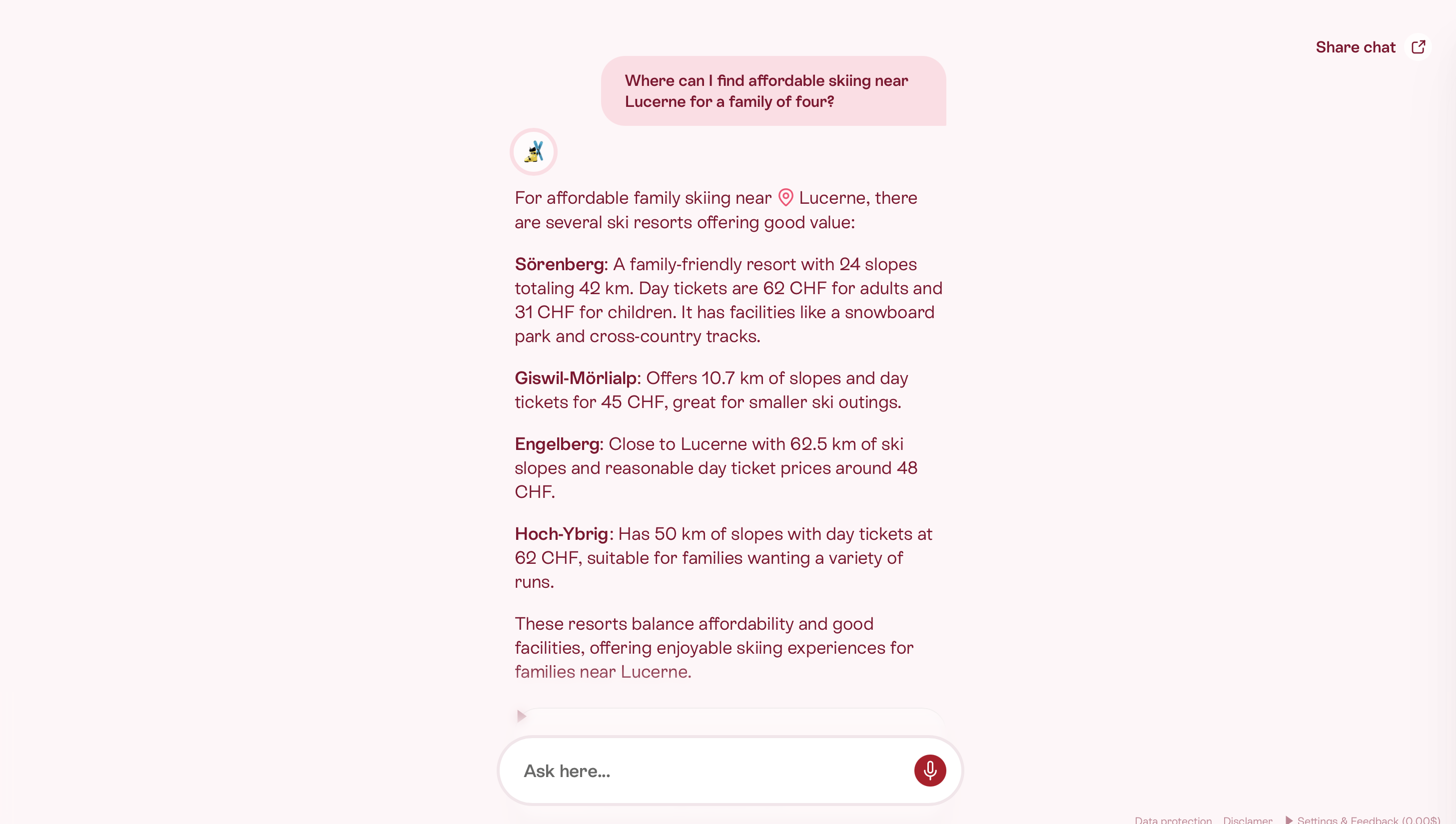
Switzerland Tourism’s AI chatbot on MySwitzerland.com shows what visitor-facing tools can achieve. Built with access to multiple APIs and live data feeds, it answers complex queries like “Where can I find affordable skiing near Lucerne for a family of four?” by combining Swiss Federal Railways timetables, weather conditions and slope status, consolidating sources that would otherwise require searching multiple websites.
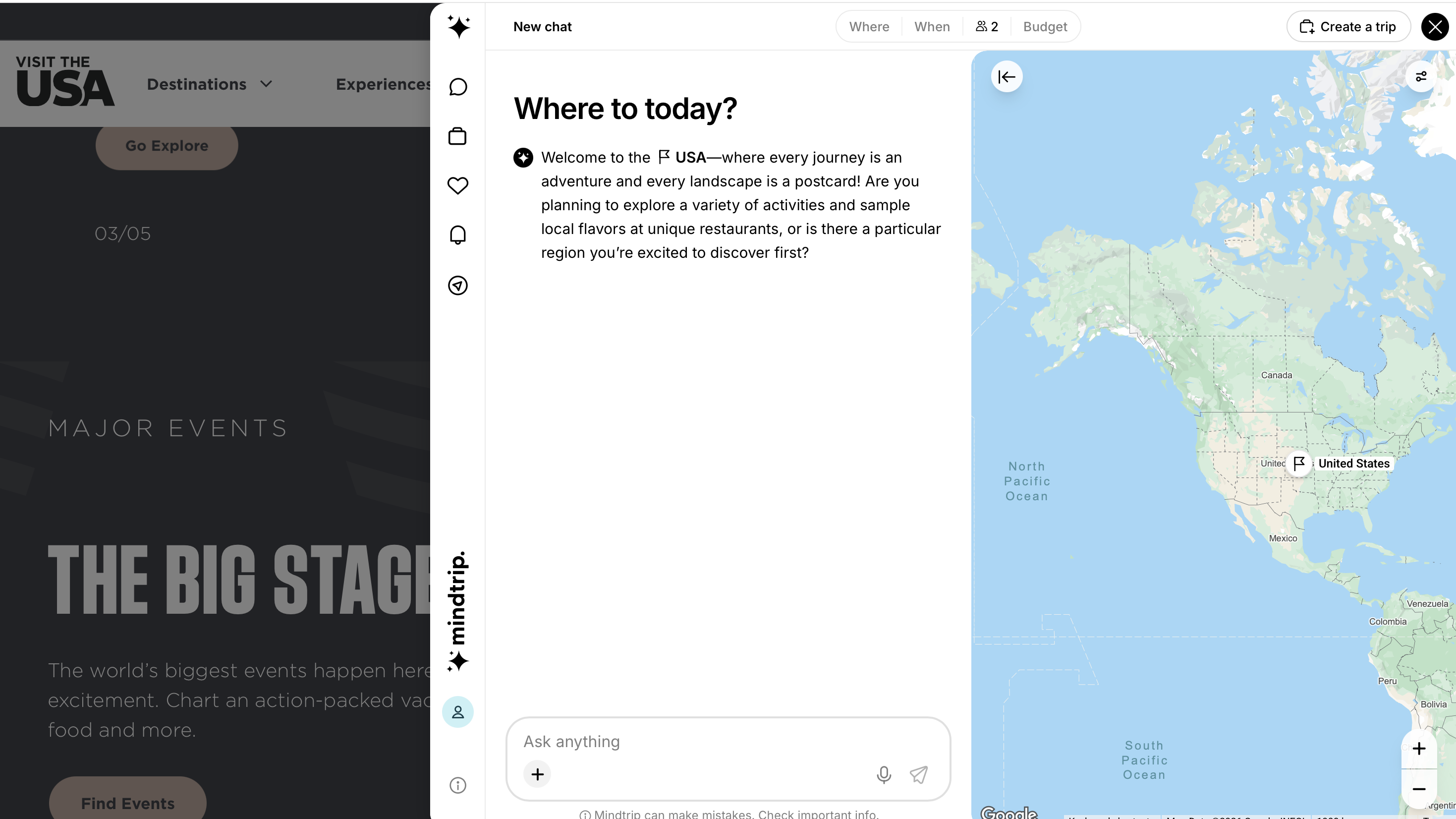
Brand USA has integrated AI capabilities directly into its global campaign platform. AmericaTheBeautiful.com, powered by AI travel platform Mindtrip, offers personalised recommendations and itinerary-building tools in 8 languages, making AI-assisted trip planning central to the visitor journey.
Some destinations are taking the initiative to develop their own AI tools, aiming to offer a competitive alternative to major platforms like ChatGPT and Gemini. The rationale is that by using their unique, authoritative content, these destination-specific tools can provide travellers with more accurate and relevant answers. This inherent advantage in specialised content presents a clear opportunity for creating better tools for travellers.
Destinations are also beginning to monitor how their content appears across AI platforms, tracking what these say about them and identifying where to improve visibility and accuracy. This represents proactive engagement with AI systems as publishing channels.
Infrastructure for the AI Era
The scraping that AI tools perform places increased pressure on server infrastructure. DMOs are consequently moving to hosting infrastructure specifically designed to handle sudden loads from automated tools, ensuring websites remain responsive to both human visitors and the intensive crawling that AI systems perform.
DMOs are also planning or implementing complete website redesigns with AI readability as a core design principle. Upcoming website launches will incorporate AI-friendly content structures, optimised technical specifications and design decisions informed by how AI systems review and understand web content.
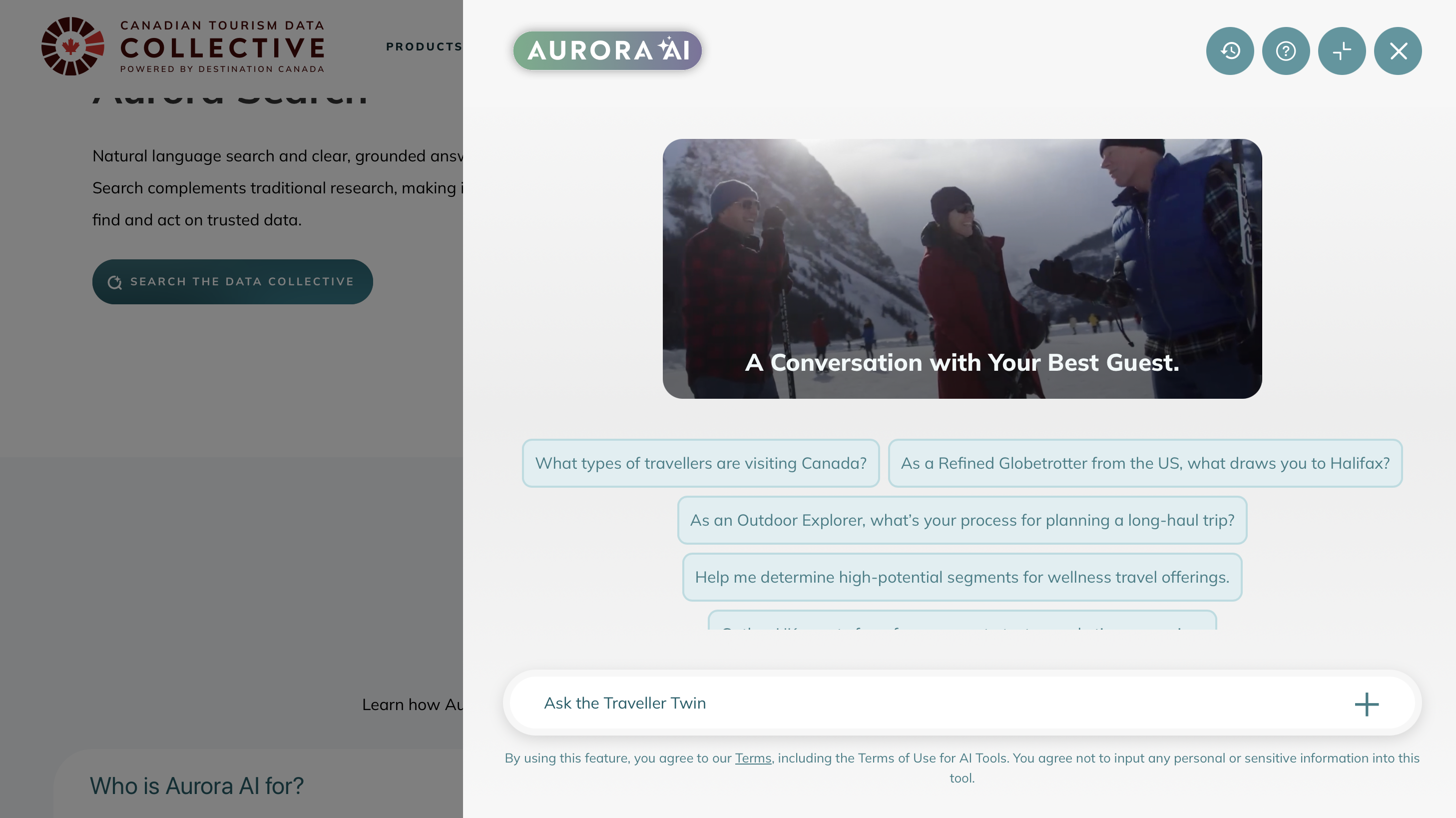
Beyond websites, some destinations are building the data infrastructure that AI applications depend on. Destination Canada's "Canadian Tourism Data Collective" unifies over 230 datasets and 34 billion rows of data into a single platform, covering visitor spending patterns, regional tourism assets, seasonality and economic impact across 5,100 regions. The platform includes AI-powered tools, such as Traveller Twin, which transforms traveller segmentation into conversational personas that marketers can query directly.
Our research suggests that AI search represents a structural shift in website engagement. The destinations thriving in this new environment are creating comprehensive, emotionally resonant content serving both human users and AI systems. Successful DMOs are building relationships with travellers through owned channels, using data and tools to understand how AI is changing visitor discovery and recognising that AI search does not replace human connection, but changes how that connection begins.
DTTT Take
Build for both audiences: Websites now serve two purposes, inspirational content for human visitors and as data sources for AI systems. Content strategy should address both.
Invest in GEO: Traditional SEO remains important, but optimising for AI systems is now equally essential. Structured content, FAQ sections, schema markup and emerging standards like llms.txt help ensure your content gets cited.
Diversify traffic sources: Over-reliance on organic search creates vulnerability. Strengthen owned channels, paid positioning and social media as traffic drivers.
Address the measurement gap: Current analysis cannot fully capture AI-influenced traffic. Monitor referral patterns, track engagement quality and advocate for better industry tools.
Prepare infrastructure: Server capacity must handle both human visitors and AI crawling. DMOs with limited technical resources should prioritise hosting upgrades to maintain performance under load.
Consider proprietary AI tools: Destinations possess unique content. Chatbots built on this content can capture queries and deliver tailored experiences.
Focus on quality over volume: Visitors who click through from AI results show higher engagement. Optimise for serving these higher-intent visitors exceptionally well.
Oops! Something went wrong while submitting the form.
The scale of AI search adoption is now undeniable, with click-through rates dropping when AI summaries appear and a growing number of travellers turning to AI tools for trip planning. For DMOs, this raises an obvious question: what can actually be done about it?
Here at the DTTT, we surveyed CMOs from leading DMOs worldwide, revealing that forward-thinking destinations are not waiting for the dust to settle. They’re already adapting, experimenting with new content approaches, technical infrastructure and channel strategies.
Strategic Adaptations: How DMOs Are Responding
Our research reveals a range of strategies: from reactive optimisation, which involves ensuring the accurate citation of destination content by AI systems, to proactive innovation, which entails developing proprietary AI tools to rival mainstream platforms.
Effective strategies consistently involve redefining the purpose of destination websites. Where websites once existed primarily for human visitors, leading DMOs now treat them equally as data sources for AI systems that increasingly mediate how travellers discover and plan trips.
Content Strategy Evolution: Beyond Simple Answers
Destinations are rethinking their content approach, moving beyond simply providing factual information towards creating content that AI finds difficult to summarise. This strategic shift signifies an acknowledgement that direct competition with AI-generated summaries for simple information requests is becoming unproductive.
The focus for many DMOs has shifted to producing extremely detailed content, such as showcasing local experiences, curated thematic itineraries and insider perspectives, offering clear additional emotional and editorial value. This represents a shift from informational content towards experiential and contextual content, providing unique value that AI summaries cannot easily replicate. Rather than explaining what exists, destinations are focusing on conveying why it matters, how it feels and what makes experiences distinctive in ways that resist compression into AI-generated bullet points.
Reverse Prompt Engineering: Understanding AI Visibility
A growing number of destinations now monitor how AI systems respond to queries about their location, using tools like AnswerThePublic to track what travellers are asking ChatGPT, Perplexity and Gemini. This intelligence then shapes content strategy, addressing gaps, correcting misrepresentations and ensuring the destination appears in relevant AI-generated recommendations.
Reverse prompt engineering is becoming essential for destinations serious about AI visibility. By systematically querying AI systems and analysing the responses, DMOs can identify where AI provides incomplete information, cites competitors instead or misrepresents the destination entirely. Successful destinations view this process not as a single audit but as continuous intelligence gathering, integrating it into their regular content planning cycles. This approach, which we implement with DMOs in DTTT's AI programmes and workshops, frequently reveals content gaps that necessitate a complete re-evaluation of content priorities.
Structuring Content for AI and Humans
Leading destinations are also restructuring existing content to serve both AI systems and human readers effectively. This includes ensuring content is clearly structured and directly addresses key questions while remaining easy for AI systems to interpret, combined with a focus on long-tail keywords that AI tools seem to favour and comprehensive content that answers questions thoroughly to encourage citation by AI systems rather than being paraphrased.
Some destinations have embraced principles from Google's E-E-A-T framework, focusing explicitly on Experience, Expertise, Authoritativeness and Trustworthiness. Content demonstrating expertise, first-hand experience and authoritative sources stands a better chance of being cited by AI systems and valued by users who click through seeking depth beyond AI summaries.
The content evolution also encompasses meta-level improvements, updating meta descriptions to match queries and user intentions, creating structured Q&A articles and developing content that directly responds to popular queries with new or updated information.
From SEO to GEO
Generative Engine Optimisation (GEO) fundamentally shifts the focus from traditional Search Engine Optimisation (SEO). While SEO aimed for high rankings in Google's organic results, GEO is centred on having your content cited, quoted and recommended by AI systems as they generate responses to user queries.
The distinction matters because the rules have changed. SEO success meant appearing on page one of search results. GEO success means being the source that AI systems trust and reference when answering questions about your destination. A destination might rank well in traditional search but be completely absent from AI-generated recommendations or vice versa.
DMOs now need to think about their content not just as pages for humans to read, but as training material and reference sources for AI systems. This means asking different questions: Is our content structured in ways AI can easily understand? Are we answering the specific questions travellers ask AI assistants? Do AI systems recognise us as an authoritative source about our destination?
The philosophy underpinning GEO comes down to a simple reality: AI systems can only cite what they can find and understand. Accurate representation requires authoritative content in the sources these systems draw from and websites remain the most effective channel, now structured for AI consumption alongside human readability.
Technical Implementation: Making Content AI-Readable
Common approaches include integrating FAQ sections on every page, providing structured question-answer pairs that AI can easily understand and incorporate into responses. More advanced approaches involve planning to deliver long-form content in HTML that remains visible to AI crawler bots whilst being hidden from standard user views, essentially creating parallel content layers optimised for different audiences.
Some organisations are implementing emerging standards, such as llms.txt, which guide large language models about how to understand and use site content. Think of it as robots.txt for the AI era, a way of communicating directly with AI about what your content contains and how it should be used.
Technical enhancements should include a strong focus on SEO fundamentals, such as correcting broken links, adding Alt tags to all images and improving schema markup and site speed. Implementing better UI and UX is also crucial. These improvements achieve two goals: they uphold performance in traditional search and establish a robust platform for future AI-driven optimisation.
Paid Search: Strategic Repositioning
Paid search efforts are expanding substantially, not as temporary compensation for organic decline but as strategic repositioning. This includes diversifying to native advertising platforms, partnerships with online travel agencies and increased investment in always-on paid social and search campaigns.
Notably, while no-click searches rise, impressions continue increasing year-on-year and paid search advertisements positioned below AI results continue to provide the highest positioning available on search result pages. The positioning of paid results directly beneath AI Overviews may actually prove more valuable than mid-page organic rankings in traditional search results.
Owned Channels: Building Direct Relationships
Email marketing and owned communication channels are receiving renewed strategic focus. Destinations are increasing their use of newsletters, building direct relationships and engagement with consumers through curated emails and reducing dependence on intermediated channels.
This owned media emphasis represents recognition that while AI may intermediate initial discovery, destinations that maintain direct communication channels retain control over ongoing engagement independent of algorithm changes or platform policies.
Social Media Driving Traffic
Social media strategies are also evolving beyond awareness-building towards traffic generation. This includes broadening activity across social platforms, leveraging content from newly launched ambassador networks for increased visibility and using social channels as alternative tools for discovery, which are less susceptible to AI search disruption.
To ensure social media drives traffic, not just impressions, content must stand out. Visit Norway's late 2025 launch of "Twigs", an AI-generated troll integrated into real Norwegian scenery, exemplifies this approach. While the long-term effectiveness of AI-generated content in converting to website visits is still uncertain, the underlying principle remains that unique content captures attention, and attention is the crucial first step toward generating traffic.
The diversification extends to conversion mechanisms themselves. Destinations are implementing alternative methods, including QR codes, instant forms and direct linking approaches that bypass traditional website navigation. This recognises that visitor acquisition in an AI-dominated discovery landscape may require rethinking not just how visitors find destinations but how they convert from interest to action.
Chatbots and Proprietary AI Tools
Chatbots are increasingly being implemented as research instruments for understanding how visitors use conversational search and identifying content gaps and needs. Notably, chatbot users tend to demonstrate higher engagement, viewing more pages than typical visitors, suggesting these tools serve dual purposes as both research instruments and engagement drivers.
Switzerland Tourism’s AI chatbot on MySwitzerland.com shows what visitor-facing tools can achieve. Built with access to multiple APIs and live data feeds, it answers complex queries like “Where can I find affordable skiing near Lucerne for a family of four?” by combining Swiss Federal Railways timetables, weather conditions and slope status, consolidating sources that would otherwise require searching multiple websites.
Brand USA has integrated AI capabilities directly into its global campaign platform. AmericaTheBeautiful.com, powered by AI travel platform Mindtrip, offers personalised recommendations and itinerary-building tools in 8 languages, making AI-assisted trip planning central to the visitor journey.
Some destinations are taking the initiative to develop their own AI tools, aiming to offer a competitive alternative to major platforms like ChatGPT and Gemini. The rationale is that by using their unique, authoritative content, these destination-specific tools can provide travellers with more accurate and relevant answers. This inherent advantage in specialised content presents a clear opportunity for creating better tools for travellers.
Destinations are also beginning to monitor how their content appears across AI platforms, tracking what these say about them and identifying where to improve visibility and accuracy. This represents proactive engagement with AI systems as publishing channels.
Infrastructure for the AI Era
The scraping that AI tools perform places increased pressure on server infrastructure. DMOs are consequently moving to hosting infrastructure specifically designed to handle sudden loads from automated tools, ensuring websites remain responsive to both human visitors and the intensive crawling that AI systems perform.
DMOs are also planning or implementing complete website redesigns with AI readability as a core design principle. Upcoming website launches will incorporate AI-friendly content structures, optimised technical specifications and design decisions informed by how AI systems review and understand web content.
Beyond websites, some destinations are building the data infrastructure that AI applications depend on. Destination Canada's "Canadian Tourism Data Collective" unifies over 230 datasets and 34 billion rows of data into a single platform, covering visitor spending patterns, regional tourism assets, seasonality and economic impact across 5,100 regions. The platform includes AI-powered tools, such as Traveller Twin, which transforms traveller segmentation into conversational personas that marketers can query directly.
Our research suggests that AI search represents a structural shift in website engagement. The destinations thriving in this new environment are creating comprehensive, emotionally resonant content serving both human users and AI systems. Successful DMOs are building relationships with travellers through owned channels, using data and tools to understand how AI is changing visitor discovery and recognising that AI search does not replace human connection, but changes how that connection begins.
DTTT Take
Build for both audiences: Websites now serve two purposes, inspirational content for human visitors and as data sources for AI systems. Content strategy should address both.
Invest in GEO: Traditional SEO remains important, but optimising for AI systems is now equally essential. Structured content, FAQ sections, schema markup and emerging standards like llms.txt help ensure your content gets cited.
Diversify traffic sources: Over-reliance on organic search creates vulnerability. Strengthen owned channels, paid positioning and social media as traffic drivers.
Address the measurement gap: Current analysis cannot fully capture AI-influenced traffic. Monitor referral patterns, track engagement quality and advocate for better industry tools.
Prepare infrastructure: Server capacity must handle both human visitors and AI crawling. DMOs with limited technical resources should prioritise hosting upgrades to maintain performance under load.
Consider proprietary AI tools: Destinations possess unique content. Chatbots built on this content can capture queries and deliver tailored experiences.
Focus on quality over volume: Visitors who click through from AI results show higher engagement. Optimise for serving these higher-intent visitors exceptionally well.
Continue reading...
Get access to 100s of case studies, workshop templates, industry leading events and more.



.svg)