X. Design Week 2026 brought destination leaders to Brussels from 2 to 4 June for three days of focused conversation on AI. Four topics ran across the programme, with four working zones giving participants a way into each subject.
X. Design Week 2026 brought destination leaders to Brussels from 2 to 4 June for three days of focused conversation on AI. Four topics ran across the programme, with four working zones giving participants a way into each subject from several different angles, building practical, strategic and critical perspectives side by side.
AI Readiness, Workflow and Knowledge Systems
AI represents a structural shift, building in layers on top of itself. While the technical barrier has fallen, the judgement to direct AI well and to own the outcome has become the biggest strategic decision. Organisations that are not actively transforming their processes find the gap widening over time. This requires moving away from viewing AI at the individual task level and structuring projects to work more collaboratively with AI systems and build up autonomous workflows.
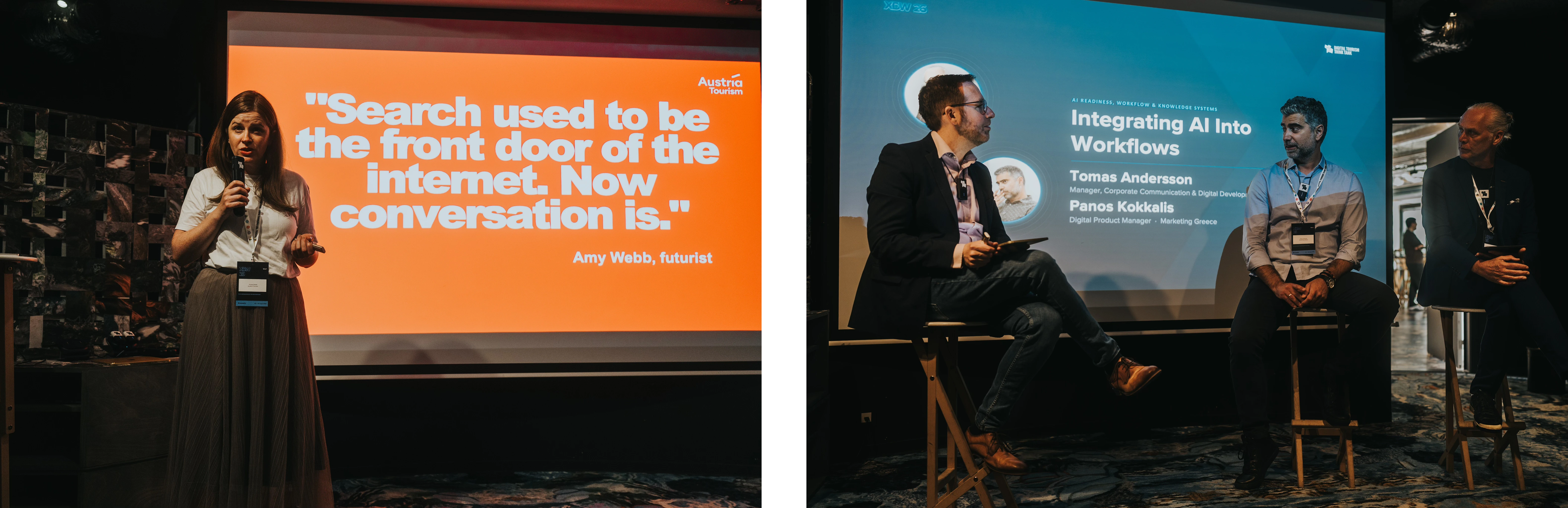
Teresa Karan from Austria Tourism walked through the work behind Change Tourism Austria, the national platform built to help the industry adapt to a new way of working. With UN Tourism identifying that almost 70% of national tourism organisations cite missing skills as their primary barrier to AI adoption, the platform exists to give Austrian tourism businesses a clear route into experimentation and integration. Curated use cases, start-up spotlights, and community sit at the centre of the approach, creating the reference points that help SMEs see what AI can do for their work. Meanwhile, hackathons enable a more challenge-specific approach to using AI to support tourism for the better.
Such platforms are essential for the tourism sector because AI causes fear for many people. Yet, when used effectively, it is designed to empower individuals and enable them to make space for what matters. Rather than focusing on top-down rollouts, bringing people together and gathering diverse perspectives has become an essential component of AI upskilling at a national level. In doing so, informal conversations build the necessary engagement that gives people an enhanced sense of job security and a stronger desire to experiment with AI to improve their skills and daily working environment.
Panos Kokkalis from Marketing Greece demonstrated the organisation's Tourism AI Playground initiative, highlighting how AI enablement often starts from a personal passion before scaling into organisational practice. This shows how AI literacy has become a new competitive advantage for destinations. However, it is important to recognise that simply rushing into AI without structure leaves an organisation with disconnected pilots and no shared culture. As Tomas Andersson from Stockholm Business Region made clear, this means alignment of expectations between senior management and staff about the role of AI in assisting outputs will only become more important. As such, there is a direct need to balance enthusiasm for experimentation and the role of AI champions with clear strategic objectives. Such a realisation demonstrates why it is important to avoid rushing into action because of the AI hype and to recognise the long-term benefits of having a defined AI governance strategy.
AI Governance and Strategy
Work is built on systems, and systems are precisely what AI is well-suited to supporting. As AI takes on more of the production, the human role moves up the funnel toward direction, curation and judgement. Governance is what keeps that directed work consistent and useful as it scales. Trust sits at the foundation of this, with honesty underneath disclosure and accountability.
"Did you use AI?" is a loaded question, creating a binary response that pushes people to hide their use, exaggerating the shadow AI usage that many organisations are observing. "How did you use AI?" opens a different conversation, one that builds the learning, sharing and accountability that lets AI become embedded across work. This requires defining an acceptable level of risk, with guardrails, process and disclosure building upon each other to set the direction forward.
Governance changes how work is done and should not be a bureaucratic process that adds to the workload. Maas van Drie and Sherry Bidgood from the Aruba Tourism Authority walked through the foundations of their AI Strategy and Roadmap. The urgency of governance, in their account, is about making sure AI does not deepen existing operational gaps. A clear roadmap creates a structured way to fix what is already broken, before scaling something new on top of it. Ownership, assignment and delegation may look top-down on paper, but in reality, the process involves everyone. This all-encompassing perspective is ultimately what transforms an ambitious strategic direction into an implementable strategic approach.
Alfred Wagenius from Visit Skåne also gave an honest account of what implementing AI policies looks like inside a public organisation. Reluctance about AI has to be addressed alongside the standards for output quality. Guidance inevitably gets stronger over time as organisations learn where reinforcement is needed. Embracing the conclusion that teams need hand-holding to scale AI use, a horizontal project-by-project approach helps to reveal the next thing that needs attention. Transparency with partners came through as a defining principle, with a two-way approach to AI disclosure giving outputs integrity.
AI Discoverability and Presence
As earned media has become more important than ever, this transparency will only become even more fundamental. AI looks for authority, influence and social value, meaning the content ecosystem itself is what shapes results collectively. Consumer research is now evolving into a sharper tool for understanding how queries are shifting, which, in turn, directs adaptations to content strategies.
Influencing the result calls for narrative depth, with a clear set of themes the whole industry can rally around and tell consistently. Yet, without experience development underneath, content drifts back toward the dominant conversations AI has already learned. This demonstrates why AI search needs to be considered from a holistic angle, instead of a purely marketing focus, to ensure DMO strategies adapt to the new digital landscape brought by AI search.
As Toby Morris from Tiki highlighted, Generative Engine Optimisation (GEO) should be framed as another channel to integrate into destination marketing strategies without absorbing all of its energy. This move towards prioritising GEO means that zero-click discovery is also creating a hidden attribution challenge. With some travellers no longer exploring destination websites, DMOs miss out on important sources of data about the quality of traffic and how they engage and navigate through a site. Nevertheless, conversational AI interfaces on websites and advertising units hold enormous value in helping DMOs evaluate how search queries change over time.
AI-generated videos also play a role in boosting destination discoverability. Content creates engagement when it carries a distinctive voice and a clear link to place. Johannes Auer from Oberösterreich Tourismus shared the work behind "In Unserer Natur", a campaign that used AI to create a cast of animal reporters championing messages about mindfulness and respect for nature, generating over 1.5 million views. Stewart Howe from Discover Peterborough similarly showcased "Dinosaur City", a campaign that connected AI-generated dinosaur characters back to physical exhibitions, trails and museum experiences across the city.
What the process behind both campaigns reveals is how much work goes into getting AI-generated content right. Different tools are needed for different parts of the workflow, and the workflow itself has to be designed with care. This requires a mindset that is playful and experimental, yet the discipline behind prompting matters to avoid high token usage costs and a pragmatic approach to overcoming persistent consistency concerns.
AI Interfaces and User Experience
Overcoming hurdles and finding practical solutions to boost efficiency and performance is also a key component of working with AI interfaces. One of the clearest messages from the conversation was to be willing to burn things down and rebuild. Vibe coding, where AI builds interfaces from plain language descriptions, is a technique that is growing increasingly common in designing interfaces, requiring teams to have a clear vision of the desired outputs.
Aleksandra Jerebic Topolovec from the Slovenian Tourist Board highlighted how partnerships and integrations have been central to the rebuilds Alma, Slovenia's AI travel guide, has gone through. Drawing on additional data sources, such as maps and hiking routes, Alma's functionality has continued to improve, demonstrating the need for continued investment to maintain and enhance user experience. Understanding changes in search behaviour also influenced how visitor interactions with the interface evolved, with a recognition that voice search is becoming a more important format for a natural and engaging input mechanism.
The legal implications of building and upgrading an AI interface also take time to dig into properly. As a developer, it is important not to solely delegate this compliance responsibility to a destination's legal department. Conducting independent research helps facilitate two-way conversations on the best direction forward, ensuring user experience is maximised, without feeling constrained by legislative complexities. This should also consider how detailed measurement and tracking are built in from the start, especially when new features are added to compare performance to the baseline.
This measurement question is increasingly important because, as Mark Merrywest from Selfe emphasised, the role of the DMO is going back to curating content. Schema markup, structure and clarity sit underneath this process. The question that AI interfaces must now determine is how to analyse the specific desires of each visitor to match authoritative source material with the questions they are asking.
How destinations build that authority sits inside a wider conversation on how AI is governed and disclosed. The Workstream discussions turned to the considerations of the EU AI Act and the work of strengthening the DTTT AI Transparency Framework. We looked at where the Act creates obligations for destinations, how the Framework gives a way to disclose AI use and its impact on organisations and the opportunities ahead for collaboratively shaping how DMOs responsibly embed AI into internal and external processes.
Oops! Something went wrong while submitting the form.
X. Design Week 2026 brought destination leaders to Brussels from 2 to 4 June for three days of focused conversation on AI. Four topics ran across the programme, with four working zones giving participants a way into each subject from several different angles, building practical, strategic and critical perspectives side by side.
AI Readiness, Workflow and Knowledge Systems
AI represents a structural shift, building in layers on top of itself. While the technical barrier has fallen, the judgement to direct AI well and to own the outcome has become the biggest strategic decision. Organisations that are not actively transforming their processes find the gap widening over time. This requires moving away from viewing AI at the individual task level and structuring projects to work more collaboratively with AI systems and build up autonomous workflows.
Teresa Karan from Austria Tourism walked through the work behind Change Tourism Austria, the national platform built to help the industry adapt to a new way of working. With UN Tourism identifying that almost 70% of national tourism organisations cite missing skills as their primary barrier to AI adoption, the platform exists to give Austrian tourism businesses a clear route into experimentation and integration. Curated use cases, start-up spotlights, and community sit at the centre of the approach, creating the reference points that help SMEs see what AI can do for their work. Meanwhile, hackathons enable a more challenge-specific approach to using AI to support tourism for the better.
Such platforms are essential for the tourism sector because AI causes fear for many people. Yet, when used effectively, it is designed to empower individuals and enable them to make space for what matters. Rather than focusing on top-down rollouts, bringing people together and gathering diverse perspectives has become an essential component of AI upskilling at a national level. In doing so, informal conversations build the necessary engagement that gives people an enhanced sense of job security and a stronger desire to experiment with AI to improve their skills and daily working environment.
Panos Kokkalis from Marketing Greece demonstrated the organisation's Tourism AI Playground initiative, highlighting how AI enablement often starts from a personal passion before scaling into organisational practice. This shows how AI literacy has become a new competitive advantage for destinations. However, it is important to recognise that simply rushing into AI without structure leaves an organisation with disconnected pilots and no shared culture. As Tomas Andersson from Stockholm Business Region made clear, this means alignment of expectations between senior management and staff about the role of AI in assisting outputs will only become more important. As such, there is a direct need to balance enthusiasm for experimentation and the role of AI champions with clear strategic objectives. Such a realisation demonstrates why it is important to avoid rushing into action because of the AI hype and to recognise the long-term benefits of having a defined AI governance strategy.
AI Governance and Strategy
Work is built on systems, and systems are precisely what AI is well-suited to supporting. As AI takes on more of the production, the human role moves up the funnel toward direction, curation and judgement. Governance is what keeps that directed work consistent and useful as it scales. Trust sits at the foundation of this, with honesty underneath disclosure and accountability.
"Did you use AI?" is a loaded question, creating a binary response that pushes people to hide their use, exaggerating the shadow AI usage that many organisations are observing. "How did you use AI?" opens a different conversation, one that builds the learning, sharing and accountability that lets AI become embedded across work. This requires defining an acceptable level of risk, with guardrails, process and disclosure building upon each other to set the direction forward.
Governance changes how work is done and should not be a bureaucratic process that adds to the workload. Maas van Drie and Sherry Bidgood from the Aruba Tourism Authority walked through the foundations of their AI Strategy and Roadmap. The urgency of governance, in their account, is about making sure AI does not deepen existing operational gaps. A clear roadmap creates a structured way to fix what is already broken, before scaling something new on top of it. Ownership, assignment and delegation may look top-down on paper, but in reality, the process involves everyone. This all-encompassing perspective is ultimately what transforms an ambitious strategic direction into an implementable strategic approach.
Alfred Wagenius from Visit Skåne also gave an honest account of what implementing AI policies looks like inside a public organisation. Reluctance about AI has to be addressed alongside the standards for output quality. Guidance inevitably gets stronger over time as organisations learn where reinforcement is needed. Embracing the conclusion that teams need hand-holding to scale AI use, a horizontal project-by-project approach helps to reveal the next thing that needs attention. Transparency with partners came through as a defining principle, with a two-way approach to AI disclosure giving outputs integrity.
AI Discoverability and Presence
As earned media has become more important than ever, this transparency will only become even more fundamental. AI looks for authority, influence and social value, meaning the content ecosystem itself is what shapes results collectively. Consumer research is now evolving into a sharper tool for understanding how queries are shifting, which, in turn, directs adaptations to content strategies.
Influencing the result calls for narrative depth, with a clear set of themes the whole industry can rally around and tell consistently. Yet, without experience development underneath, content drifts back toward the dominant conversations AI has already learned. This demonstrates why AI search needs to be considered from a holistic angle, instead of a purely marketing focus, to ensure DMO strategies adapt to the new digital landscape brought by AI search.
As Toby Morris from Tiki highlighted, Generative Engine Optimisation (GEO) should be framed as another channel to integrate into destination marketing strategies without absorbing all of its energy. This move towards prioritising GEO means that zero-click discovery is also creating a hidden attribution challenge. With some travellers no longer exploring destination websites, DMOs miss out on important sources of data about the quality of traffic and how they engage and navigate through a site. Nevertheless, conversational AI interfaces on websites and advertising units hold enormous value in helping DMOs evaluate how search queries change over time.
AI-generated videos also play a role in boosting destination discoverability. Content creates engagement when it carries a distinctive voice and a clear link to place. Johannes Auer from Oberösterreich Tourismus shared the work behind "In Unserer Natur", a campaign that used AI to create a cast of animal reporters championing messages about mindfulness and respect for nature, generating over 1.5 million views. Stewart Howe from Discover Peterborough similarly showcased "Dinosaur City", a campaign that connected AI-generated dinosaur characters back to physical exhibitions, trails and museum experiences across the city.
What the process behind both campaigns reveals is how much work goes into getting AI-generated content right. Different tools are needed for different parts of the workflow, and the workflow itself has to be designed with care. This requires a mindset that is playful and experimental, yet the discipline behind prompting matters to avoid high token usage costs and a pragmatic approach to overcoming persistent consistency concerns.
AI Interfaces and User Experience
Overcoming hurdles and finding practical solutions to boost efficiency and performance is also a key component of working with AI interfaces. One of the clearest messages from the conversation was to be willing to burn things down and rebuild. Vibe coding, where AI builds interfaces from plain language descriptions, is a technique that is growing increasingly common in designing interfaces, requiring teams to have a clear vision of the desired outputs.
Aleksandra Jerebic Topolovec from the Slovenian Tourist Board highlighted how partnerships and integrations have been central to the rebuilds Alma, Slovenia's AI travel guide, has gone through. Drawing on additional data sources, such as maps and hiking routes, Alma's functionality has continued to improve, demonstrating the need for continued investment to maintain and enhance user experience. Understanding changes in search behaviour also influenced how visitor interactions with the interface evolved, with a recognition that voice search is becoming a more important format for a natural and engaging input mechanism.
The legal implications of building and upgrading an AI interface also take time to dig into properly. As a developer, it is important not to solely delegate this compliance responsibility to a destination's legal department. Conducting independent research helps facilitate two-way conversations on the best direction forward, ensuring user experience is maximised, without feeling constrained by legislative complexities. This should also consider how detailed measurement and tracking are built in from the start, especially when new features are added to compare performance to the baseline.
This measurement question is increasingly important because, as Mark Merrywest from Selfe emphasised, the role of the DMO is going back to curating content. Schema markup, structure and clarity sit underneath this process. The question that AI interfaces must now determine is how to analyse the specific desires of each visitor to match authoritative source material with the questions they are asking.
How destinations build that authority sits inside a wider conversation on how AI is governed and disclosed. The Workstream discussions turned to the considerations of the EU AI Act and the work of strengthening the DTTT AI Transparency Framework. We looked at where the Act creates obligations for destinations, how the Framework gives a way to disclose AI use and its impact on organisations and the opportunities ahead for collaboratively shaping how DMOs responsibly embed AI into internal and external processes.
Continue reading...
Get access to 100s of case studies, workshop templates, industry leading events and more.



.svg)