Where the AI Interface Belongs in the Visitor Journey
As destinations move past basic chatbots, they are deploying targeted AI interfaces, from local port planners to connected city networks, to support travellers while preserving a destination's unique voice.
DTTT Knowledge Team
09 Jun 2026
In this piece
More than 90% of visitors now report some trust in AI for finding travel information. This confidence is strongest for inspiration, while logistical questions are treated with more caution. In parallel, it is clear that visitors still want to retain control over their bookings. A recent survey found that only 20% would be comfortable with AI curating an entire travel itinerary. Travellers will use AI to support trip planning, up to the point where they lose the ability to make the decision themselves.
For DMOs, having a website chatbot is where the conversation tends to start and where it often stops. An AI interface, any tool that lets a visitor have a back-and-forth conversation with AI, can sit in many places along the visitor journey. Each location needs a different kind of design. A general-purpose chatbot trying to serve every visitor in every moment tends not to serve any of them well. The most important decision is where the interface belongs and what role the DMO plays.
A Focused Tool for One Moment
Taking that decision means understanding the needs of travellers and how they can be best supported. These needs understandably differ between segments. A good example can be seen in how cruise passengers require different interactions compared to those who have made a more considered choice to visit a specific city.
Halifax welcomed more than 200 cruise ships in 2024, carrying over 350,000 passengers. Each ship arrives with visitors having a handful of hours to spend in the city. In 2025, Discover Halifax built a custom AI-powered itinerary planner designed for that one moment. The planner sits separately from the general website assistant, which runs on a different platform. The prompt that guides what the planner can say is tightly written and the recommendations stay within the area visitors can reach in the time available. Hotels are left out, dining takes second place to attractions and the system factors the current time, day, weather and season into the recommendations.
The simplicity of the interface and exerting strong control over the variables were key to ensuring that the AI kiosks at the port are fit for purpose, matching the specific needs of the target audience. What gets less attention is that those scoping decisions are also brand voice decisions. Choosing what the planner would say about Halifax and, crucially, what it would not is a highly important editorial consideration to ensure it presents the destination in the best light for the few hours a visitor is present.
Having a positive experience also brings long-term value since it is well-known that many cruise passengers return on future trips to spend more time exploring the destination. This means striking a balance between presenting lots of options in AI-recommendations to generate sustained interest and simplicity to avoid 'information fatigue'.
A Network of AI Assistants
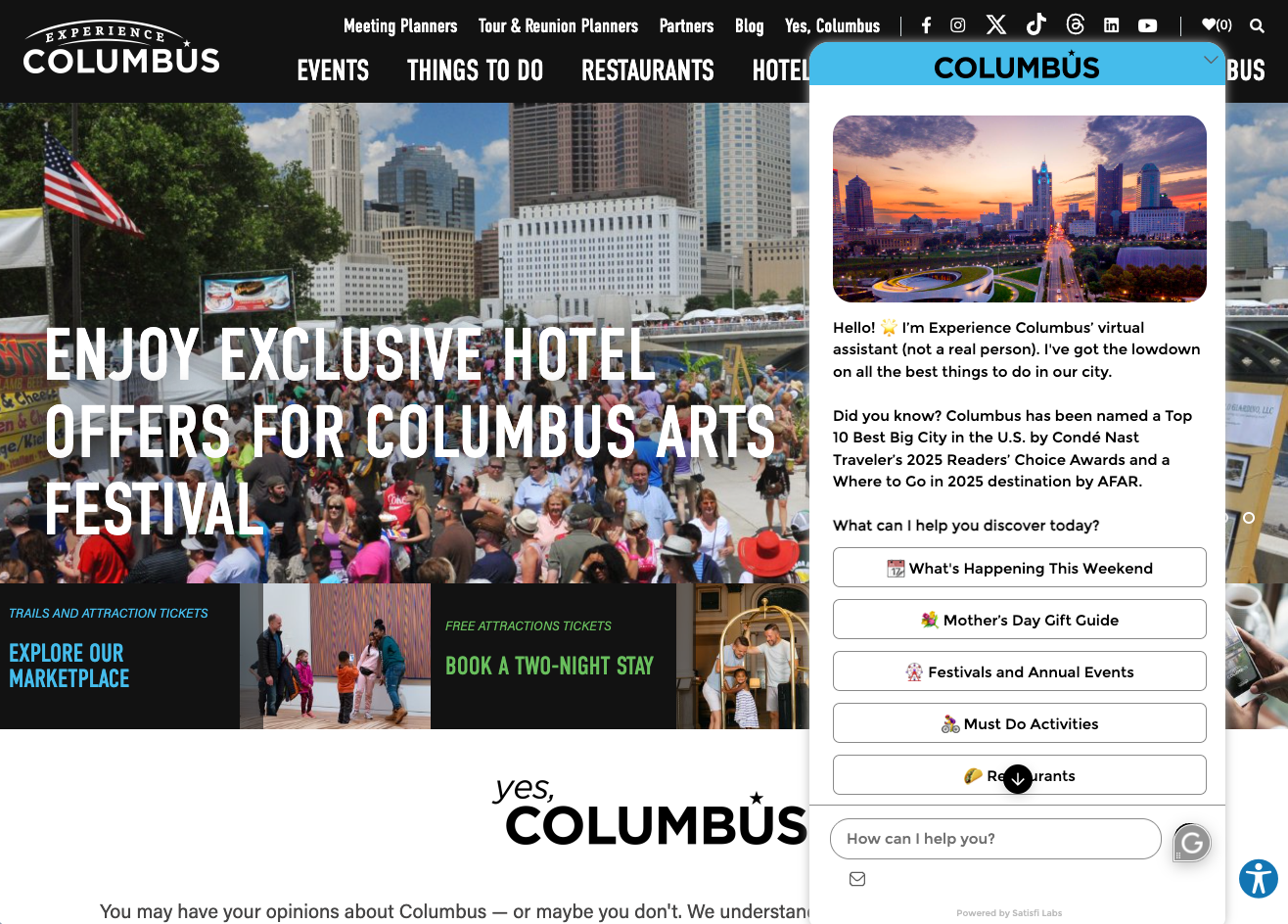
Experience Columbus has taken a very different approach. In March 2026, the destination started testing a connected 'Agentic City' programme, a model that intends to create a more connected AI interface ecosystem. Launching a shared platform between the DMO and its attraction, dining and retail partners places connected AI agents at the centre of the visitor journey. This means that the interface has been designed to support the natural transition of chats between venues as travellers search different attractions and experiences.
Experience Columbus has described the work as creating a connected city and a connected experience for visitors, powered by data shared across the partner network. That coordination is the part most destinations have been quietly struggling with for years. A city’s visitor experience is made up of thousands of small decisions and each venue tends to know more about itself than any central system could. Letting each venue answer its own questions, while a shared set of standards keeps the answers consistent across the network, addresses the fragmentation problem that builds up when every business runs its own website and AI interface in isolation.
This shared knowledge base also helps different venues to support each other, by championing nearby locations and reliably surfacing detailed and relevant responses based on data from across the network. The DMO's role here is to set those shared standards and help businesses of all sizes join the network, which is a different kind of authority from running a single chatbot. Through this approach, access to AI can be democratised, meaning SMEs don't get excluded because of a lack of budget, while the destination benefits from having a coherent brand voice.
Where the Visitor is Already Searching
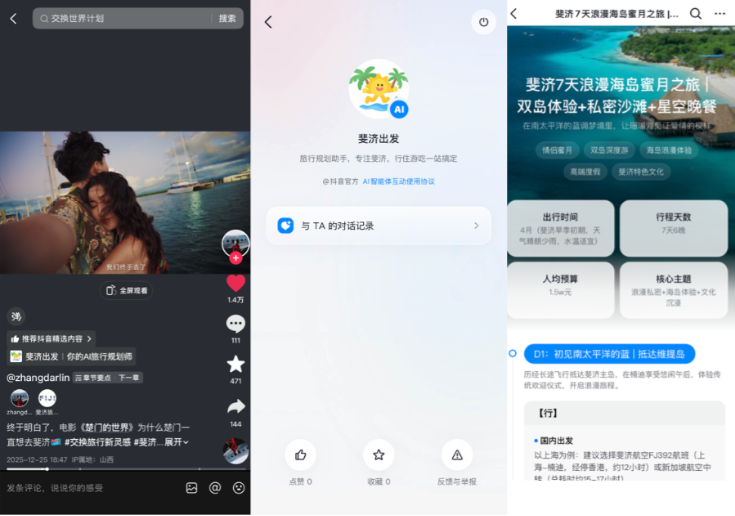
Some of the more interesting moves are not on the destination's owned channels at all. In March 2026, Tourism Fiji partnered with Douyin, a Chinese short-video platform, to launch the Fiji AI Travel Planner. A Douyin user watching videos about Fiji can tap once to open a chat interface, where an AI chatbot recommends places to visit and builds a multi-day itinerary based on the user's conversational input and the videos they have interacted with. This inaugural pilot project is designed to test whether AI can drive conversion from someone watching a short clip into a clear plan for visiting the country.
The choice of channel is worth paying particular attention to. Travellers have been doing destination research on social media platforms for years, often without ever visiting a destination's own website. Building an AI interface inside the social platform itself, instead of trying to pull users out of it, treats the platform as part of the destination's distribution layer. This is in stark contrast to the current focus many destinations place on it as a referral source. The strategic question this raises is which platforms deserve a destination's content, structured data and editorial input.
The other shift becoming hard to ignore is that large language models are themselves becoming the interface. In October 2025, OpenAI launched Apps SDK with Booking.com and Expedia as travel partners, placing both companies directly inside ChatGPT's chat interface. A traveller can describe a trip in natural language and get live pricing and availability pulled in from either platform without leaving the conversation. Anthropic's Claude has followed with its own Expedia integration and now also connects to Booking.com, Viator and TripAdvisor.
What both partnerships have in common is that they handle single-component bookings well, but they do not yet build a coherent trip. A traveller asking ChatGPT to book a hotel for next weekend will get a useful answer. A traveller asking it to plan a five-day cultural trip across two regions, with the right pace, the right transport and the right balance of activities, will get something closer to a list than a journey. The piece that is missing is the destination's own knowledge of which season favours which experience and how the parts join up. That gap is where DMOs have a role most have not yet claimed.
What Progress Looks Like
Where DMOs fit in AI-supported trip planning is ultimately a question about authority. That is the question every DMO is going to have to answer in some form. Placing an AI interface somewhere specific is a decision about where the destination's voice belongs, who gets to use it and where it stops. Where in the visitor journey is friction highest? What does the interface need to achieve? Does the AI system operate in isolation or should it be connected to other touchpoints?
Those questions tend to surface late in most projects, after a tool has been chosen and the destination is trying to make it work. Yet, they should be viewed as governance questions that are decided before any interface is built. This is vital because it is the combination of functionality, practicality and simplicity that determines whether travellers value an AI interface. This highlights why setting a clear scope and leveraging iterative design processes are key in obtaining a strong return on investment.