Ads Come to ChatGPT: What Conversational Advertising Means for Diversifying Marketing Channels
ChatGPT’s emergence as an advertising platform is driven in part by OpenAI’s financial reality. Despite surpassing $20 billion in annualised revenue by the end of 2025, the company’s computing power costs continue to outpace its income substantially.
DTTT Knowledge Team
11 Feb 2026
In this piece
On 9 February 2026, OpenAI started testing banner ads on ChatGPT for free-tier and ChatGPT Go users in the United States. The ads appear at the bottom of ChatGPT’s responses, clearly labelled and contextually matched to the conversation at hand.
ChatGPT’s emergence as an advertising platform is driven in part by OpenAI’s financial reality. Despite surpassing $20 billion in annualised revenue by the end of 2025, the company’s computing power costs continue to outpace its income substantially. HSBC analysts have estimated that OpenAI may not reach profitability until at least 2030 and could face a $207 billion funding shortfall by that point. Advertising represents one of several strategies the company is pursuing to close that gap and diversify its revenue base beyond subscriptions and API access.
With ChatGPT established as one of the most widely used digital platforms in the world, attracting over 800 million weekly active users, its reach now rivals that of the major social media platforms and search engines. With travellers increasingly using conversational AI to research destinations, compare options and build itineraries, the implications are significant. If the interface where travellers ask questions is now also the interface where they encounter sponsored content, destinations and tourism businesses face a meaningful shift in how they can reach and influence potential visitors.
Contextual Targeting in a Conversational Interface
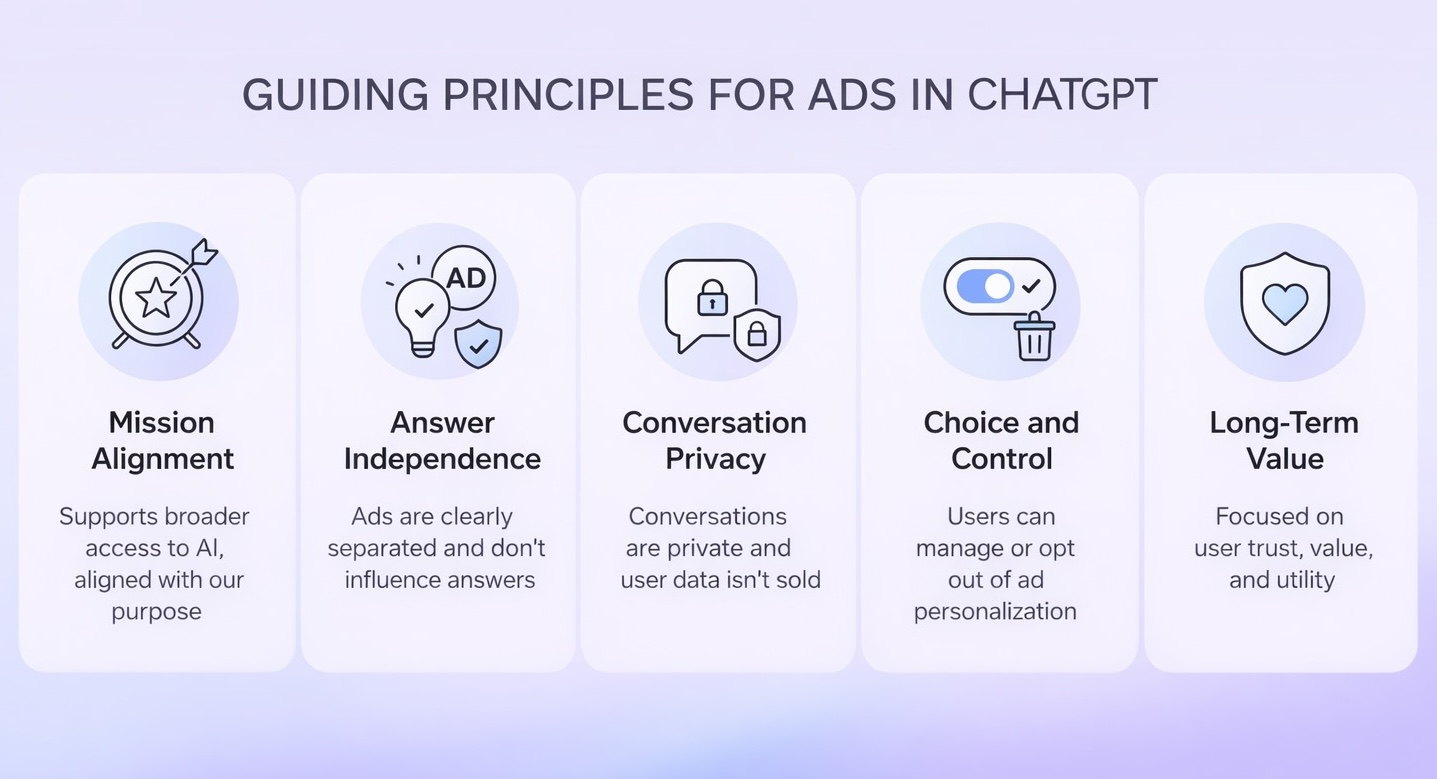
What distinguishes ChatGPT’s advertising model is its reliance on conversational context rather than traditional tracking mechanisms. While display advertising has long depended on third-party cookies and cross-site tracking to build user profiles, ChatGPT’s ad targeting, by contrast, draws from the content of the conversation itself. When a user asks about trip ideas, the AI system can surface a contextually relevant ad for accommodation or local experiences without needing to track that user’s browsing history across other websites.
ChatGPT Generated Image
The introduction of this advertising approach aligns with a wider industry shift. As third-party cookies continue to lose ground through browser restrictions and evolving privacy regulation, marketers have been searching for targeting methods that are both effective and privacy-compliant. Conversational targeting offers a distinct alternative. It delivers relevance based on what someone is actively thinking about in the moment, rather than relying on inferred interests built from past behaviour.
The potential is particularly pronounced in the tourism sector as surveys regularly state that travellers are receptive to directly booking travel within generative AI platforms. With these users actively making decisions about where to go and what to book, an ad that appears in that context arrives at a far more decisive moment than one served days later on an unrelated website.
At the same time, ChatGPT ads challenge the traditional distinction between paid and organic discovery. This raises a pointed question about what value an ad actually delivers when the free-of-charge answer is already communicating similar information. For pure awareness, the answer may be very little, because the organic response has already done that work. Where advertising in this format is more likely to prove its worth is in driving a specific action.
This is where the conversational model offers distinctive advantages over traditional search through accumulated context. ChatGPT’s memory feature means the platform may know what preferences a user has expressed over time and how far along they are in their decision-making process. This depth of contextual understanding creates advanced targeting possibilities that go well beyond keyword matching.
Impact on Social Media Content
Moving towards advertising directly within AI platforms also has broader marketing strategy implications. Social media platforms have historically served as awareness drivers, while search and booking platforms have captured the conversion. ChatGPT’s introduction of advertising collapses this distinction. For destinations heavily invested in social media content, this raises questions about the role that such content will play as AI increasingly mediates discovery. If travellers are making decisions within ChatGPT, then the reach and influence of social content may diminish.
If ChatGPT becomes a primary decision point for travellers, then ensuring visibility within AI-generated recommendations, both organic and paid, may prove more valuable than reach metrics on social platforms. Conversely, if social media is to retain its role in the funnel, it may need to work harder on driving traffic to owned channels before AI platforms capture the decision entirely. Responding to this new opportunity of direct advertising within AI platforms means that DMOs and tourism businesses need to carefully evaluate where their content generates the strongest results.
Accuracy and Liability
Another key dimension that must not be overlooked is the question of what happens when an AI platform’s recommendations are wrong. This is an essential consideration given that multiple studies have shown that AI-generated travel itineraries are often riddled with inaccuracies.
When ChatGPT was purely an informational tool, the consequences of such errors were borne by the user. However, when advertising enters the picture, the attribution of responsibility becomes more complex. If a sponsored property appears alongside a flawed itinerary or if an advertiser’s offer is bundled into a recommendation that misdirects travellers, questions of responsibility become harder to answer.
For advertisers, this creates a reputational consideration. If a destination or hotel appears in an ad adjacent to incorrect or misleading content, does the user associate the error with the platform or with the brand? This is especially true given that the financial implications for travellers of such errors may be severe. Destinations and tourism businesses considering advertising through ChatGPT would be wise to monitor how their placements appear in context and to ensure that their own digital content is accurate and up-to-date.
Not all AI companies are following OpenAI’s path. In early February 2026, Anthropic announced that Claude will remain ad-free. Anthropic’s reasoning centres on the nature of AI conversations involving personal, sensitive or complex topics. To underscore the point, Anthropic launched a Super Bowl advertising campaign with the tagline: "Ads are coming to AI. But not to Claude". Such divergent approaches demonstrate that while OpenAI's commercialisation of the platform may deter some users, AI platforms will continue to remain an important source of information for travellers.
Ongoing Beta Testing
While ads are gradually arriving on ChatGPT, their long-term effect on user trust and interaction remains unknown. For ChatGPT, beta testing is currently providing initial insights into the format of ads that are most engaging for users, with additional formats to be gradually developed. These early ad placements are being sold on an impression basis, with a reported minimum advertiser commitment of $200,000. With a targeted CPM of around $60, the platform is positioning itself for high-intent moments. This contrasts with $38 for Google Search ads and only $3 for Google Display Network ads.
This pricing structure suggests OpenAI is prioritising advertiser quality and user experience over rapid scale as the strategy undergoes refinement. However, monitoring of OpenAI's ad performance is currently restricted to aggregate metrics, with no granular conversion tracking. For performance-driven marketers accustomed to the precision of Google Ads or Meta, this represents a significant gap.
There is reason for cautious optimism, however, with web analytics platforms already tracking referral traffic from AI search tools, proving that attribution can be extended to include conversational interfaces. As AI platforms invest more heavily in commercialising their role as discovery channels, more sophisticated tracking of ad-driven conversions is likely to follow.
DTTT Take
For DMOs and tourism businesses, the arrival of ads in ChatGPT introduces a new variable into an already complex media landscape. While the initial pricing is prohibitive to most tourism businesses, as the platform scales and pricing models mature, it will become an increasingly realistic option. When it does, it will compete directly for the same budgets currently spent on search advertising, paid social and display campaigns. Destinations that have historically concentrated their paid media spend on Google and Meta will need to assess whether conversational AI platforms warrant a share of that investment.
The strategic value from leveraging ChatGPT's new banner ad format likely lies in upselling and conversion-focused messaging. This demonstrates why AI advertising is unlikely to be the complete disruptor that it was once heralded as. Other, more traditional formats remain much more likely to deliver a strong return on investment when reaching mainstream audiences with broad targeting. Yet, the opportunity lies in targeting higher-value travellers. When a traveller asks for destination recommendations and receives a list of options, a well-placed visual ad, alongside a conversational recommendation, could be more persuasive than either element in isolation.
For DMOs and tourism businesses to make the case for experimenting with ads on AI platforms, several conditions need to be met:
Targeted placements can distribute visitor flows: For DMOs grappling with overtourism, advertising directly within AI platforms could offer a strategic lever. When a traveller asks for recommendations in a well-known destination, the organic response will likely surface the usual suspects. A well-placed ad creates an opportunity to put lesser-known alternatives in front of travellers at the moment they are making decisions. This approach helps to reframe the narrative about destinations. The organisations best positioned to benefit will be those that avoid treating conversational AI as an addition to media plans, recognising instead that the opportunity is built upon a shift in how discovery works. That means investing in the quality and structure of digital content so it surfaces organically, preparing to test paid formats as they mature, and critically, understanding the behavioural nuances of how travellers use these tools.
Clearer attribution mechanisms: If the strategic value of advertising on ChatGPT lies in upselling and conversion rather than awareness, then tourism marketers need the ability to trace bookings and revenue to specific ad placements. The current aggregate reporting makes it difficult to build a business case for continued investment, yet the extensive testing underway should help with developing the necessary benchmarks. Without clearer attribution, the channel risks being dismissed before its potential is properly understood.
Establishing consumer safeguards: Given the documented accuracy issues with AI-generated travel recommendations, prominent disclaimers advising travellers to verify all details before booking should become standard practice. Clear guidelines on advertiser responsibility are also needed for cases where bookings made through ChatGPT ads lead to disputes. As this channel matures, the absence of such protections would create risks for travellers, advertisers and OpenAI itself.