The Circular Economy: How Tourism Builds Supply Chains That Give Back

From stays to souvenirs, tourism relies on extended supply chains driven by a 'take, make and dispose' system, consuming limited resources for short-term value and creating a trail of waste.

From dining and accommodation to activity gear and souvenirs, tourism relies on extended supply chains that stretch well beyond the destination itself. Most of that movement follows the same pattern: take, make and dispose, drawing in finite resources, extracting short-term value and leaving behind a trail of waste.

The circular economy works differently. It treats materials, products and value as things to keep in use for as long as possible, with the residues of one activity becoming the inputs of another. In a tourism setting, that means creating closed-loop supply chains that keep resources circulating locally, where waste is engineered out at source and where any surplus circulates back to residents and local businesses. A 2020 conceptual framework published by the CE360 Alliance through the European Circular Economy Stakeholder Platform set out the case for treating this as a structural shift in how the sector operates.

The more difficult question is what it takes to make the shift practical. Supply chains do not change because a destination wishes them to. They change when procurement decisions are reorganised, when operators have somewhere to send products at the end of their first life and when visitors are given reasons to participate in the loop.

Starting With What The Destination Already Has

The shortest supply chain is the one that begins and ends in the same place. Sourcing food, furnishings or services from within the destination keeps value local and cuts the resources needed to bring things in from elsewhere.

Farm-to-table is the obvious example. Restaurants and hotels that work with nearby producers offer visitors a genuine taste of the region, pairing authentic local character with ingredients at the peak of their freshness. The same logic extends to furniture, textiles, event materials and tour equipment, all of which can be sourced, repaired and replaced through regional networks.

Tirol Werbung has built much of its sustainability strategy around this. Its 2025 position paper “Circular Tourism: From Theory To Practice”, developed with the Circular Economy Forum Austria, sets out how regional value chains, sharing models and reuse can sit at the centre of a tourism economy. The report draws on a Systemiq estimate that circular approaches could reduce tourism’s environmental footprint by up to 41% by 2030, with the largest gains coming from how destinations procure, build and operate.

Source: Tirol Werbung

Written directly into procurement guidelines, the principle should be to buy from the local community first, then the broader destination and finally within the same region. Bringing anything in from further afield should be treated as the rare exception.

Designing Waste Out Of The Visitor Experience

A lot of the visitor experience is built around products designed for short or single use, from disposable amenities to single-night camping equipment. Each is a point where a different design choice changes how resources are used.

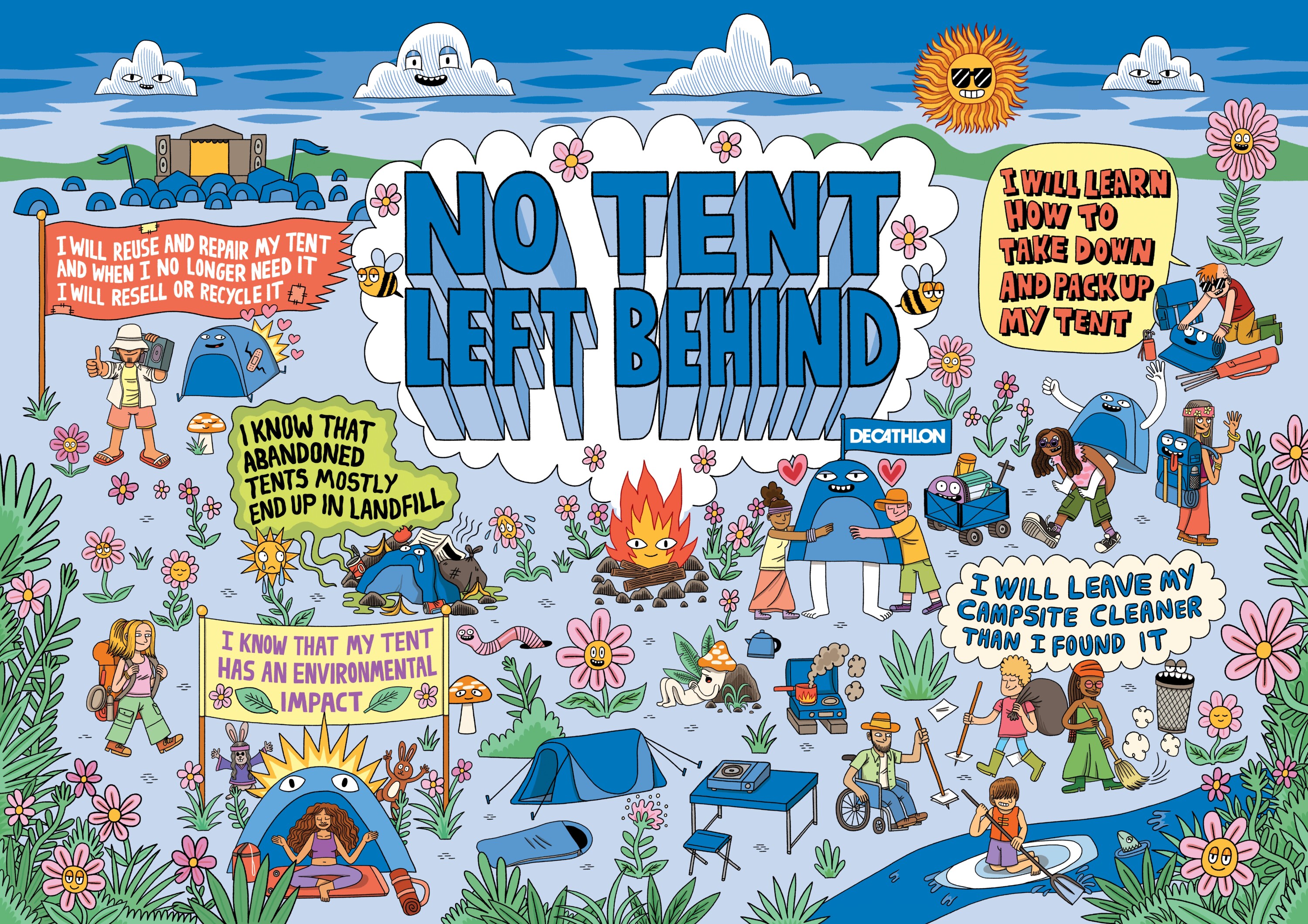
Decathlon’s “No Tent Left Behind” scheme is a useful demonstration. The Association of Independent Festivals estimates that 250,000 tents are abandoned at UK festivals every year, most of them sent to landfill. To tackle this unnecessary waste, Decathlon extended its buy-back commitment across its entire tent range. Visitors return tents bought through the summer season for the full purchase price in store credit, with returned stock cleaned, refurbished and resold through the company’s Second Life platform.

Source: Decathlon

The principles shown in this example are a lesson in effective nudging and apply across the entire visitor economy. The visitor was given an incentive to bring the product back, a convenient way to do it and a guarantee that what they returned would be used again. Building those conditions into the transaction is what changes behaviour at scale.

Closing The Loop Within The Destination

When waste does end up in the destination, circular thinking finds a route for it to contribute to the local economy.

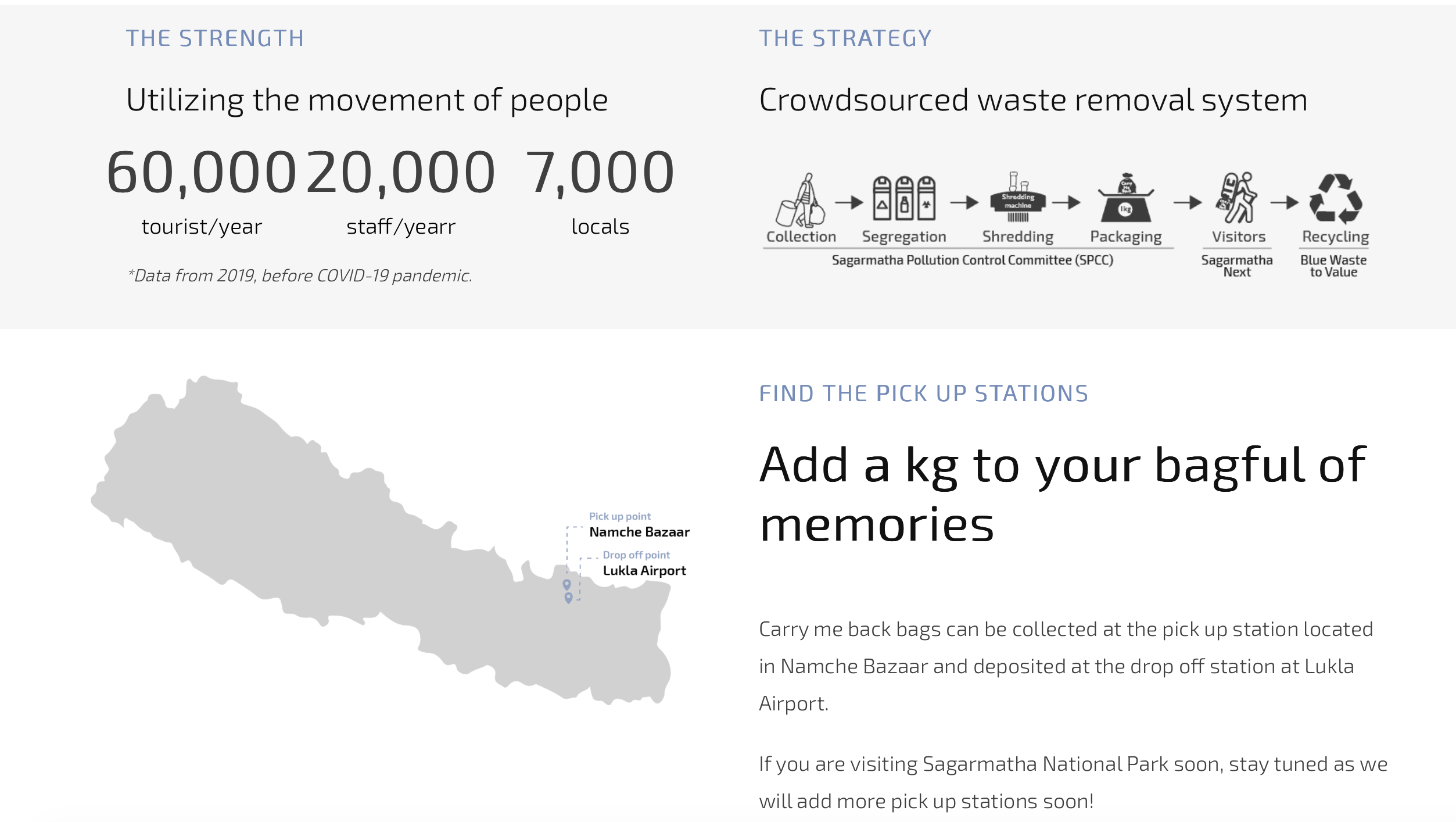
Sagarmatha Next’s “Carry Me Back” programme in Nepal’s Khumbu region puts that route into operation. Each trekking season produces volumes of waste in a region with little recycling infrastructure. Local partner SPCC pre-processes the waste, shreds it and packs it into one-kilo bags. Trekkers collect a bag in Nacho Bazaar or Pangboche and drop it at Lukla airport on their way down, where local airlines fly it to Kathmandu for recycling. Since the programme launched, more than 20 tonnes of waste have been removed from the park. Higher-grade plastics are then converted into souvenirs by Dutch design partner Super Local, including a Himalaya scale model made from recovered bottle caps.

Source: Sagarmatha Next

By weaving logistics directly into the visitor experience, the programme creates a multi-layered impact. Turning visitor movement into the primary transport system for an inaccessible area, it creates local jobs in processing and design, while giving souvenirs a far deeper meaning as tangible keepsakes made from what the visitor helped transport down the mountain.

Green Phenix in Curaçao runs a parallel model. The social enterprise collects beach plastic, which is shredded and moulded and used as the raw material for souvenirs and household items. These are produced through a learn-and-work programme that has trained dozens of long-term unemployed residents. The result is a souvenir economy that no longer depends on items shipped in from elsewhere, but draws its inputs and its workforce from the destination itself.

Souvenirs are one part of tourism’s supply chain that visitors touch most directly, yet remain among the least examined in destination strategies. Rerouting them changes who benefits, what materials they are made of and what story they tell about the place that produced them.

Building The Conditions For Change

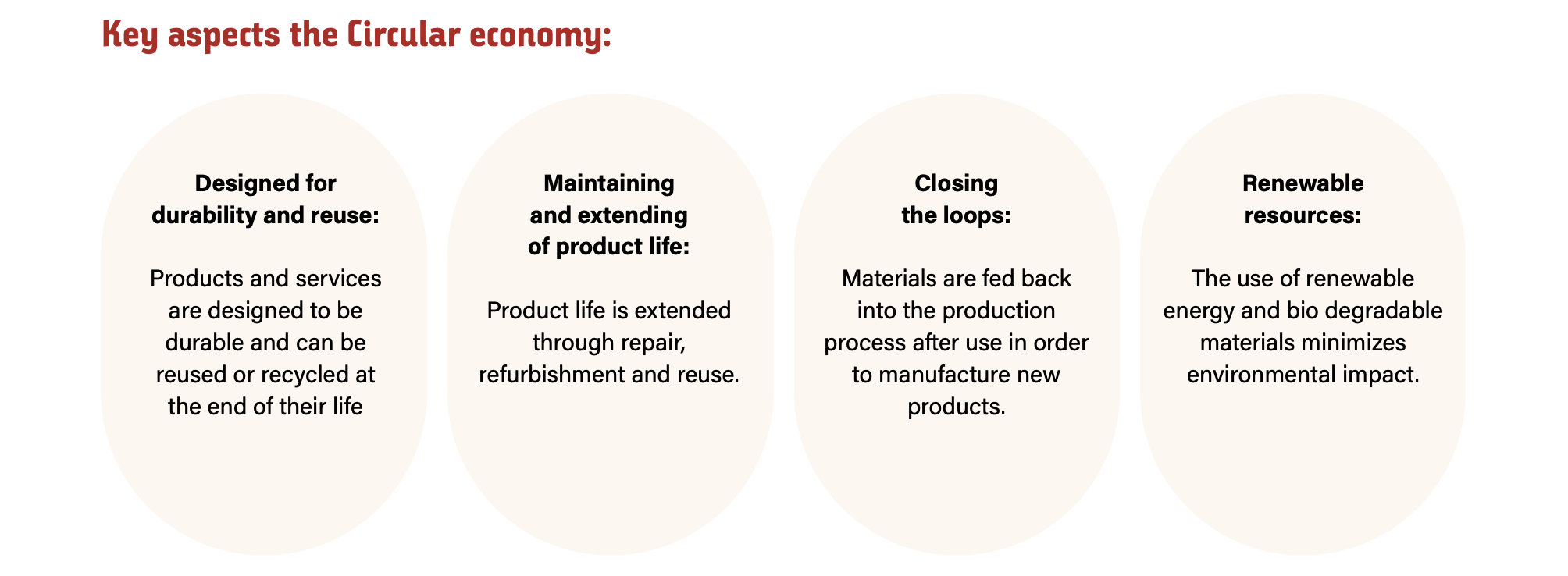
Individual schemes work, but circular tourism needs coordinated infrastructure to move from showcase projects to standard practice. That means shared platforms for materials reuse, public procurement that prioritises circular suppliers, common standards across destinations and the training to make it operational. Far from being a one-size-fits-all approach, the CE360 Alliance's conceptual framework and Tirol Werbung's position paper identified multiple mechanisms for circular business models to create value:

  1. Sharing Economy: Car and bike sharing schemes take the strain off local roads and encourage efficient resource usage.
  2. Product-as-a-Service: The focus shifts to access over ownership; a model illustrated by on-demand outdoor and sports equipment hire.
  3. Take-Back and Recycling Programmes: Eliminating waste by launching dedicated take-back and recycling schemes for single-use packaging.
  4. Circular Supply Chains: Collaborating with suppliers to close the loop, turning end-of-life products back into raw materials for the next production cycle.
  5. Driving Innovation With Circularity: Expanding the guest experience into purposeful hands-on activities, such as tree planting or trail clean-ups.
  6. Circular Infrastructure: Giving infrastructure a second life through reuse and refurbishment.

The Interreg North Sea 3ST programme, running from 2023 to 2027, is one example of how that infrastructure is taking shape. Eleven partners across six countries, including Visit Skåne, Westtoer and Pas-de-Calais Tourisme, are running nine regional pilots on waste, water and energy, supported by three academic partners and a shared methodology. The Tyrol Chamber of Commerce offers a different kind of infrastructure through Circular Inventory, a B2B platform that connects hotels, venues and event organisers with materials being released from refurbishments and closures, so furniture and fittings find a second life within the sector.

How does the tourism sector lay the groundwork for circular supply chains while creating the incentives and conditions that drive consumer demand? CAMPUS 2026 is designed to work through that question. Taking place from 30 September to 3 October in the Turku Archipelago, Finland, CAMPUS brings together destinations and industry for hands-on engagement with sustainability across its environmental, socio-cultural and economic dimensions to design a new destination management blueprint.
From dining and accommodation to activity gear and souvenirs, tourism relies on extended supply chains that stretch well beyond the destination itself. Most of that movement follows the same pattern: take, make and dispose, drawing in finite resources, extracting short-term value and leaving behind a trail of waste.

The circular economy works differently. It treats materials, products and value as things to keep in use for as long as possible, with the residues of one activity becoming the inputs of another. In a tourism setting, that means creating closed-loop supply chains that keep resources circulating locally, where waste is engineered out at source and where any surplus circulates back to residents and local businesses. A 2020 conceptual framework published by the CE360 Alliance through the European Circular Economy Stakeholder Platform set out the case for treating this as a structural shift in how the sector operates.

The more difficult question is what it takes to make the shift practical. Supply chains do not change because a destination wishes them to. They change when procurement decisions are reorganised, when operators have somewhere to send products at the end of their first life and when visitors are given reasons to participate in the loop.

Starting With What The Destination Already Has

The shortest supply chain is the one that begins and ends in the same place. Sourcing food, furnishings or services from within the destination keeps value local and cuts the resources needed to bring things in from elsewhere.

Farm-to-table is the obvious example. Restaurants and hotels that work with nearby producers offer visitors a genuine taste of the region, pairing authentic local character with ingredients at the peak of their freshness. The same logic extends to furniture, textiles, event materials and tour equipment, all of which can be sourced, repaired and replaced through regional networks.

Tirol Werbung has built much of its sustainability strategy around this. Its 2025 position paper “Circular Tourism: From Theory To Practice”, developed with the Circular Economy Forum Austria, sets out how regional value chains, sharing models and reuse can sit at the centre of a tourism economy. The report draws on a Systemiq estimate that circular approaches could reduce tourism’s environmental footprint by up to 41% by 2030, with the largest gains coming from how destinations procure, build and operate.

Source: Tirol Werbung

Written directly into procurement guidelines, the principle should be to buy from the local community first, then the broader destination and finally within the same region. Bringing anything in from further afield should be treated as the rare exception.

Designing Waste Out Of The Visitor Experience

A lot of the visitor experience is built around products designed for short or single use, from disposable amenities to single-night camping equipment. Each is a point where a different design choice changes how resources are used.

Decathlon’s “No Tent Left Behind” scheme is a useful demonstration. The Association of Independent Festivals estimates that 250,000 tents are abandoned at UK festivals every year, most of them sent to landfill. To tackle this unnecessary waste, Decathlon extended its buy-back commitment across its entire tent range. Visitors return tents bought through the summer season for the full purchase price in store credit, with returned stock cleaned, refurbished and resold through the company’s Second Life platform.

Source: Decathlon

The principles shown in this example are a lesson in effective nudging and apply across the entire visitor economy. The visitor was given an incentive to bring the product back, a convenient way to do it and a guarantee that what they returned would be used again. Building those conditions into the transaction is what changes behaviour at scale.

Closing The Loop Within The Destination

When waste does end up in the destination, circular thinking finds a route for it to contribute to the local economy.

Sagarmatha Next’s “Carry Me Back” programme in Nepal’s Khumbu region puts that route into operation. Each trekking season produces volumes of waste in a region with little recycling infrastructure. Local partner SPCC pre-processes the waste, shreds it and packs it into one-kilo bags. Trekkers collect a bag in Nacho Bazaar or Pangboche and drop it at Lukla airport on their way down, where local airlines fly it to Kathmandu for recycling. Since the programme launched, more than 20 tonnes of waste have been removed from the park. Higher-grade plastics are then converted into souvenirs by Dutch design partner Super Local, including a Himalaya scale model made from recovered bottle caps.

Source: Sagarmatha Next

By weaving logistics directly into the visitor experience, the programme creates a multi-layered impact. Turning visitor movement into the primary transport system for an inaccessible area, it creates local jobs in processing and design, while giving souvenirs a far deeper meaning as tangible keepsakes made from what the visitor helped transport down the mountain.

Green Phenix in Curaçao runs a parallel model. The social enterprise collects beach plastic, which is shredded and moulded and used as the raw material for souvenirs and household items. These are produced through a learn-and-work programme that has trained dozens of long-term unemployed residents. The result is a souvenir economy that no longer depends on items shipped in from elsewhere, but draws its inputs and its workforce from the destination itself.

Souvenirs are one part of tourism’s supply chain that visitors touch most directly, yet remain among the least examined in destination strategies. Rerouting them changes who benefits, what materials they are made of and what story they tell about the place that produced them.

Building The Conditions For Change

Individual schemes work, but circular tourism needs coordinated infrastructure to move from showcase projects to standard practice. That means shared platforms for materials reuse, public procurement that prioritises circular suppliers, common standards across destinations and the training to make it operational. Far from being a one-size-fits-all approach, the CE360 Alliance's conceptual framework and Tirol Werbung's position paper identified multiple mechanisms for circular business models to create value:

  1. Sharing Economy: Car and bike sharing schemes take the strain off local roads and encourage efficient resource usage.
  2. Product-as-a-Service: The focus shifts to access over ownership; a model illustrated by on-demand outdoor and sports equipment hire.
  3. Take-Back and Recycling Programmes: Eliminating waste by launching dedicated take-back and recycling schemes for single-use packaging.
  4. Circular Supply Chains: Collaborating with suppliers to close the loop, turning end-of-life products back into raw materials for the next production cycle.
  5. Driving Innovation With Circularity: Expanding the guest experience into purposeful hands-on activities, such as tree planting or trail clean-ups.
  6. Circular Infrastructure: Giving infrastructure a second life through reuse and refurbishment.

The Interreg North Sea 3ST programme, running from 2023 to 2027, is one example of how that infrastructure is taking shape. Eleven partners across six countries, including Visit Skåne, Westtoer and Pas-de-Calais Tourisme, are running nine regional pilots on waste, water and energy, supported by three academic partners and a shared methodology. The Tyrol Chamber of Commerce offers a different kind of infrastructure through Circular Inventory, a B2B platform that connects hotels, venues and event organisers with materials being released from refurbishments and closures, so furniture and fittings find a second life within the sector.

How does the tourism sector lay the groundwork for circular supply chains while creating the incentives and conditions that drive consumer demand? CAMPUS 2026 is designed to work through that question. Taking place from 30 September to 3 October in the Turku Archipelago, Finland, CAMPUS brings together destinations and industry for hands-on engagement with sustainability across its environmental, socio-cultural and economic dimensions to design a new destination management blueprint.
Subscribe to our Newsletter

Thank you! Your submission has been received!
Oops! Something went wrong while submitting the form.